

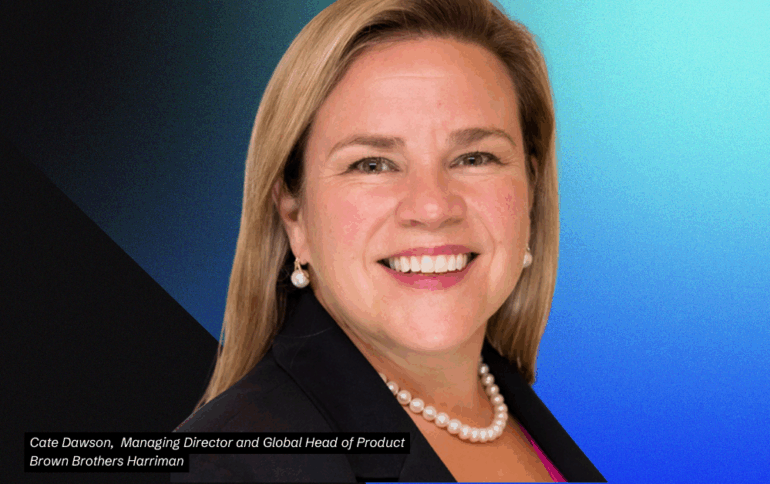
“One of the most critical things in choosing a partner is cultural alignment. If your bank values high-touch client service, you can’t partner with one that prioritizes chatbots and call centers. It just doesn’t work. You need to know your values match because friction in values leads to friction in the relationship.” — Cate Dawson, Brown Brothers Harriman
For Cate Dawson, the world of banking is at a crossroads where regulatory demands, relentless technology shifts, and the need for agility are reshaping how banks do business.
In a recent conversation with Future Nexus, Dawson, managing director and global head of product for financial institutions at Brown Brothers Harriman (BBH), discussed how her team supports financial institutions facing unprecedented change while also safeguarding the resilient backbone of legacy systems and fostering partnerships that are as much about culture as technology.
Banks Are in the Middle of a Structural Rethink
Dawson’s purview stretches from the traditional realm of sub-custody and global custodian services to a frontier of digital solutions aimed at responding to the sector’s evolving needs.
“We really have two segments of clients: asset managers and global banks. For banks, we’ve carved out specialized teams focused directly on building out product strategy to create solutions that best suit their complex requirements,” she said.
Dawson said many banks are quietly in the middle of a structural rethink. She describes the current moment as unusually pivotal, and her mandate is focused: shape products and technology that serve global banks which are increasingly users of BBH’s technology, data, and servicing platforms. As these products evolve, they are becoming more bespoke and tailored rather than off-the-shelf custody alone.
In practical terms, that means helping institutions confront a basic question: in a market defined by rising costs, regulatory pressure, and unrelenting client demands, who do they actually want to be over the next five years??
Costs, Regulation, and Relentless Client Demand
Banks are also reviewing their operating models, technology stacks, and product menus all at once, testing each against where they believe they can truly add value, she said.
Dawson is candid about the hurdles banks face today, including structurally higher costs, intense margin compression, and accelerating expectations from end clients.
In addition, regulatory mandates continue to multiply, requiring dedicated resources and “limited return on investment.” Adding to all of this is the pressure to keep up with a lightning-speed technology market, while maintaining secure, resilient infrastructure and cyber defenses that have become significantly more expensive, even as competition holds down pricing for core services.?
Customers now demand their bank will deliver modern digital experiences, advanced analytics, and flexible reporting as standard, not as premium extras. For many institutions, it’s forcing a rethink of which businesses they can afford to run on their own and which they should source through partners.
“Other industries are talking about things like generative AI before banking has embraced them, but clients’ demands do not slow down just because banks are cautious,” Dawson said.
AI and Laying a New Data Foundation
Despite the banking industry’s traditional lag in the early adoption of certain technologies, Dawson highlights artificial intelligence as a game-changer for efficiency and proactivity.
“Even at 99% STP (straight-through processing) rates, you’re talking thousands of transactions that still require manual intervention,” she said. “AI allows us to automate more, to do reconciliations and anomaly detection that used to be manual, and to move from reactive to predictive analytics.”
But banks won’t be able to capitalize on these tools without foundational change like good data infrastructure, Dawson said.
“What’s fundamental now is a strategic data platform,” she said. “You need clean, structured and secure data to leverage AI tools to ensure compliance with regulations like GDPR. Without it, you’re just building technology on unstable ground.”
Banks are working on this modernization, which includes shoring up data infrastructure while adapting legacy systems with new open architectures for digital assets, alternatives and next-generation analytics.
Dawson believes the bigger shift will come from predictive analytics that change how operations teams work. Instead of reacting to breaks after they occur, banks will organize around the probability that a process might fail and intervene in advance. That change will reshape roles and expectations across operations, as clients increasingly expect proactive prevention rather than efficient clean-up, she said.
Navigating a Globalized, Regulated World
Dawson also touched on the growing complexities of global finance, cross-border payments and the unpredictability of political and regulatory climates.
Banks are starting to use or rely on fintech companies, and need to be prepared because things happen quickly. She gave the example of Russian banks being moved off of the Swift network in 2022, at the start of the Ukrainian conflict.
“Those are things that require immediate reaction,” Dawson said. “What we saw was not necessarily every fintech was prepared in that space. As a bank and being already a regulated entity, that’s a world we’re already familiar with, so we are prepared to adapt, and we’ve made sure that our applications and our systems are built in a configurable way that we can react very quickly.”
Partnerships and Culture
Facing these complexities ties into Dawson’s work on strategic partnerships. She envisions a growing tapestry of partnerships between banks, fintechs and the ecosystem.
However, she expects banks to become increasingly selective about what they build and run themselves versus what they source from vendors, fintech specialists or even other banks. In BBH’s case, she points to shared?infrastructure arrangements where another bank uses BBH’s global custody technology under its own brand, with both parties benefiting from shared regulatory upgrades, code changes, and future investment.
Dawson believes the defining success factor is less about technology than about cultural fit.
“One of the most critical things in choosing a partner is cultural alignment. If your bank values high-touch client service, you can’t partner with one that prioritizes chatbots and call centers. You need to know your values match because friction in values leads to friction in the relationship.”
Building for the Long Term
Looking ahead, Dawson said the winners will be those that honestly assess where they excel, invest in resilient data and technology foundations and choose partners whose values match the kind of client experience they promise to deliver.
And as the industry stands on the brink of dramatic transformation, she returns to the centrality of people and values amid technological and regulatory change.
“Choosing how you evaluate and choose your partner is critical to the long-term success of your business,” Dawson said. “It’s about cultural alignment and governance and what ensures you can innovate, adapt and truly deliver for your clients.”