
Subscribe
Logo
Logo
  • Topics Icon Topics
    • AI Icon AI
    • Banking Icon Banking
    • Blockchain/DeFi Icon Blockchain/DeFi
    • Embedded Finance Icon Embedded Finance
    • Fraud/Identity Icon Fraud/Identity
    • Investing Icon Investing
    • Lending Icon Lending
    • Payments Icon Payments
    • Regulation Icon Regulation
    • Startups Icon Startups
  • Podcasts Icon Podcasts
  • Products Icon Products
    • Webinars Icon Webinars
    • White Papers Icon White Papers
  • TechWire Icon TechWire
  • Search
  • Subscribe
Reading
Embedded finance could be lifeline for a struggling economy
ShareTweet
embedded finance for inclusion
Home
Fintech
Embedded finance could be lifeline for a struggling economy

Embedded finance could be lifeline for a struggling economy

Isabelle Castro Margaroli·
Fintech
·Dec. 8, 2022·3 min read

Embedded finance has been on the rise, despite challenging conditions. 

In the five years between 2016 and 2021, the market boomed at 26.9%. Growth has continued through 2022 by another $11.3 billion and, according to FMI, is expected to continue expanding YoY by 16.4% until 2030. 

In 2021 alone, both embedded finance and banking as a service attracted billions of VC funding, their markets growing over three times over the year. Dealroom and ABN Amro expect the value of embedded finance to reach as much as $7.2 billion by 2030.   

Aside from streamlining financial services between businesses and their customers, in the increased challenges of the economic environment, they could now provide a lifeline. 

Adrian Mizzi, CTO and Co-Founder of Weavr.io explained that the technology could lower the entry barrier for individuals who have traditionally been left out of the financial system. 

“Imagine having an innovator who’s building a solution to, let’s say, offer a mobile phone contract,” he said. “They can attach the contract to a native bank account so that customers can manage their payments, thereby unlocking and giving a solution to people who might not be able to get services from the bank, and can also get a prepaid card ready to do day-to-day finances.”
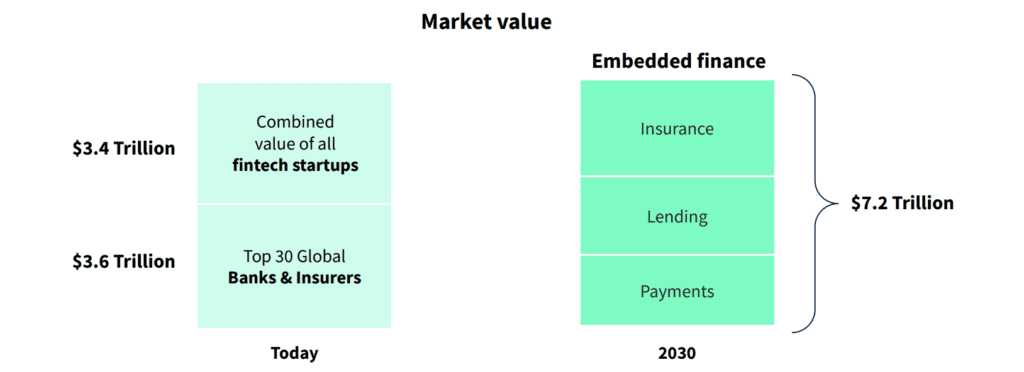
chart showing possible future market value of embedded finance
Source: Dealroom

Improving inclusion for customers

A key benefit of fintech has been its ability to bring financial services to more people. In many jurisdictions where smartphone usage surpassed individuals’ access to a bank account, fintech has introduced many alternatives to continue offering financial services. 

Embedded finance multiplies that reach, allowing brands to provide financial services to their customer base. 

Denise Johansson, co-founder, and co-CEO of Enfuce

“Consumers prefer to procure financial products from brands and providers that they trust — and those providers don’t necessarily have to be banks,” said Denise Johansson, co-founder, and co-CEO of Enfuce, in a recent interview with Sifted. 

Bain and Company found that already, 5% of transactions made in the US were through embedded finance. 

It has been found that brands’ connection to customers comes with benefits that the technology can amplify. Insights already significantly developed by brands’ relationships with loyal customers can be acted upon. Embedded finance allows businesses to provide solutions, assisting with pain points in their financial relationships with customers.

This could be critical as the economic downturn, and possible recession takes hold. Solutions like alternative payment options could help vulnerable customers weather the storm ahead.  

A win-win solution 

As well as providing customer support, the turn to embedded finance could also help businesses. 

Adrian Mizzi, CTO, and Co-Founder of Weavr.io

“There are established businesses that see embedded finance as an opportunity for them to, rather than look for new business, increase revenue streams from their existing customers,” said Mizzi.

He explained that one of these success stories is Shopify. The company increased its revenues by adding financial services to its software-as-a-service business model. 

In a webinar hosted by Weavr on the disruptive potential of embedded finance, the company showed research on this happening with other businesses such as Amazon and Starbucks. 

“Let’s take a step back and ask why these non-financial businesses are investing in these new fintech capabilities,” said George Bailey, Product marketing lead at Weavr. “It’s for two reasons. Firstly, if you can find ways to remove friction around things like ordering and payments, your day-to-day user experience is much more convenient and seamless.”

“At the same time, when you add new financial features into your app, these are things that you can directly charge more for…It’s about bigger populations of users being more commercially active in your platform, and the more active they are, the more money you are making.”

While investment in startups for new development, such as integrating embedded finance, is currently scarce, it can increase existing customers’ inflows. 

“It’s becoming so easy to do that,” said Mizzi. “It’s adding extra revenue you can earn from your existing customers. In today’s economic climate, that’s certainly something businesses seek.”

Related:

  • Embedded finance/B2B convergence an important trend: Galileo report
  • Fintech Nexus USA 2022: Factors to consider with embedded finance
  • Alviere turns to Crypto-as-a-Service
  • Isabelle Castro Margaroli
    Isabelle Castro Margaroli

    Isabelle is a journalist for Fintech Nexus News and leads the Fintech Coffee Break podcast.

    Isabelle's interest in fintech comes from a yearning to understand society's rapid digitalization and its potential, a topic she has often addressed during her academic pursuits and journalistic career.

    View all posts
Tags
Bainembedded financeemfiHomepageweavr
Related

What does 2026 hold for Fintech? 

Renton’s Take on Loan Model Risks

Green Dot’s GM of Embedded Finance on Banking Transparency

Funded: Routefusion raises $26.5M Series A to simplify global payouts with a resilient payments network

Popular Posts

Today:

  • FNThe Bank Charter Gold Rush: What’s Really Happening and What it Means for Banking Feb. 12, 2026
  • FN articleVisa’s Director of Product Management on BNPL’s Future Jul. 22, 2025
  • Copy of Fintech Nexus – Newsletter Creative (1)Unpacking PayPal’s Missed Moment: 7 Takeaways Feb. 5, 2026
  • Check-and-gusto-logoPayroll Is a Nightmare. Can Embedded Finance Fix It? Mar. 27, 2025
  • VancouverWeb Summit Dispatch: Debate Rages Over AI Applications’ Human Impact  May. 28, 2025
  • Jon StonaTips from Airwallex x McLaren on Making the Best of a Fintech Sponsorship  Jun. 18, 2025
  • Fintech ForecastWhy Every Lender Should Be Using Cash Flow Underwriting Today Jul. 29, 2025
  • 5 Founders Driving Humanoid AIThe Humanoid Era: 5 Leaders Defining Physical AI Sep. 10, 2025
  • Battle of the BotsFintech’s Battle of the Bots Sep. 25, 2025
  • Fintech 3.0Fintech 3.0 Runs on Stablecoins: Norwest VP Jordan Leites Shares Fintech’s Next Infrastructure Gains Jan. 15, 2026

This month:

  • Copy of Fintech Nexus – Newsletter Creative (1)Unpacking PayPal’s Missed Moment: 7 Takeaways Feb. 5, 2026
  • FNThe Bank Charter Gold Rush: What’s Really Happening and What it Means for Banking Feb. 12, 2026
  • 2026 FintechWhat does 2026 hold for Fintech?  Jan. 29, 2026
  • TISC Salmon Problem HD“The Salmon Problem” – Building AI For High Stakes Decision Making Jan. 22, 2026
  • Copy of Fintech Nexus – Newsletter CreativeWhy PDF Table Extraction Fails in Production—and What Banks Need to Do About It Feb. 5, 2026
  • The Unintended Consequences of the BaaS CrackdownThe Unintended Consequences of the BaaS Crackdown Apr. 10, 2025
  • Lin Qiao HDOPINION: Renting Intelligence is a Losing Game; Successful Enterprises Will Own It Jan. 22, 2026
  • Fintech 3.0Fintech 3.0 Runs on Stablecoins: Norwest VP Jordan Leites Shares Fintech’s Next Infrastructure Gains Jan. 15, 2026
  • Diya JollyXero’s Jolly on building a tech roadmap to level playing field for small businesses Jan. 14, 2026
  • FNThe Credit Building Boom: Innovation or Score Manipulation? Jan. 8, 2026

More News
  • About
  • Contact
  • Disclaimer
  • Privacy Policy
  • Terms
Subscribe
Copyright © 2026 Fintech Nexus
  • Topics
    • AI
    • Banking
    • Blockchain/DeFi
    • Embedded Finance
    • Fraud/Identity
    • Investing
    • Lending
    • Payments
    • Regulation
    • Startups
  • Podcasts
  • Products
    • Webinars
    • White Papers
  • TechWire
  • Contact Us
Start typing to see results or hit ESC to close
lis digital banking USA Lending Club UK
See all results