

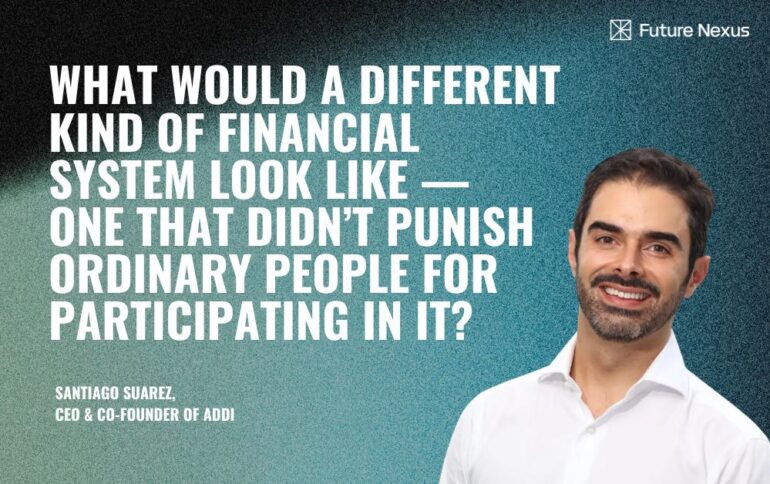
“Wouldn’t it be great if we could actually do a different way of doing banking, lending or consumer finance in Colombia?” – Santiago Suarez, co-founder and CEO, Addi
When Santiago Suarez talks about why he started Addi, a Colombian credit and buy now, pay later platform, he doesn’t begin with technology, funding rounds or market sizing. He starts with losing his family’s home.
In 1999, Colombia went through what Suarez describes as the country’s equivalent of the 2008 financial crisis in the U.S. — the worst in 70 years. His parents owned a modest apartment worth about $40,000, financed with a mortgage of roughly $30,000.
Within three years, thanks to an “outrageous” structure of interest on interest, the debt ballooned to $60,000. The bank foreclosed. The family lost the apartment, the car, even the home computer.
“I thought that was just so fundamentally unfair,” Suarez said. “It was this foundational experience that inspired me to eventually do something different.”
That experience planted a question that never really left: What would a different kind of financial system look like — one that didn’t punish ordinary people for participating in it?
Years later, after attending Yale University and 15 years in the U.S., Suarez decided it was time to answer that question. He moved back to Colombia and started Addi.
Fixing a broken system
The government’s response to the 1999 crisis was, in Suarez’s view, relatively competent: bank failures were contained, and some of the worst financial instruments were dismantled. But when he returned to Colombia, the underlying structure of the system hadn’t really changed.
For example, three banks controlled about 70% of assets. Fees were everywhere. Consumers would be charged after just two online logins a month to check their balances. ATM withdrawals from your own bank’s machines could incur fees after a small number of free transactions.
“To this day, there’s no single account in Colombia that’s 100% no-fee,” Suarez said. “Only one in every five Colombians has access to credit, and less than one in 10 have access to a credit card. It’s an extremely exclusionary system.”
The result is a system that pushes people into high-cost, long-term debt. Suarez described his father once paying for a $9 breakfast over 36 installments on a credit card — a small purchase that eventually cost around $40.
Therefore, his mission for Addi is simple: credit should help people live better lives, not trap them in compounding obligations.
Building Addi to fit Colombia
Addi’s strategy rests on three pillars:
- Clarity of purpose: The company’s mission is to “create pride and abundance among Colombian consumers and businesses.”
For Suarez, that north star has been non-negotiable — from product design to which merchants Addi partners with.
- Technology as a cost and access advantage: Colombia has high interest rates regulations. That means that unless a financial player runs extremely lean, it’s tempted to hide revenue in opaque fees or exclude large swaths of the population.
Addi took the opposite approach of building a technology company from day one, with a best-in-class cost to serve and a lean headcount.
Today, the company is net income profitable, while offering consumers 0% interest options and short, responsible installment plans designed to prevent over-indebtedness.
“No one wants to pay for a T?shirt in 12 installments, right?” Suarez said. “We don’t let you overextend yourself.”
- World-class team for a local problem: Suarez set out to build a “world-class company, even if it only operated in Colombia at the beginning.”
The team includes veterans from Amazon, Capital One and eBay’s hypergrowth years, paired with deep local expertise.
Just as importantly, Addi resisted the temptation to simply copy-paste models from Brazil, Mexico or the U.S. Instead, it invested heavily in building a two-sided ecosystem tailored to Colombia — a robust merchant network on one side and a tightly designed consumer experience on the other.
“It was a big investment to begin with because we’ve had to build our own network, but once we hit scale, you could actually see the benefits of that investment,” Suarez said.
Customer loyalty and market penetration
Indeed, the company now boasts over 35,000 transacting merchants and 3 million active customers. It has also seen over 100% in year-over-year revenue growth in the past five years and has scaled to over $1.3 billion in annualized gross merchandise value and $200 million in annual recurring revenue, according to Suarez.
“One of the decisions we made early on was that we wanted our brand to be part of the sale,” he said. “That has paid off — one in every 10 Colombian adults has an active relationship with us.”
That didn’t come without some early hard decisions. For example, one of the country’s biggest merchants wanted to use Addi, but only as a white label version, meaning without Addi’s branding. Suarez turned them down in favor of continuing to show consumers who was behind the product.
Much of the focus of fintech in Latin America is in Brazil and Mexico — rightly so because those are the largest countries. However, companies like delivery super app Rappi, Chile’s Xepelin Argentina’s Uala and now Addi, prove companies can find success outside of those markets.
A mistake some investors make is underestimating the profit pools or only looking at total addressable markets, Suarez said. And, while the countries are smaller, there is an ability to capture the footprint there more fully.
For example, Addi has an enormous market penetration — it’s in all 32 of Colombia’s departments and more than 70% of its municipalities, including remote communities overlooked by legacy institutions, like the Amazon, he said.
Credit as an economic ladder
Behind the technology and metrics are the stories Suarez returns to most often: the consumers and merchants who see Addi as an economic lifeline.
For roughly half of Addi’s consumers, the company is their only meaningful access to credit. They use it to buy school supplies, furnish a first apartment or secure a smartphone for work. In one case, a customer used Addi to buy wigs for her mother undergoing cancer treatment, he said.
On the merchant side, especially among small businesses, the impact can be transformative. Suarez recalls a merchant in southern Colombia who grew from $80,000 in annual sales to nearly $1 million and expanded from a single location to 10. Addi now represents about 70% of that merchant’s total sales.
For tens of thousands of businesses like this, Addi isn’t just another payment option; it’s a growth engine, Suarez said. It’s a pathway into the formal economy, complete with bank accounts, tax reporting and a more stable footing in the local ecosystem.
“Apple will be fine if we disappear, but for many of these small merchants, we’re a core driver of their economic success,” he said.
Investing in the future
If the early story of Addi was about reimagining credit, the current chapter is about maintaining a strong foundation.
The company plans to invest further in artificial intelligence, using agentic workflows to transform internal processes end-to-end — from increasing the share of AI-assisted code changes to deeply embedding automation into how every team works.
Addi is also preparing to deepen its marketplace. The company has been net income profitable for about six quarters, and a core tenet of its expansion is how to now go about funding it organically, Suarez said.
“The credit solution we’ve built for the last year is one that millions of consumers use every month, and on average, they use it more than once a week,” he said. “With the right agents, the right automated workflows and models, this is the year where we put all of that together in a way no one else is doing.”