

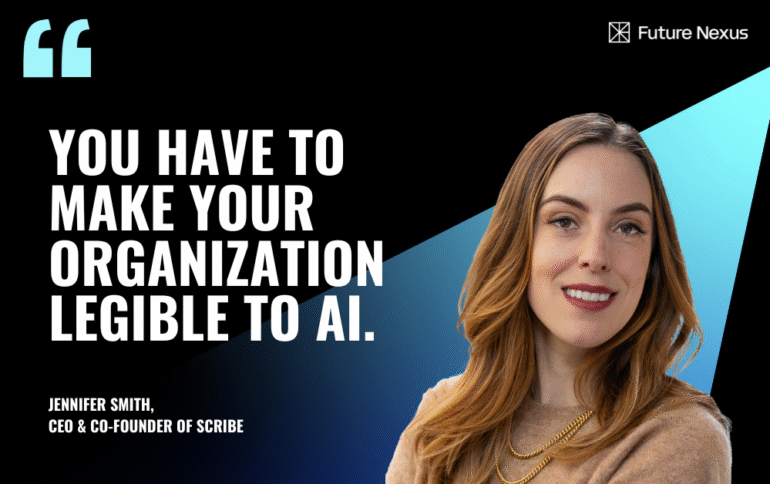
“You have to make your organization legible to AI.” – Jennifer Smith, co-founder and CEO, Scribe
When Jennifer Smith and Aaron Podolny set out to build Scribe, they didn’t start with a product idea. They started with a question: How is work actually getting done inside organizations?
To find out, they interviewed around 1,200 executives. What Smith said she heard over and over was a mix of pride, anxiety and uncertainty. And essentially some version of the same story:
“They told me, ‘People are my most valuable asset,’” she told Future Nexus. “‘They show up to work every day. They’re doing really valuable things, but I don’t always know what those things are.’”
They could see inputs, like tools, salaries and headcount, and outputs, like tickets resolved, revenue generated and projects shipped. However, the transformation in the middle — the actual workflows, decisions and steps people take on their computers — was effectively invisible. That “missing middle” is the problem Scribe is built to solve.
Scribe, the workflow AI platform, is used by 6 million people and 94% of the Fortune 500. Its Scribe Capture automatically turns any workflow into step-by-step guides, while its Scribe Optimize discovers and analyzes a company’s real-time workflows across the organization to show where to improve and automate for measurable return on investment.
As the Scribe co-founder and CEO prepares to speak on the “When AI Joins the Team” panel at the HumanX AI conference taking place April 6-9, Smith is focused on a message she believes will define the next decade of business:
“You have to make your organization legible to AI,” she said. In other words, if companies want AI to work like a true teammate, they need to give it something to read.
Preventing “Know-How” Loss
One of the most relatable examples Smith hears from customers is the “Barbara problem.”
“Barbara’s been here for 20 years and she’s retiring in two years,” she said. “Everyone knows she does something really important. No one really knows what it is.”
That kind of institutional knowledge is being lost in companies all over the world because it is rarely documented in full. It lives in people’s heads, walks out the door at 5 p.m. and eventually walks out for good when they retire or leave.
Now scale that across hundreds or thousands of employees, and Smith said that translates into constant reinvention of the wheel, inconsistent processes and outcomes and real workflow that is never fully understood.
In a pre?AI world, that was already a serious business risk. In an AI world, it’s “orders of magnitude worse,” Smith said.
Companies now have access to incredibly powerful AI agents — but those agents still need to know what work needs doing and how it should be done.
Building a “Context Layer” for Working with AI
Healthy organizations are continually finding better ways to work, Smith said. Scribe’s answer to that starts with Scribe Capture, a tool that observes how experts do their work and automatically turns that into step?by?step guides — no extra effort required from the expert.
The idea is simple but powerful: Take the person who’s figured out the best way of doing something, figure out how to easily take that out of their brain and automatically serve that to a colleague or a customer, Smith said.
“Now we’ve made everybody as good as the expert the first time they do something,” she said.
Essentially, the colleague can ping “the Barbara” on their team when they don’t know how to do something, and Scribe surfaces the right workflow in context.
The company’s newer product, Scribe Optimize, takes that a step further. If Capture answers the question “What are we doing and how?” Optimize asks, “Where could we be better?”
Smith describes Optimize as agentic. It uses workflow data to proactively find opportunities for improvement, based on what a company cares about most. That could mean anything from productivity and time savings to better tool usage to automation opportunities.
Crucially, Smith notes that most companies today aren’t using workflow data at all, not because they don’t want to, but because they’ve never had a practical way to collect it at scale.
“People don’t accurately report on their workflows because it’s hard to remember everything,” she said. “Then most will remember the way it should go, not necessarily the way that it actually goes. For example, what happens if you run into hiccups, or a person said it was a nine-step process, but it’s actually a 15-step process.”
Lessons for Company AI Deployment
For Smith, artificial intelligence is not about replacing humans, but about giving them leverage.
For example, a salesperson doesn’t take a job because they love logging calls and wrestling with CRM fields, she said. They take it because they like building relationships and solving customer problems.
Smith’s focus for AI is to quietly handle the administrative burden while the human leans further into the uniquely human parts of the role. She’s also clear on where AI should not be focused.
“We believe very strongly in humans and human potential,” Smith said. “AI should pull away the time?sucking parts of the job so people can spend their time in their zone of genius.”
When Smith speaks on the HumanX panel, she wants participants to go away from it with ways on how to make their organizations legible to AI. Without that, they will just be dropping powerful systems in the midst of an opaque operational environment void of context.
“There’s going to be a bunch of really bad outcomes from that,” she said.
Looking ahead a year or two, she predicts that knowledge workers will each have dozens or even hundreds of agents at their disposal, acting like a force?multiplier for their skills. However, that future depends on how you make AI work for you.
“AI is not going to function like a teammate if it doesn’t know what it’s supposed to be doing,” Smith said. “It doesn’t have the context for what, how or why, so it’s never going to help you raise the bar.”
That is, unless you give it the data and legibility it needs. That’s the key to giving knowledge workers more leverage to achieve whatever outcome your organization is looking for, she said.
Keeping Humans and Agents In the Loop
Smith believes the companies that win in the age of AI will be those that can do two things at once: Aggressively deploy AI, and continuously update AI (and humans). There’s a caveat, though.
“They will have to do it while understanding what the work is to be done and making sure they’re giving that information to both agents and the humans,” she said.
That’s because the work to be done is dynamic. It will keep changing over time, especially as tools, markets and teams change. Smith said the challenge will be how they do that fast, and how they build tight feedback loops that keep humans and agents aligned with reality.