


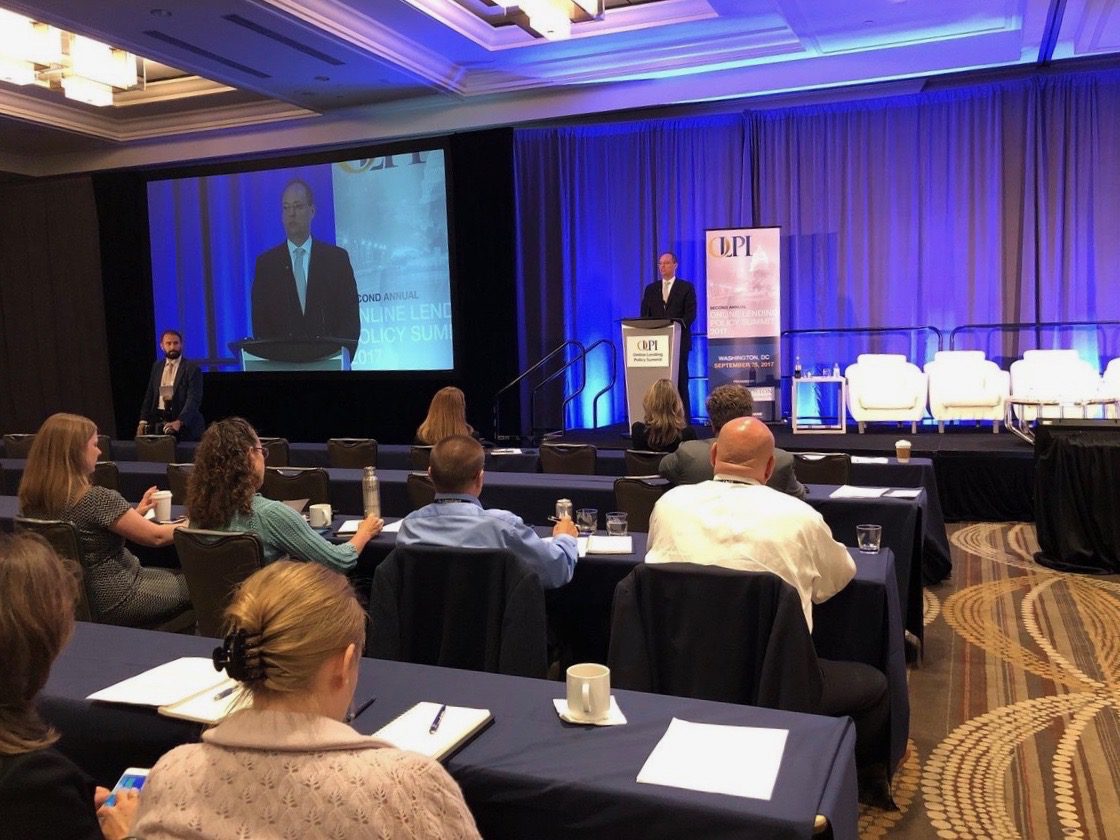
Yesterday, I attended the second annual Online Lending Policy Summit in Washington DC. It was headlined by the Acting head of the OCC, Keith Noreika, Congressman Greg Meeks (D-NY), Congressman Tom Emmer (R-MN) and William Isaac, the former head of the FDIC.
The event was opened by Cornelius Hurley, Executive Director of the Online Lending Policy Institute (OLPI). He then introduced the first speaker, Phil Goldfeder, head of Government Affairs at Cross River Bank, who laid out an overview of where we are today with online lending. Following that we had a panel focused on the Madden issue. There was a long discussion about the impact that this decision has had on borrowers in Second Circuit states: NY, VT and CT. Research has been done by Columbia University and others that show lending is down significantly in the three states and one panelist noted that “no marketplace lending platform is issuing loans in these states to borrowers under a 625 FICO.” If for some reason the Madden decision was to be expanded to all states then lending platform volume could drop as much as 50%. But there was some optimism that a legislative fix would be successful here.
William Isaac was the head of the FDIC under President Reagan and he painted a stark picture of the US today where 60% of the population cannot get a bank loan. He said that we have to do better and figure out a way to lend to a broader cross section of the population.
Acting Comptroller of the Currency, Keith Noreika, struck a surprising upbeat tone in his remarks. He began his speech by saying that online lending was a natural evolution of banking. This caught the attention of American Banker as well as everyone in the audience. He also cautioned that one of the problems with the industry today was a lack of profitability and the fact that the loan books have not been tested in a downturn. These are concerns we have all heard before. Not surprisingly he argued that online lending platforms should consider directly entering the banking industry. But what was interesting was that he did not mention the OCC fintech charter, instead pointing out other the various other types of banking charters that might be suitable for fintech companies.
There were some great panel discussions in the breakout rooms and then we came back to the keynote hall for a conversation with Republican Congressman Tom Emmer who is a member of the House Financial Services Committee. He talked about the need for organizations like OLPI and the Marketplace Lending Association to act as a resource for lawmakers.
Also on the House Financial Services Committee is Democratic Congressman Greg Meeks who followed Emmer on the main stage. Meeks is co-sponsor of the “Madden fix” bill, along with Congressman Patrick McHenry, that was introduced over the summer. I found Congressman Meeks to be the most engaging speaker of the day. His enthusiasm for financial innovation was infectious. He said that fintech should focus more on being an enabler than a disruptor. We need to enable more access to credit through partnerships with traditional financial institutions. He brought up the idea that fintech platforms could partner with black-owned banks that are struggling to keep up with the technological changes happening today.
I had the honor of chairing the last panel of the day. My goal was to take on some of the themes of the day and dig into them a little deeper. We started by talking about the challenge of government in keeping up with all the technological change that is happening in finance today. JoAnn Barefoot pointed out that implementing regulatory changes over a 2-3 year period is not going to cut it any more. There needs to be a dramatic increase in the responsiveness of government to new changes otherwise the USA could lose its leadership position in finance globally. We talked about whether or not we would ever see an OCC fintech charter as the states are making this new initiative less likely. I also brought up the idea that maybe this 36% APR arbitrary line in the sand for responsible credit could be increased and that could be a way to expand access to credit. Not surprisingly, there was no consensus of on that idea.
The event had a good mix of new faces and old friends and when we retired to the bar afterwards the consensus was that it was very much a worthwhile event. While it was good to see members of congress and regulators at the event there is a need for much more engagement. But events like this one are an important part of getting our voices heard in Washington.