
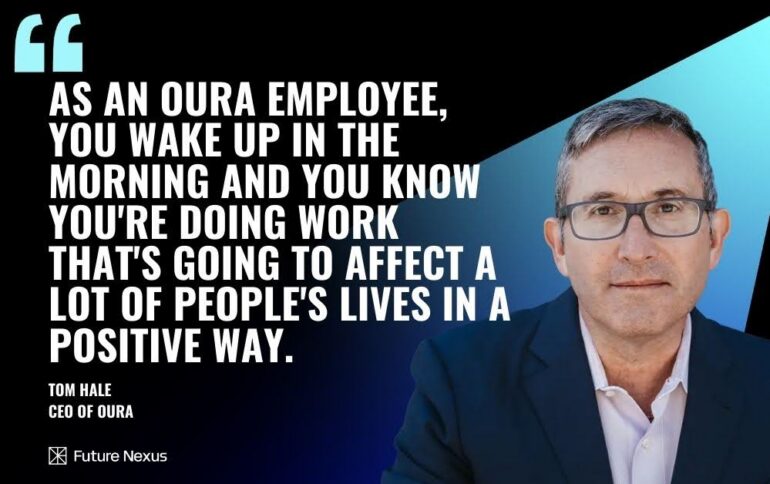
“As an Oura employee, you wake up in the morning and you know you’re doing work that’s going to affect a lot of people’s lives in a positive way.” – Tom Hale, CEO, Oura Labs
For most of his life, Tom Hale considered himself a “championship sleeper.”
“I can fall asleep at a moment’s notice and stay asleep forever,” he told Future Nexus.
Then the fall of 2021 hit. The company he’d just sold — Momentive — was in the process of being “unsold” by shareholders. His kids were in what he called “the terrible early teen years.” And the world was cycling through yet another wave of Covid.
“I could not fall asleep, and I could not stay asleep,” he said.
He started doing research on things that might help, and he came across the Oura Ring, a discreet smart ring that tracks sleep, readiness and recovery. Hale ordered one and started using it.
Over the next eight weeks, Hale learned that even though he was a “championship sleeper,” sleep had actually been invisible to him. When he cracked the code, it was like an awakening, pun intended.
Learning those things about him, in his own way, will be one of the focuses Hale, CEO of Oura Labs, will speak about on the “Decoding the Future of Health” panel at the HumanX AI conference taking place April 6-9.
A ring on his finger
Hale didn’t come to Oura as a gadget skeptic.
“I’ve always been a wearable person,” he said. “Partly it’s a love of measuring things.”
As a teenage road cyclist, he kept a binder of handwritten stats. Metrics like how far he rode and how fast. Then Hale got his first consumer wearable, a Nike+, which was a puck that fit into a special cavity in your running shoe and talked to your iPod.
He recalls Lance Armstrong being in his ear telling him things like, “Great job, that was your best mile yet.”
“I remember being a little captivated by it,” he said.
But Oura hit differently. The ring didn’t just celebrate miles but quietly reflected back the rhythms of his nervous system.
Guided by its data, Hale made what sounds like small tweaks. He stopped drinking coffee, stopped using alcohol to unwind from the coffee, stopped doom-scrolling on his phone before bed and went to bed “with an intention to fall asleep, not an intention to watch Netflix,” he said.
“All of sudden, my cognition, my mood and my habit of snacking — all these things — changed,” he said. “What I realized was that I had been sleep deprived, literally, since my 30s.”
The ultimate fan becomes CEO
Hale reaches for an old-school metaphor to describe what happened next with his health.
“I used to have this television set when I was a kid,” he said. “It was a black-and-white Panasonic, really grainy. It felt like I was walking out of that television into a 4K Technicolor, 70-millimeter Lawrence of Arabia.”
He remembers thinking: Do people feel like this all the time? “I had forgotten what it felt like to feel good,” Hale said.
That experience didn’t just convert him into a paying customer. It made him want to join the company. Oura, it turned out, was running a CEO search after founder Harpreet Rai stepped down.
The recruiter told him that although the software data engineer wasn’t exactly what Oura was looking for, it might make a difference to write a letter.
So Hale wrote a letter, making the case that he was, in fact, the person they were looking for. Complete with describing why this “software data person who loves wearables and has no problem falling asleep” was exactly the right match. More importantly, he felt pulled by the mission.
“I felt the connection to the mission,” Hale said. “As an Oura employee, you wake up in the morning and you know you’re doing work that’s going to affect a lot of people’s lives in a positive way. For some people that doesn’t matter, but for people who work at Oura, that matters a ton.”
Prevention starts with behavior change
The Oura Ring tracks metrics like oxygen, heart rate variability, temperature trends and detailed sleep staging. When asking Hale what metrics will matter most for preventative care over the next decade, he starts with behavior.
“Preventative care, in many ways, is about behavior modification,” he said. “What are the metrics that cause people to modify their behaviors? It turns out it’s actually the person. It’s what matters to that person.”
He gave some examples:
- A 35-year-old father of two, juggling career and family, is likely to care about stress. For him, heart rate variability (HRV) —“the tension between the two sides of your nervous system, fight-or-flight or rest-and-digest” — is a powerful mirror. Low HRV means your sympathetic ‘fight-or-flight’ system is dominating,” he said.
- A woman in their 20s might care more about temperature and ovulation — “either not getting pregnant or getting pregnant, whichever your objective is,” he said.
- For someone like Hale, in a high-stress leadership role, sleep and a metric called resilience — “a measure of your response and recovery to stress” — have been the big unlock. “Understanding my resilience has actually changed my behaviors,” he said.
Hale is also excited about the ring’s ability to track cardiovascular age, derived from pulse wave velocity, which measures how fast pressure waves move through your arteries.
“The higher it is, the stiffer your arteries are and the more risk you have for stroke or myocardial infarction,” Hale said. “It’s what resting heart rate was in the 1990s and HRV was in the 2010s.”
The caveat is that context is everything when it comes to “cardiovascular age.” For instance, a cardiovascular age of minus five means something very different at 20 than it does at 50, he said.
Prediction: catching illness before it catches you
So if prevention is about changing what you do, prediction is about seeing what’s coming.
“Prediction is about seeing things before they’re a problem, which is sort of the problem of the health care system,” Hale said. “The health care system wants to intervene when you’re already sick.”
Oura’s answer is a feature called Symptom Radar. As Hale describes it, the ring will monitor certain metrics, including skin temperature, heart rate variability, respiratory rate and inactive time. When those metrics breach the boundary condition of what looks normal for that person, it will send you a notice that you might be getting sick.
The person can then see that and adjust their day or be the nudge needed to cancel a dinner, lie down, and drink tea instead of pushing through, he said.
“The direction of health is a one-way street, so that’s really powerful, and that’s a superpower for everybody,” Hale said.
The future is democratized health care, featuring AI
At HumanX, Hale will be speaking with Midi Health co-founder and CEO Joanna Strober about how AI is shaping the future of health care.
As Hale sees it, our health care system is in the middle of a phase shift.
“Health technology is being democratized right now in both information and access,” he said. “People can get their own blood tests, they can get their own wearables and they can gain access to information about themselves that has heretofore not been available.”
Care is also getting more distributed, Hale said. For example, it used to take place in a hospital or doctor’s office. He described the long-standing institution of medicine as “an ivory tower.” Today, that relationship has shifted. Care can be done in other places like at home.
Now layer AI on top of that, and the power dynamic starts to flip and democratization is accelerating. Hale cited the all-too-familiar scenario where you wait days for a doctor to interpret a test result.
“We’re moving to a world where convenience, speed and access are all the properties of something where you can open up your browser, upload your test results, and it will talk you through, with some measure, what your experience is,” Hale said. “Access to information is going to be radically different.”
Oura is already leaning into domain-specific AI. In February, the company rolled out an AI model for women’s health which he described as “the first owned-and-operated, specific-to-a-particular-domain-of-health, large language model.”
It’s trained on 30 textbooks and tuned with input from five board-certified physicians, aligned with standards from U.S. gynecological societies.
“We’ve made sure it has a really good basis of authority,” he said.
Hale also says that health AI can’t be a generic chatbot, and that you have to trust the quality of the information because a general-purpose AI will sound extremely confident, but might actually be giving you erroneous information.
That’s where ethics and guardrails come in: strict privacy, transparent limitations and clear boundaries around what AI is allowed to do.
“AI doctors shouldn’t be able to treat, operate or prescribe until there’s real demonstrated security,” Hale said. “These systems will be working hand-in-hand with people — they will be an extension of the care team — but there will be checks and balances so as not to allow them to run unfettered over people’s lives and health.”
The infinitely patient coach (that remembers everything)
One of the more surprising things Hale has learned from Oura’s AI experiments is just how emotional the user relationship can be.
For example, women use Oura’s existing AI features “twice as frequently and for twice as long” as men, he said. When the team asked why that was, the answers stuck with him.
“They said, ‘It’s infinitely empathic. It’s infinitely patient. It knows everything about me, and it cares to answer every question I ask,’” he recalled. “It’s an interesting observation that there’s this very emotive connection.”
Users even asked for the ability to name the AI, which Hale believes is a sign that in a world where people may not be empathic and patient, there’s a lot of value in something that is not a human but provides some kind of human link.
He points to companies like Hippocratic AI, which builds virtual nurses that call patients to check blood pressure, medication adherence and follow-up appointments. In one recording he heard, an older man starts out hostile and ends up confiding that his daughter left and his cat died. The AI nurse responds, “I’m so sorry to hear that, Mr. Smith. You can call me anytime.”
“Here’s this person who is alone and getting some support from something that is — I’m not kidding you — a machine,” Hale said. “A nurse who has to go home to pick up their kid from school, or is stressed out because their boss is a jerk, might not be able to provide that. I actually mark that as an improvement.”
So what does that mean? To Hale, it’s that there is an “interesting human element of coaching,” but also a line between helpful coaching and unwelcome nagging.
We don’t need a bunch of robots constantly interrupting, he said, but more of an experience that “feels like a magical session with somebody who really knows you, gives you good advice, and connects with you on some human level — that’s going to be transformative.”
In his view, we’re moving from a world of scarcity in health care, where there is limited doctor time and limited access, to one of abundance, powered by sensors like Oura and AI.
“Call it the doctor in your pocket or the doctor in the cloud,” Hale said. “Whatever it is, is something that’s got knowledge of you that’s really intimate, has a sense of what’s actually going on in your body and has developed some track record of success. It’s not a random chatbot, but a trusted entity. It’s going to 100% change the dynamics of health.”