Pigment co-CEO Eléonore Crespo wants to give CFOs superpowers
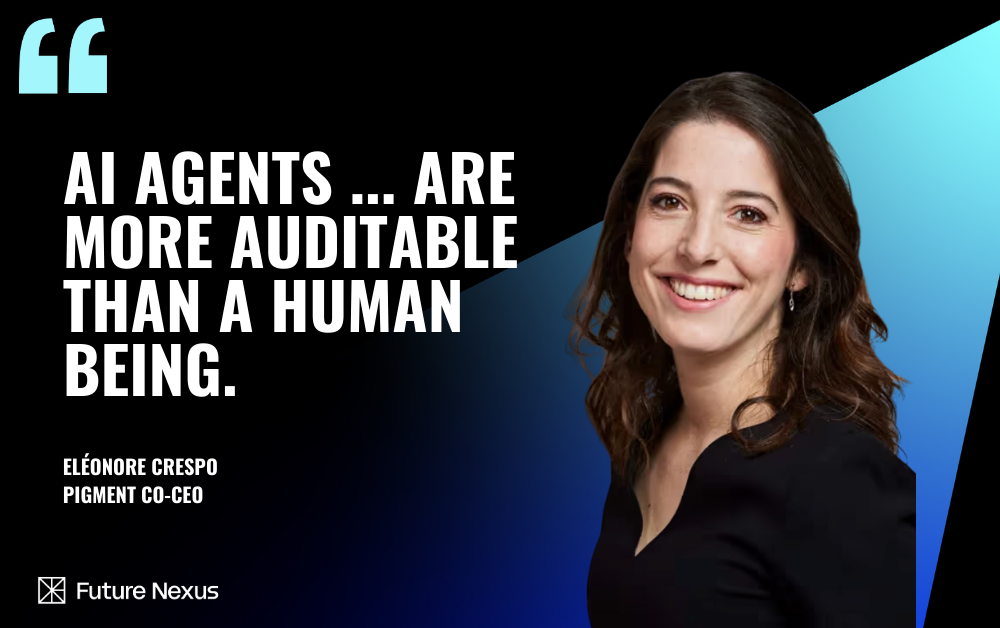
“AI agents are actually the contrary of a black box. They are more auditable than a human being.” – Eléonore Crespo
When Eléonore Crespo says she would rather study AI than watch Netflix, she is only half joking. That curiosity has turned into Pigment, a Paris-born business planning platform that wants to use artificial intelligence to make slow, spreadsheet-driven planning feel as outdated as dial-up internet.
And companies are responding.
“More than 50% of our customers come from legacy platforms,” Crespo told Future Nexus. “They have decided to rip and replace the incumbents with us because of our innovation on AI capabilities.”
The company, which she co-founded with Romain Niccoli, the co-founder and former CTO of Criteo, also found its footing as a global business, attracting more than 60% of its revenue from the United States.
Prior to launching Pigment in 2019, Crespo was an investor at Index Ventures and a financial analyst at Google, where she advised the Europe, Middle East and Africa president and CFO on strategy and planning.
As co-CEOs, Crespo and Niccoli raised nearly $400 million to help enterprises like Unilever, Klarna, Merck, Figma and others move beyond manual financial models into AI-augmented, always-on planning.
The AI-powered business planning and performance management company is approaching $100 million in annual recurring revenue, while also doubling its revenue each year, Crespo said.
As Crespo prepares to join peers at the HumanX AI conference taking place April 6-9, she is focused on making AI a teammate for Pigment’s customers so they can rethink how work happens, how decisions get made and ultimately, gain superpowers.
Customer Obsession and Building in Europe
While at Index Ventures, Crespo had a vantage point of seeing both what great companies did right and where promising startups stumbled. That knowledge helped shape how she built Pigment from day one.
Her biggest takeaway from the venture world? An almost fanatical focus on the customer.
“We have an obsession with what the customer wants,” Crespo said. “They have pain points, and my vision is to solve them. That has been the main driver for me since the beginning.”
The Pigment team constantly loops in customers on new capabilities, from early agent concepts to fully productized features, and uses that feedback to refine everything from UX to pricing.
That customer-first mindset also influenced why Crespo chose to build the company in Paris. It also didn’t hurt that co-founder Niccoli was already in Paris and had a track record of assembling top-tier engineering teams there.
Starting in Europe forced Pigment to think globally from day one, selling across markets rather than staying comfortable in a single domestic base, she said.
“Our secret weapon is our engineering team,” Crespo said. “We knew we could put together one of the best engineering teams from Europe. Plus, when you’re in Europe, you have no choice but to get out of your own comfort zone. The market is too small, so you’re not going to sell only in France. That was also a big factor for me — making sure that we understand this multicultural element and are capable of creating a global business.”
What Pigment Actually Does
At its core, Pigment is a cloud-based business planning platform built to replace brittle spreadsheets and legacy enterprise performance management tools.
Teams across finance, sales, supply chain and HR use Pigment to build connected models, run what-if scenarios and keep plans in sync as reality shifts.
“We think about how we can automate as many workflows as possible for a team and how we can bring as much intelligence at the right time to any decision maker,” Crespo said. “At the end of the day, we have so much volatility today in the market so you have to reach very fast to that. The goal is to manage that.”
Instead of dozens of disconnected Excel files, Pigment brings data, logic and workflows into one shared environment so, for example:
- Finance can update a forecast and instantly see the downstream impact on hiring plans or regional profit and loss statements.
- Sales ops can align quotas and territories with the latest revenue targets.
- HR can adjust capacity plans in real time when headcount assumptions change.
That connectivity has helped Pigment win big customers like Unilever and fueled significant funding rounds to accelerate product and AI investments.
AI Agents, Not Just Dashboards
The “ChatGPT moment” was important, but it wasn’t the turning point for Pigment. The real shift, Crespo said, came about a year and a half ago when the team started exploring agents — AI that doesn’t just answer questions, but can actually take actions on your behalf inside the platform.
Pigment has since rolled out or announced a family of specialized agents designed to compress the time between question and decision. These include:
- An analyst-style agent that can comb through models, spot risks and opportunities and run complex analyses automatically.
- A modeler-style agent that builds and maintains planning models from natural language intent, including data quality checks and optimizations.
- A planner-style or automated planning agent that takes insights and turns them into proposed actions and updated plans.
For one of Pigment’s customers, a large transportation company, the company is working toward a fully automated capacity and revenue model that can be recalculated with a click, something that previously required weeks of manual work.
Meanwhile, Lauri Sulonen, head of financial planning at Finland-based mobile gaming company Supercell, told the Financial Times that using Pigment’s analyst agent enabled him to “produce the monthly performance report that typically took his team three hours, it was done in five minutes.” All with no mistakes and references so he could check numbers.
“I was pretty bearish before starting this…I’ve changed my assumptions,” Sulonen told FT.
Killing the “Black Box” Fear
Many CFOs worry that AI will turn critical planning into an opaque black box. Crespo argues the opposite: modern AI agents, especially when embedded in a structured platform like Pigment, can actually be more transparent and auditable than human analysts.
“AI agents are actually the contrary of a black box,” she said. “With the modular agents, you can actually read everything through your models. When you ask the model agent a question, it can actually explain, end-to-end, things like how the model was built and who modified it and which assumptions, drivers and data sources led to a recommendation. It’s actually mind-blowing.”
Every step is logged and that audit trail persists even when a human model owner leaves the company. So it’s solving a big problem that a lot of companies have when that team member leaves and takes that knowledge with them, Crespo said.
One Pigment customer, ServiceNow, is seeing this play out in real-time. It is already leveraging these capabilities to build end-to-end enablement flows that teach teams how models work, using the same agentic infrastructure that powers the planning itself. Instead of tribal knowledge living in someone’s head, the logic becomes inspectable and sharable, she said.
Why This Moment Matters
Looking ahead, Crespo expects most of the repetitive financial planning and analysis and budgeting tasks — data gathering, reconciliations, basic forecasting — to be fully automated.
Human finance teams will spend far more time on strategic questions, scenario design and business partnering, with AI acting as the ever-present modeler, analyst and planner in the background.??
Tools like Pigment aim to slash the time from question to decision, make organizations legible to AI, and turn every planner into something like a “mini CFO” inside their domain.
“What if analysis helps them think through being an amazing business partner to whoever they are working with?” Crespo said. “With the latest progress on AI, that’s exactly what’s happening.”