

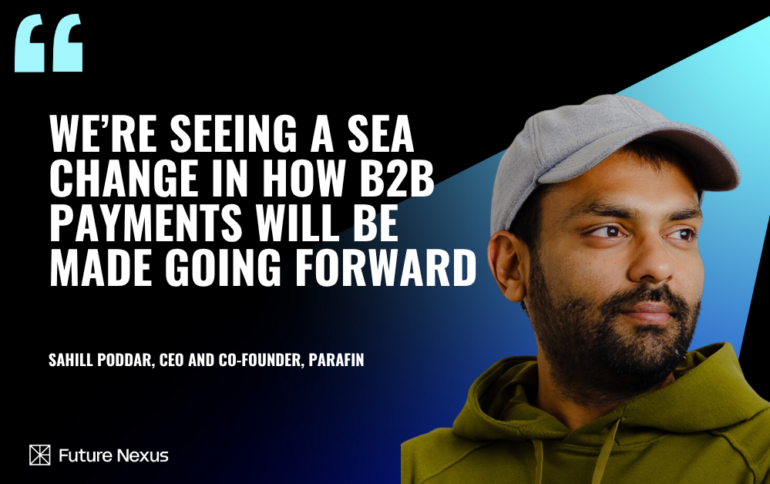
Parafin co-founder Sahill Poddar said it took one visit to an auto body shop to know he and co-founders Vineet Goel and Ralph Furman were on the right track with their vision for an embedded financial infrastructure company, one that addresses a $2 trillion opportunity.
When Parafin was in its infancy, Poddar walked into an auto body shop and asked the owner if he had ever considered adding a second lift. The owner had, but didn’t trust the many random solicitations he had received over the years from unfamiliar institutions.
What if he received an offer from his payment processor?
“He immediately said he’d take it because he trusts them,” Poddar recalled in an interview with Future Nexus. “They have known his business for several years. They obviously want to continue having his payment business, so they would never put a product in front of him that would be against his best interests.”
That conversation took place seven years ago. Since then, Parafin has grown to fund close to 50,000 businesses and has secured partnerships with Amazon, DoorDash, Gusto, TikTok Shop and Walmart. The company counts Ribbit Capital, Thrive Capital, GIC, Notable Capital, and Redpoint Ventures among its investors.
Building A New Way to Measure Risk
The Parafin founding team, which met at Robinhood, brings an analytical approach to lending, with education in computer science, particle physics, and mathematics. Poddar brings additional perspective from his childhood, having grown up as the son of a small business owner.
He learned early that small businesses either fund growth through earnings or by accessing debt markets. But even when financing is available, lenders tend to evaluate entrepreneurs through the lens of personal credit scores rather than the performance of their businesses, a practice that can perpetuate bias and leave many qualified borrowers underserved
The team realized this was a very solvable problem in the internet era, when enterprising fintechs have access to large data sets and the technology to interpret them. That data is what Parafin leverages, working with the largest platforms that small businesses use daily, trusted entities that most have worked with for years.
From this base of data, machine learning and AI bring the technology to interpret it.
How Technology Changes the Lending Equation
Parafin offers three core products. Its working capital option underwrites applications based on sales. A small business BNPL offering is unique in the space. An embedded credit card product provides a new revenue stream while fostering brand loyalty.
Solving the small business funding gap begins by recognizing that a historically biased system that lets thousands of worthy applicants fall through the cracks isn’t using the proper criteria, especially as that information can now be gleaned from voluminous data by machine learning and AI.
“You combine those to make smart decisions and do so in a low-latency, absurdly fast manner,” Poddar said. “And you can provide an extremely delightful merchant experience while aligning all incentives with the merchant and platform itself.”
Parafin’s recipe has proven alluring to the biggest brands serving small businesses. Its partnership roster includes Amazon, Walmart, DoorDash and major players in point-of-sale systems and businesses including gyms and fitness.
The next key ingredient is bringing a consumer-level user experience to small business lending. Poddar said a proper UX must minimize applicant effort so it’s not considered an additional stressor in a busy life. This means building a product which conducts the necessary procedures in the background and doesn’t repeat questions. The goal is to deliver funding the same day.
The Missing B2B BNPL Boom
Why has B2B BNPL received far less attention than its consumer counterpart? Poddar points to the industry’s longstanding reliance on personal credit scores and technology maturation. Only recently has the technology evolved enough to evaluate businesses on their own merits, using operational and transaction data instead of personal financial histories. For Parafin, that shift has been meaningful.
Machine learning and AI allow fintechs to deliver consumer-level experiences, while decisions are rendered within acceptable time frames.
“For all of these to come together, there had to be a technology shift,” Poddar said. “GenAI and the existence of LLMs have essentially enabled that.”
“Today, that technology exists. We’re seeing a sea change in how B2B payments will be made going forward, and we are extremely proud to be pioneering that.”
And that translates directly into partnerships; for example, working with Gusto, Parafin facilitates a BNPL payroll option, allowing merchants to defer payroll. Interesting invoicing options are arising. Parafin sees all small business spending categories, both discretionary and non-discretionary, as significant opportunities.
The Next Phase of Growth
Looking ahead, Parafin will continue to serve the largely untapped small business financing opportunity, including expanding to global markets.
“How quickly we adapt these technologies and diffuse them into the organization is going to be the important thing,” Poddar said.
One area Poddar is watching closely is stablecoins, which he believes could eventually help businesses manage currency volatility and move money more efficiently across markets.
“I see it becoming an important piece of the treasury management stack at some point in the future,” Poddar said.
