
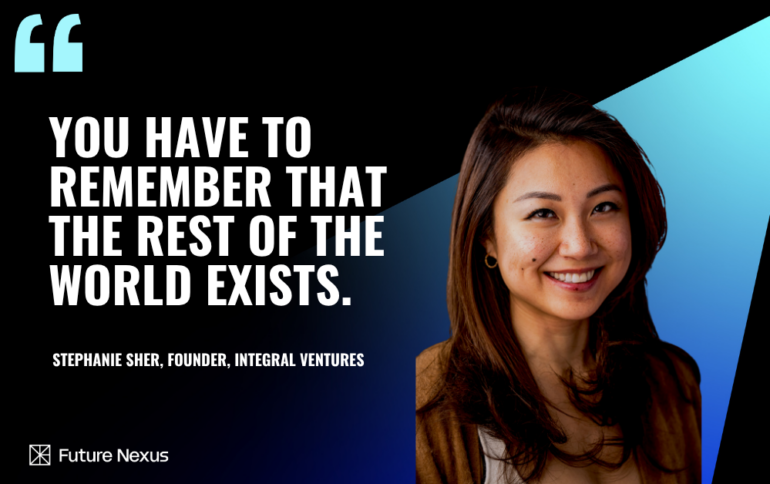
“You have to remember that the rest of the world exists.” — Stephanie Sher, founder and general partner of Integral Ventures
Stephanie Sher is not interested in winning venture capital by playing the usual game.
As founder and general partner of Integral Ventures, she is building a firm around a very specific, and increasingly rare, discipline: backing deeply technical founders. The remit is not research projects dressed up as companies, but true production-grade businesses.
A former go-to-market leader at Datadog, one of the most successful and durable software businesses of the last decade, Sher brings a combination of operator credibility, systems thinking, and contrarian instinct to early-stage AI and infrastructure investing.
That mix underpins Integral’s thesis and, more importantly, how she actually chooses where to spend time and capital.
From Datadog to Integral
Sher spent her formative years at Datadog, first in New York and later in San Francisco, working at the intersection of product, engineering and customers. She got an up close look at how a technically ambitious product actually becomes infrastructure the world runs on.
The company’s success, she argues, was not a fluke of hype or branding, but the result of relentless attention to fundamentals, including strong technical vision, real customer pain, carefully sequenced product expansion and timing that aligned with the broader shift to cloud and distributed systems. That shaped her investing lens.
During her time at Datadog, Sher saw how misunderstood technically forward founders can be. Their emails to investors were often “hard to parse” for anyone without a deep operating or technical background. Many VCs passed, in part because the story didn’t fit a neat narrative or because it didn’t map cleanly onto the trends they were optimizing around.
“Because I know and love technical founders and talent, I understand their blind spots,” she said. “The blind spots are that you cannot just be good and people will come. You need to be good and communicate that in a way that accounts for a reasonable amount of attention span, a reasonable understanding of where they stand right now, that’s product marketing.”
That disconnect between the founders who actually build enduring infrastructure and the investors who are optimized for narrative and fund-marketing became the seed for Integral Ventures.
“Despite being technical-founder heavy, I also have huge respect for sales and what people would call forward-deployed engineering in a company,” Sher said. “I was that arm at Datadog. You can have a brilliant vision and you can build something, but people will not come.”
Building Integral as small, focused and results-led
Sher started Integral roughly two years ago, after years of angel investing and scouting for venture capital giant Sequoia Capital. Integral’s first investment vehicle, between $5 million and $10 million, came together relatively quickly, she said. It was backed by friends from Datadog, a family office and a couple of institutional investors.
“My brand, or ‘modus operandi’ has always been to pay attention to fundamentals,” Sher said. “It’s a small fund, so I have the luxury of investing where it makes sense.”
That said, Integral’s first fund is deliberately small and tight. Sher caps post-money valuations at around $30 million, keeping entry prices grounded in reality and with the goal of lowering the probability of down rounds.
The strategy is unapologetically results-led: she wants companies where both the multiples and the underlying business fundamentals make sense, not just paper marks.
She invests “under the app layer,” for example, in development tools, infrastructure and AI tooling that helps the “magic” of AI actually show up in production and then usually geared for Fortune 500 customers.
In other words, she wants products that connect directly to end-customer use and bottom line, not abstract demos.
Sher says she doesn’t enjoy fundraising, so the fact that limited partners are now proactively approaching her for Fund II, before Fund I has fully seasoned, is its own kind of signal.
“The results were speaking for themselves and will only improve given when looking at the multiples,” she said.
Finding the unknowns before they become known
Sher’s edge is not in showing up to the hottest, most over-subscribed rounds. It’s in finding the right teams before the rest of the market understands them.
She leans heavily on highly curated technical networks, built over years across Datadog, New York’s infrastructure ecosystem and San Francisco’s AI and systems communities.
“I look for the signals and indicators that are different from what most VCs are looking for,” Sher said. She gave an example of former executives of a big customer relationship management company now building the next AI-native CRM company. It’s the kind of thing which would naturally grab venture capitalist attention because their previous tech was proven.
Sher said investing in a company like that “makes sense from a first-degree perspective.” However, from her point of view, she “would probably pick at that a little bit more.”
As a result, the founders she backs tend to be engineering-driven: people whose visions may not look “investor-ready” at first glance, but whose understanding of systems, timing and product mechanics runs deep.
Her default, when she meets a deeply technical founder whose articulation isn’t yet polished, is to lean in, not dismiss them.
She pushes on questions like:
- Who are your design partners?
- How will you commercialize this?
- Do you understand who pays you and why?
Getting past the AI hype
Sher is also outspoken about where she thinks today’s AI market is getting ahead of itself.
“A sales cycle can be nine months because it takes a lot of time for large organizations to build trust,” Sher said. “Right now, people in big companies are refusing to use AI. The sentiment is very distrustful, and for good reason. A lot of people who have built AI could not possibly wrap their minds around it.”
She views both tech and AI as bubbles in the sense that large parts of the ecosystem are detached from how value is actually created and paid for.
Within that, she sees San Francisco as its own bubble, often disconnected from the pragmatism of New York, where top operators and customers are more likely to say: “Show me the money. Show me the revenue. Show me the bottom line.”
She said she is wary of research-heavy companies that raise large rounds without a clear line to end customers. Sher also sees infrastructure hype where investors extrapolate AWS-style narratives onto today’s AI model layer, without acknowledging how different the stack and adoption patterns really are.
In addition, Sher sees tooling, such as evaluations platforms, that live too far from production. In her view, evaluating AI systems only makes sense when it incorporates real production data and feedback from paying customers. Otherwise, you’re optimizing in a vacuum, she said.
Where signals are emerging
Sher believes the first phase of AI, dominated by research breakthroughs and model races, is nearing its natural limit as a venture edge.
The “stars” of that era will not be the same people or companies who make AI broadly useful and dependable, she said.
The hardest problems ahead will be organizational and commercial, not purely technical, according to Sher. Those will include things like how to integrate AI systems into existing processes at scale, teaching more seasoned employees what is actually possible and trustworthy and how to design incentives, security, verification, and workflows around AI agents in production environments.
Meanwhile, Sher expects some of the most important value to be created by teams that blend research orientation with serious engineering and product discipline and commercial operators who have lived inside large enterprises and know how decisions actually get made.
In that world, she can imagine, for example, technical consultants from the likes of McKinsey, Bain Capital or BCG building the AI-native equivalents of Palantir “without the war spin.”
“The whole dream with AI from the beginning was to simplify people’s lives enough that we would all find value in painting, art and being kind to each other,” Sher said. “I hope that everything we’re seeing right now is just friction on the way there.”