Abacum’s CEO: The Future of Finance Looks Like Product
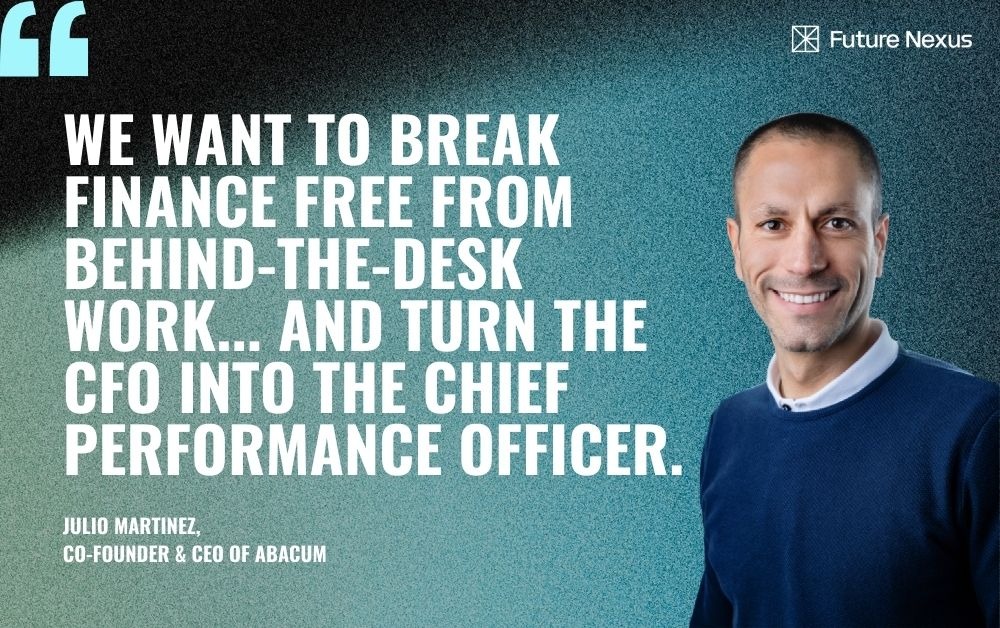
“We want to break finance free from behind the desk work, connect all the stakeholders in a business so they become a trust advisor, and turn the CFO into the Chief Performance Officer driving performance in the business and making better decisions.” — Julio Martinez, co-founder and CEO of Abacum
Abacum co-founder and CEO Julio Martínez is betting that the next generation of finance teams will look a lot more like product teams: plugged into live data, collaborating across functions and constantly running scenarios instead of just closing the books once a month.
New York-based Abacum’s all-in-one platform helps CFOs forecast revenue, plan headcount and model financial scenarios amidst tough macroeconomic headwinds. The company is in 40 markets around the world and boasts a client list that includes Abridge, Strava and Trilogy.
Future Nexus spoke to Martinez about how Abacum is using an AI-native architecture to reinvent financial planning and analysis, why scenario planning sits at the top of the value pyramid and how finance leaders can stay ahead of the next wave of macro and funding volatility in 2026.?
The following was edited for clarity and length.
For founders used to hearing “AI-powered” everywhere, you describe Abacum as “AI native,” not just a planning tool with AI bolted on. What does that actually mean for how finance teams use the product day-to-day??
Martínez: I see it in two layers. First is the technology architecture: being AI native means your architecture can actually support AI in a flexible, robust way. Many legacy financial planning and analysis tools were built 20 or 25 years ago, so their architectures are rigid, and they can only layer a bit of AI on top, which is rarely transformational. We built a fresh, AI-driven architecture from the start so we can integrate AI where it matters instead of treating it as a cosmetic feature.?
The second layer is how AI shows up in the workflow. For us, AI is not a chatbot floating on the screen that finance teams have to talk to. We want AI to be invisible and embedded in the job to be done. If I’m a finance professional modeling my next forecast or budget, I can use AI-powered modeling and smart templates so that around half to most of my model is generated automatically, saving up to a week of work.
When it comes to data, instead of cleaning and classifying everything in spreadsheets — which is error-prone and exhausting — we use AI to clean, classify and prepare the data inside Abacum. We’re very deliberate about building a “glass box,” not a black box, so finance teams have full traceability and explainability for every number they sign off on.?
Beyond shaving off some hours, how are capabilities like data cleaning, anomaly detection or automated forecasting genuinely changing how your customers work??
Martínez: Productivity is real and important. Many finance professionals come from investment banking or consulting, and then they land in roles where half their time feels like manual, repetitive work. We’ve seen customers report that a large share of the time they used to spend on manual tasks can be automated away.?
The bigger shift happens once that time is freed and finance teams can become proactive partners. They’re connected through the platform to stakeholders across the business and have clarity on what’s happening in the pipeline, with partners, with closing capacity, with product launches.
They can see, for example, whether they have excess sales capacity relative to a bottleneck in pipeline generation, or how a delay in a product release is likely to cascade into revenue. I call this “cognitive clarity:” going from a world where it’s hard to make sense of anything to a world where you understand the business, can slice and dice the data quickly and can communicate those insights to the rest of the company.?
Looking at this year, what core FP&A tasks do you expect to be mostly automated, and which do you think will remain more strategic and human??
Martínez: The area I’m most excited about is scenarios. Scenario planning is where AI and finance get truly powerful together. We recently launched an AI-powered Scenario Studio, which is one of our flagship capabilities. It lets finance teams run complex, constraint-based scenarios on the fly and answer questions in real time that used to require days of spreadsheet work.
For finance professionals, that’s the top of the pyramid, like the prime-time moments when they need to shine. We’re turning that into something they can do any time, not just once a quarter.?
What stays human is business partnering. Finance needs to be embedded in day-to-day conversations with revenue, product, and HR, navigating politics, uncertainty and negotiation while still protecting budgets and driving performance. Those relationships and judgment calls are not going away.
You’ve talked about planning through uncertainty and more agile annual planning. What kinds of scenarios do you expect finance teams to run routinely this year??
Martínez: Macroeconomic and geopolitical conditions are driving a lot of the scenario work. Recently we’ve seen tariffs come in and out, which has affected many customers’ supply chains. Tax changes have also triggered new modeling exercises. With what’s happening in different regions, customers, especially in manufacturing or those exposed to factors like energy prices, are constantly updating assumptions and running scenarios on costs, supply and demand.?
Another big theme is capital scarcity, especially for SaaS and high-growth tech companies. Many of our customers are privately held, some pre-IPO, and they’re asking what it means if they can’t raise on the same terms as before, or if an IPO window opens and closes very quickly.
They’re running scenarios like, “We’re burning several million per month — do we need to bring that down?” and “If our listing gets pushed by two months, what happens to our runway and hiring plan?”
Key takeaway
Historically, a finance team would disappear into a cave for a week to answer questions and still feel tentative because the data wasn’t reliable enough, Martinez said. Instead, Abacum wants to enable a more agile cadence of rolling, monthly conversations instead of static annual plans, so finance becomes the glue of the business rather than a back-office reporter.?