

After helping build robots for Mars and underground mines, Dr. Ali Agha is bringing a safety-first AI brain to the world’s most dangerous worksites.
When people think of modern robotics, they usually picture humanoids doing backflips, or doomsday scenarios of autonomous machines hitting the frontlines, and eventually turning into killer robots (like Black Mirror’s “Metalhead”).
The imagination runs wild, but for Dr. Ali Agha, CEO of FieldAI, robotics is about doing the boring and highly dangerous work of pulling humans out of muddy trenches, collapsing mines, and unpredictable construction sites that pose a daily threat to their lives. Every year in the U.S. alone, a single subsection of the construction industry sees over 1,000 deaths and many more injuries.
To make this vision of robotics a reality, Dr. Agha and his team aren’t building just a better robot but a ‘universal AI brain’ that can operate different robot types – from small and large machinery to humanoids and robot dogs – across different environments and conditions, including some of the toughest terrains on Earth that are changing by the minute.
“The real future of robotics is not one form factor — it’s a spectrum of specialized machines, all powered by a common intelligence layer, each optimized for the job it needs to do,” Agha told Future Nexus in an interview on the sidelines of the HumanX conference. “We build tools, and good tools are purpose-built.”
That vision took a decade to build, forged in environments far more hostile than a construction site.
From Mars to the mines
A decade ago, Agha was at NASA, where he drove several high-stakes initiatives, including the work on the Ingenuity helicopter, which took off on Mars in an historic flight in 2021, and DARPA’s Subterranean and RACER Challenges.
The DARPA challenges, in particular, pushed the boundaries of field robotics to their absolute limits. In the Subterranean Challenge, Agha’s team deployed coordinated fleets of legged, wheeled, and flying robots into dark, unmapped, and GPS-denied environments to navigate entirely on their own.
“We spent many days in complex environments developing cutting-edge tech, from 900 feet underground in coal mines to environments we’d never seen before,” he recalled.
It was through these extreme deployments that commercial demand began pouring in, eventually prompting him to leave NASA and start FieldAI in 2023. But stepping into the startup world didn’t mean adopting Silicon Valley’s famous “move fast and break things” approach.
“Speed and rigor are not opposites,” Agha explained. “You spend years preparing for a single one-hour competition where everything has to work in an environment the system has never seen before. There’s no second chance. That forces a level of discipline, reliability, and execution that stays with you.”
With that discipline and the visible demand, Agha fused two entirely different schools of AI.
His NASA and DARPA veterans were experts in “risk and uncertainty quantification”, or the ability to understand risks in unpredictable environments. To complement that, he brought in co-founders and researchers from heavyweights like Google DeepMind and Meta who specialized in building massive, generalizable data-driven models.
“They brought generalization (for different robot types), we brought in risk and uncertainty quantification, and we (ultimately) came up with a new class of models we call Field Foundation Models,” Agha said.
The 99.999% standard
When a home robot fails to do something like picking up a napkin, the issue is negligible. You can simply ask it to do it again. Even when AI assistants like ChatGPT hallucinate, you have time to reason and double-check what it got wrong. But if a 5,000-pound machine navigating a 60-story scaffolding hallucinates close to a human worker on an active site, the outcome can be life-threatening.
There’s just no room for reasoning or reattempts in dangerous environments like construction and mining sites.
This is why Agha views the AI industry’s current obsession with scale – feeding massive amounts of data into a “black box” neural network and hoping it learns – as fundamentally dangerous for heavy machinery.
“I cannot say, ‘Look, I tried it in simulation, I tried it based on web-based data, and it looks good.’ You can never fly with a plane that somebody says is 99% going to work. There are consequences,” he explained.
While 80% to 90% reliability can be acceptable for a chatbot, Agha argues that industrial safety has to be at 99.999%. For him, deploying robots into these environments is about building an active and intelligent safety net, which can even flag an unmarked hole or a slippery surface before a human ever steps near it.
To achieve that, Field Foundation Models reject the black box approach. Instead, they rely on an interplay between two underlying models: a “world model” that understands the physics of the environment or what’s happening around the robot, and a “dynamics model” that understands the physical limits of the specific robot itself.
For instance, a robot approaching unstable ground checks its world model for terrain risk and its dynamics model for whether its joints can handle the load, before it ever moves.
What actually separates FieldAI from the rest is Agha and his team’s expertise in “uncertainty quantification.” The AI is programmed to know when it is confused or doesn’t know anything about the problem.
“It is okay if you don’t know something… but it is not okay that you take an action when you don’t know something,” Agha said. “You have to have high uncertainty and say, ‘I am seeing something that I don’t know about.’ And then, because it’s robotics, you can take another view and reduce uncertainty before you commit to an action (or non-action).”
This architecture is constantly fed by a massive real-world data flywheel. As robots encounter bizarre, undocumented edge cases in the dirt, they collect that data, return to their charging stations, and upload it. The cloud model learns, distills the data, and beams an updated, smarter brain back down to the edge.
The robots then detach and operate entirely without the internet, navigating the chaos of the physical world with a continuously evolving mind.
“For the last 15 years, my CTO and I have been everywhere from 900 feet underground in a West Virginia coal mine to the Mojave Desert. We have the DNA of understanding corner cases and what real-world deployment actually means. We started with a different architecture, tested it, and it paid off. The traction is there because we have been deploying since day one. That flywheel between data, model, and deployment started spinning early, improving the model rapidly,” Agha added while noting that they also use simulations but real-world deployment data “eclipses all the others,” doing 80% to 90% of the heavy lifting.
Outcomes over humanoids
Even as companies continue to push humanoids as the go-to solution for homes and factories, Agha’s argument is simpler: customers only care about cost, reliability, and ROI, not the form factor of the machine delivering it.
“Our view is that the form factor should serve the application – not the other way around,” he noted. “If flipping a robot’s fingers backwards gives you a 10% improvement in throughput, you should do that. Good tools are purpose-built.”
Industrial sites run heavily on legacy machinery. FieldAI doesn’t force companies to buy shiny new fleets. Once a 20-year-old tractor or excavator is made “drive-by-wire,” a standard, cost-effective hardware upgrade, FieldAI’s brain can take the wheel.
This interoperability unlocks a key technical moat: multi-robot coordination. Because the exact same intelligence layer pilots both a modern Boston Dynamics robot dog and a retrofitted 20-year-old bulldozer, they can seamlessly collaborate. A drone can map a hazardous site from the sky, share its risk assessment with a quadruped on the ground, and safely guide an excavator into position.
But as fleets of autonomous tools begin taking over worksites, Agha insists this won’t lead to mass worker replacement. Instead, it will solve the risky part of the job for them and expand their capacity.
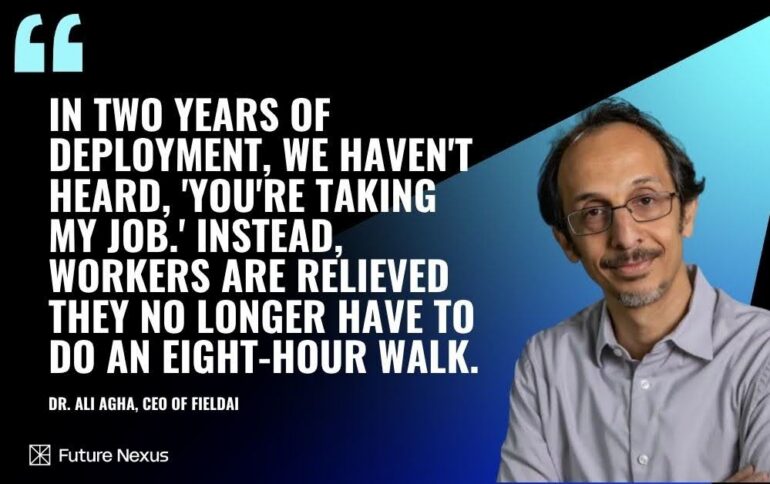
“In two years of deployment, we haven’t heard, ‘You’re taking my job.’ Instead, workers are relieved they no longer have to do an eight-hour walk on-site and can focus on more complex tasks,” he said.
In a world obsessed with what robots can replace, Agha is focused on something quieter: what they can protect.