AI Is Booming. Wing VC’s Zach DeWitt Is Preparing for the Shakeout
Wing VC’s Zach DeWitt has been investing in AI since before ChatGPT. Now he’s watching for the companies that can endure when today’s euphoria fades.
Artificial intelligence is seemingly omnipresent in 2026. But for Wing Venture Capital partner Zach DeWitt, it’s actually been a key focus for the better part of a decade.
Since joining the venture firm in 2017, DeWitt has backed startups including Dust, 1mind, AirOps and Standard Practice.
He credits Wing’s co-founders Peter Wagner and Gaurav Garg for being laser focused on AI and data, dating back to when the firm raised its first fund in 2013.
“They were already excited about applying AI in applications to business workflows and problems, so my whole lens when I got into Wing was AI,” said DeWitt. “I was very lucky.”
The firm aims to make high conviction investments and is often among the first checks deposited by a startup, generally receiving a board seat and a 15% to 20% stake in return for its commitment.
DeWitt developed a bull thesis on voice AI products after witnessing the rapid growth of Gong, which transcribes and analyzes sales calls and is one of Wing’s earliest investments.
That influenced a decision to lead Deepgram’s Series A round, announced in early 2020.
“They were doing a little bit less than $1 million of revenue and fast forward to today, they’re well north of $100 million of revenue,” said DeWitt, outpointing the roughly $1.3 billion ascribed to the company in its most recent funding round.
He believes that growth within enterprise voice will outpace expectations. “We think the voice market’s going to be eight to ten times bigger than Gartner estimates,” he said, noting that this should benefit Deepgram as well as other enterprise conversational AI companies like ElevenLabs and Sierra.
Away from voice, one of DeWitt’s prescient bets was a seed investment in Voyage AI, a specialist in embedding models, which was acquired by MongoDB within two years of Wing’s investment.
As funding rounds expand in size, Wing has leaned on its flexibility by participating rather than leading in certain circumstances.
“We always want to be involved with the best companies,” said DeWitt, who drove the firm’s Series A investment in Goodfire, an interpretability specialist, which was led by Menlo Ventures. (In an essay this month, Anthropic CEO Dario Amodei highlighted interpretability as a major priority.)
DeWitt describes himself as perennially entrepreneurial. He started two companies while at college before following a well-trodden path into the world of finance, working at both Goldman Sachs and TPG on the West Coast.
“I was in a circle where a lot of my friends were founding companies, joining startups or investing in startups, and so I really felt at home,” recalled DeWitt. “I felt extremely energized and excited being in the Bay Area.”
Business school beckoned, but before arriving at Harvard’s campus, DeWitt co-founded Drop, a startup that facilitated location-based digital content sharing. Users could leave a ‘drop’ for others to find in the wild — offices, restaurants, airports, sporting venues and more.
“As you moved around, your world came alive with contextual messages,” explained DeWitt.
During his early days at Harvard, Drop entered TechCrunch Boston and after a two minute pitch that stood out among almost two dozen startups, proceeded to receive term sheets from Spark and Accomplice.
“We ended up raising money, I dropped out of business school and moved right back to San Francisco, hired a team and worked on it for two years,” said DeWitt, who served as CEO of the company.
Drop built geofencing technology, developed battery preservation with location services, and was live in around 60 countries, he said, before being acquired by Snapchat for its technology, which aided in the development of Snap Map.
Though ultimately happy with the sale, DeWitt harbors some regrets around certain product decisions and what could have been, particularly because Snapchat later acquired Drop’s rival Zenly for more than $200 million. “We were a mere fraction of that,” he mused. “It was painful to see our competitor have such a better outcome.”
Still, he’s pragmatic, recognizing that living the founder experience from start to finish was invaluable. “I think of regrets more as learnings for my career — every failure, every success is a learning.”
While completing his MBA, DeWitt was both working on startup ideas and exploring venture opportunities when one of his classmates, Alex Sambvani, received an inbound from Wing. Sambvani, who was on the precipice of founding a startup known as Slang.ai, suggested Wing meet with DeWitt instead, and — in a full circle moment — Wing later led Slang.ai’s seed round.
Early stage venture can be brutally competitive, but Wing VC’s efforts to build relationships within the AI community have borne fruit.
The firm hosts events dubbed ‘Wing AI,’ at which up to 400 attendees gather for panels headlined by business builders such as Glean CEO Arvind Jain, you.com CEO Richard Socher, LangChain CEO Harrison Chase, and later share ideas over pizza and beer.
And three years ago, following the launch of ChatGPT, the firm began hosting ten-person dinners in San Francisco with a goal of fostering dialogue between AI product specialists, many of whom were founders of emerging startups or potential future founders.
Since then, DeWitt has made two investments as a result of those dinners and has a term sheet out to a third founder.
He’s careful not to provide prescriptive advice as a VC, and instead aims to ask questions and brainstorm scenarios.
“I think the founder really knows deep down what he or she should be doing, but you want to push them by asking probing questions, especially when times are good, because they can always be better, and it’s a time when you can accelerate and take share,” said DeWitt, who honed his approach by observing the actions of VCs he admires in boardrooms and elsewhere. “Asking the right question at the right time sounds easy, but it’s a real skill and it commands the entire room when someone does it well.”
As for what he’s excited by? The inference market, next generation hardware as well as both agentic and application software.
“There’s a lot more opportunity for great software that’s personalized, adaptive and proactive, so I think we’re going to see a lot of great applications built that have enduring value and a lot of scale,” DeWitt said.
To be sure, he’s cautious about the idea that rising tides can lift all boats.
“Right now, it feels like everything’s working and I don’t think that’s going to persist forever,” he said, comparing the current environment to the world for SaaS startups five years ago, when up rounds were routine.
“AI will keep going in a massive way, but I don’t think every single company will so even in this environment of frenetic pace and euphoria, it’s really important to hold a high bar, be really discerning and think about how some of these companies can endure,” said DeWitt.
He says that great startups can create a moat by both moving fast and hiring and retaining talent.
“The competition for people right now is the most fierce I’ve ever seen it,” he said. “Founders are quitting their own startups to take $20 million offers from the frontier labs and leaving their companies out to dry.”
DeWitt and his colleagues at Wing are keenly aware of the risk of mediocre exits, which they’ve dubbed a “2X fail.”
“Even if the company doesn’t work or reach its potential, you still may make 2X your money, because the team’s really good, the product’s pretty good and an acquirer is interested enough to buy it,” he explained, referencing other potential wrinkles such as founders pursuing licensing deals rather than an outright sale.
“It’s a lot harder for value come back to venture firms for some of these lower-end outcomes and that’ll have a big impact on returns and the whole ecosystem,” he pondered. “However, the winners are getting so much bigger that that may make up for everything.”
And while he loves that VC rewards his competitive spirit, curiosity and insatiable appetite to learn, DeWitt admits his entrepreneurial drive is far from extinguished.
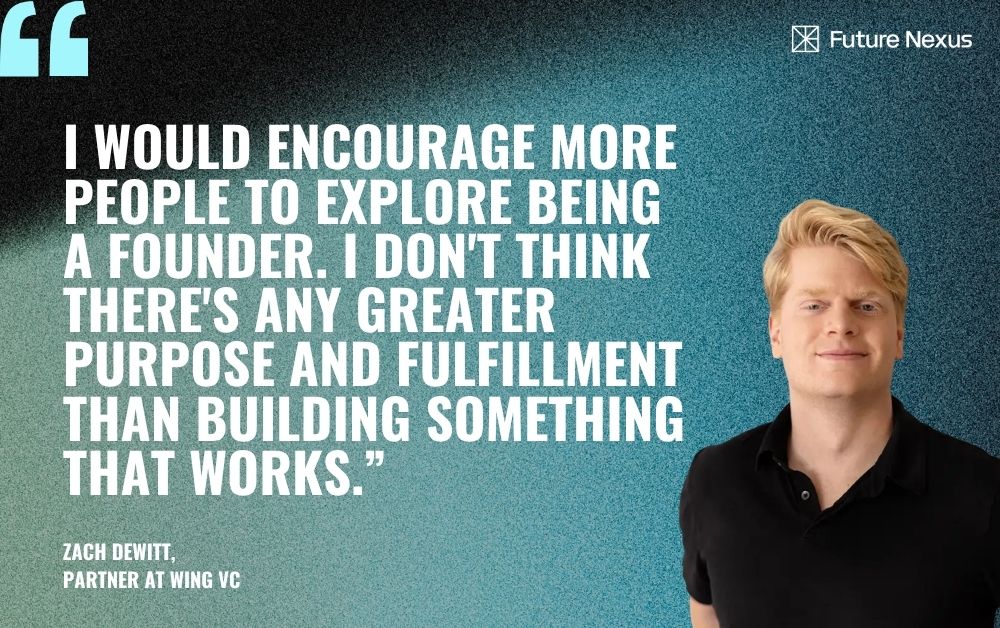
“I would never rule out becoming a founder again, and I would encourage more people to explore being a founder,” he said. “I don’t think there’s any greater purpose and fulfillment than building something that works.”