Allium CEO Ethan Chan on making blockchain data usable
Only a fraction of blockchain activity is economically meaningful.
Allium co-founder and CEO Ethan Chan envisions his company becoming the Bloomberg of cryptocurrency. And with a deep background in artificial intelligence and machine learning, he’s well on his way to making that vision a reality.
Chan studied AI and Computer Science at Stanford before serving as director of engineering at Primer AI, a provider of real-time machine learning and data infrastructure systems for enterprise and government clients. In 2021, Chan and Cheng Han Lee co-founded Allium. The company has since raised a $16.5 million Series A led by Theory Ventures in 2024, followed by a $40 million Series B led by Amplify Partners in 2026, and today cleans data across more than 150 blockchains with a team of roughly 50.
Valuable lessons learned over the previous decade were ingrained in Allium’s DNA. Chan said one was that, in order to ensure the best outcomes, providers need two things – the best data and the best computing power.
A trillion-dollar asset class, flying blind
Come DeFi Summer (the 2020 stretch when decentralized-finance activity exploded), the cryptocurrency industry had access to significant data sets, but struggled to make great use of them.
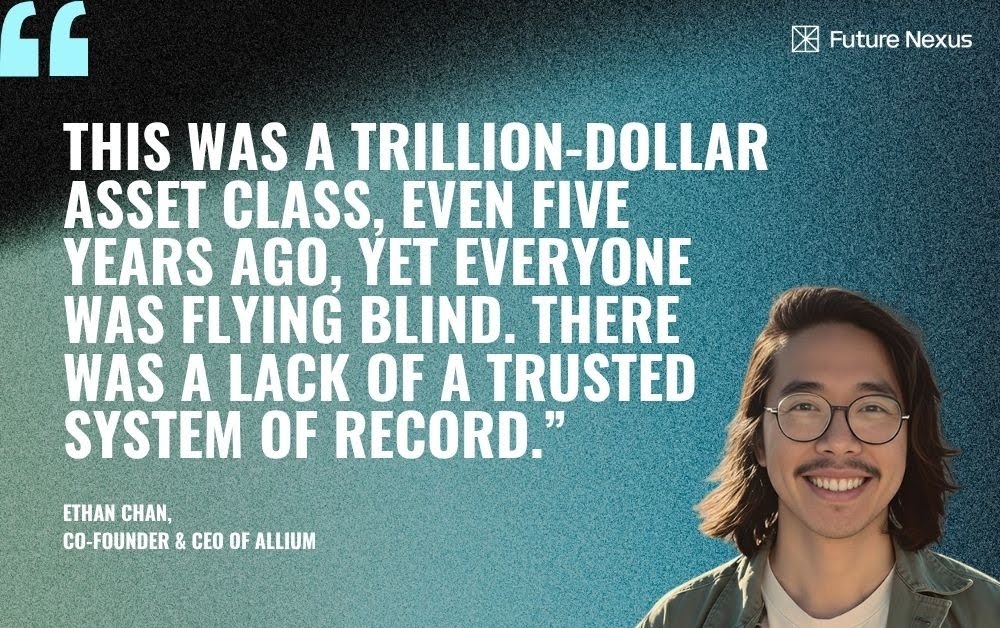
“This was a trillion-dollar asset class, even five years ago, yet everyone was flying blind,” Chan said. “It was clear to me that there was a lack of a trusted system of record.”
But isn’t the blockchain, in essence, a system of record? Yes, but Chan said it falls far short of what functional financial systems require. Blockchains don’t distinguish between meaningful economic activity and the same dollar working its way through innumerable bank transfer stops (by his estimate, only roughly 20% of activity has real relevance). The 150 or so blockchains aren’t standardized or normalized; there’s no body tracking legitimate stablecoins and blockchains.
“As a finance person, I want to know how much value shifted from A to B,” Chan said. “That’s the foundation of Allium. We wanted to be that trusted and transparent foundation for the entire industry.”
Master the boring before the sexy
And for that industry to truly flourish, it has to master the boring before chasing the sexy. Chan looks back a decade at what the few lasting AI companies, like Databricks, did right by first building the hard and messy, but necessary, infrastructure. Allium is doing the same in blockchain, establishing scalable and efficient data-cleaning infrastructure that allows stakeholders to quickly engage with and build upon the data, without having to figure out missing pieces themselves – much like what Plaid has also done for banking.
“I think really good businesses are formed when you do all the hard work, especially the long-tail hard work, and you present that as a unified solution to a customer and you abstract away everything,” Chan said.
Generating finance industry-level clean data is hard work. It begins with identifying and separating meaningful economic activity on every one of the 150+ non-standardized blockchains. Ignoring, for example, many unproductive USDC-linked tokens. Manually verifying across every token. Filtering out the five or six stops that a dollar takes between payer and payee, rotating wallets used for security reasons, and bot trading.
Strip all of that away, and less than 10% of blockchain activity remains. That thin slice of value actually moving between parties is what Allium is designed to surface.
Closing the trust gap to be an institutional go-to
Chan places Allium clients into three broad buckets: finance teams that need data reconciliation, growth and investment teams that require analytics intelligence, and engineering teams building decentralized apps (DApps). Its customers already include Visa, which built its Onchain Analytics dashboard on Allium, along with Stripe and the U.S. Federal Reserve, both of which have cited its data.
Within the next decade, Chan estimates 5% of finance will be conducted on blockchain rails. That will disrupt every step and every stakeholder. Just as market participants look to their trusted Bloomberg terminal, Chan is confident institutions will go to Allium for blockchain data.
But the industry has to generate more trust and transparency. While blockchains are public records, extracting everything you need from them takes time, skill and resources.
Allium reduces the trust gap on several fronts. It reconciles semantic differences between chains (e.g., a “transaction” or a “transfer” can mean different things on Ethereum than on Solana). It fills the standardization and infrastructure gaps that otherwise force every team to rebuild the same systems from scratch, such as the constant work of reconciling “reorgs” (when a blockchain rewrites its own recent history and any data already pulled from it has to be rolled back and corrected).
And it also provides a trust and accountability center. With distributed ledgers, accountability is a critical issue. Say an institution moves millions of dollars in a series of transactions across 100 different blockchains. Someone has to collate that activity into a coherent record, and should a process flaw be identified, someone has to answer for it. That someone is an infrastructure layer like Allium.
“Some infrastructure provider has to own that process for this industry in order to take it to the next level,” Chan said.
While many questions remain, Chan is confident that properly-built processes will answer them.
“At Allium, we want to underpin that which reinforces this system of record.”
__
Correction: A previous version of this article stated that Chan envisions his company becoming the Bloomberg of cryptocurrency. The article has been updated to more accurately characterize Allium’s positioning and ambitions.