American Express’s Hannah Bozian on What 176 Years of Payments Teach Us About AI Agents
As AI agents start making purchases on customers’ behalf, American Express is betting that trusted, secure transactions will start with proving user intent.
While artificial intelligence has hit financial services like a freight train, American Express VP of Agentic Partnerships and Strategy Hannah Bozian said that by working with key industry stakeholders and learning from past technology waves, financial services firms can be well-prepared for what comes next.
Bozian was a featured speaker at TechCrunch’s Disrupt, where she shared the stage with Pedro Sanzovo, Plaid’s Head of Fraud and Identity, and QED Investors Partner Victoria Zuo on a panel titled, Artificial Intelligence, Fintech + Payments – AI, Trust & Verification in Financial Services.
Learnings from a century of building trust
Eighteen months ago, Bozian’s AI preparations were already well underway; she knew it would shape her efforts in the oncoming years.
“I dug into agentic AI and knew that meant AI that can do something for you,” she said. “I pretty quickly thought that meant AI that can buy something for you. We’re going to have strong opinions about what that means to a customer, and how we make sure that is safe, secure and a trusted experience customers feel comfortable in leveraging.”
Agentic commerce is the next step in the progression from in-store retail to e-commerce. In each stage prior, Bozian gleaned valuable lessons that continue to inform her approach in this next paradigm shift: Recognize new capabilities. Anticipate partnerships with companies responding to them. And do it all while maintaining the trust, security and service built up over American Express’ 176-year history.
That means never losing sight of the customer experience, remaining mindful of the payment experiences of your card networks, issuers, and emerging platforms.
“How do we work together as an ecosystem to bring through our brand promise?” Bozian asked, reflecting on the importance of staying true to a long-trusted brand even while adapting to new partners and industry changes.
Transaction intent as a safeguard
And indeed, the industry is quickly moving, especially to standardize agentic safeguards. On October 13, 2026, American Express published its Intent Intelligence framework, its recommended approach to capturing and authenticating a customer’s intent before its AI agent completes a transaction, then preserving that intent as a control throughout the transaction lifecycle.
“By making its framework publicly available, American Express aims to help advance a common industry approach for intent in agentic commerce,” the company said in a statement. “At the core of Intent Intelligence is an approach that differs from current implementations by making a customer’s authorized purchase intent available to the issuer earlier in the transaction lifecycle — before an agent executes a purchase. “
Bozian said payment providers must be proactive in protecting the sector from agentic fraud; that’s why standardization is so important. However, any approach must be flexible to adapt to shifts in technology and regulations.
Same fraud, new vectors
It appeared that the panelists agreed fostering trust is necessary for agentic commerce to fulfill its potential. This means ensuring the agent is what it claims to be, that it’s tied to the right user, and it’s authorized to act. It must also reflect a range of user autonomy preferences: some customers may want to sign off on every purchase, while others may be willing to hand an agent standing authority to reorder groceries.
“I think the cross-ecosystem collaboration is important,” Bozian reinforced, reflecting that many people have concerns about fraudsters leveraging AI to attack at different points in the payments process. Bozian acknowledged that safeguards must account for the fact that agents may have access to passwords, card numbers and other personal information.
But the underlying problem, Bozian noted, is again an old one.
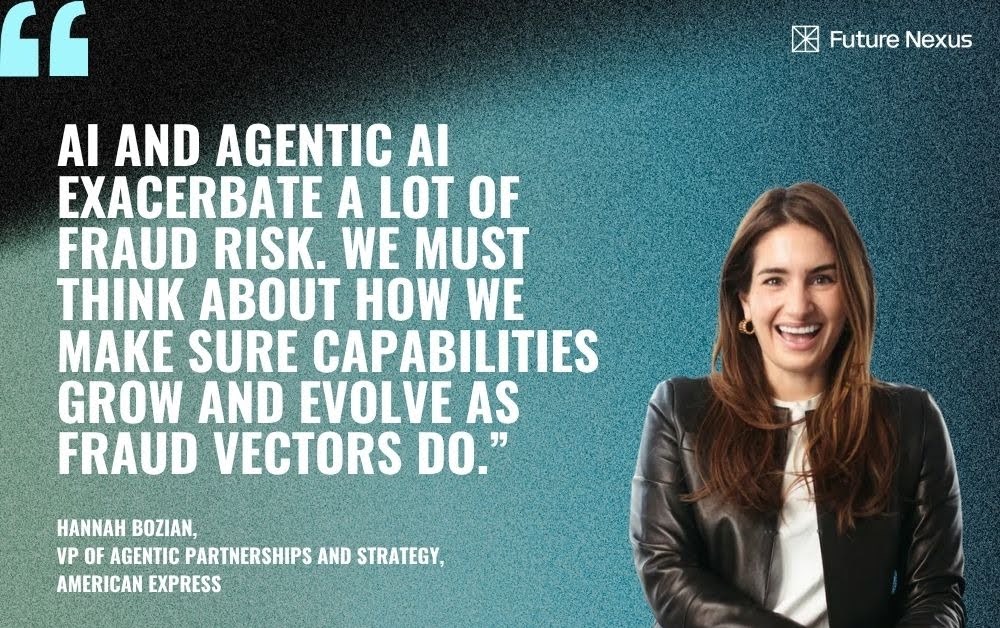
“Account takeover isn’t new,” Bozian said. “As we think about fraud across the ecosystem, I’d say AI and agentic AI exacerbate a lot of fraud risk. It produces new potential for the agent going off. We must think about how we make sure the capabilities we have in place continue to grow and evolve as those fraud vectors we know today grow and evolve, and as new fraud vectors are introduced.”
Consumer or corporate, the customer comes first
American Express is in an interesting spot, as it serves both consumer and corporate customers, and agentic commerce looks different on each side. A consumer’s agent typically sits at the endpoint, while commercial agents can thread into many business processes, widening the surface area where something can go wrong.
Yet Bozian advised that the principles remain the same: authentication, authorization, controls, and most of all, the customer’s needs coming first.
“Getting the core things right is true across the board,” Bozian concluded. “Honing the customer and merchant experiences is going to be key as we take off with this.”