ElectronX CEO Sam Tegel on Building a New Market from Scratch
Sam Tegel, CEO of ElectronX, has a myriad of reasons to be upbeat.
Atop the list? On Monday, the startup received a green light from the U.S. Commodity Futures Trading Commission that was nearly 27 months in the making.
Through direct access, users of ElectronX’s power derivatives exchange can manage intraday power price volatility or, put simply, can enter hourly contracts to hedge against wild swings in electricity prices. The regulator’s blessing unlocks intermediated trading through Futures Commission Merchants, which will launch this fall.
“We’re really proud,” Tegel said in an interview with Future Nexus, acknowledging that the development should result in better price discovery, broker access and improved flow, thereby enhancing ElectronX’s appeal to hedge funds and institutions. “We think it’ll be a big, big growth factor for us.”
Operating an API-first and open access platform, the exchange has processed in excess of 100,000 trades since its formal launch in February. That volume represents 100 GWh of electricity across the four biggest U.S. grid systems: PJM Interconnection, ERCOT, MISO and CAISO.
Notably, over a third of that total — or more than 37,000 contracts representing 37 GWh of electricity — occurred in July alone, underscoring the company’s momentum, which should gather steam following the introduction of futures and binary options contracts across remaining U.S. ISOs.
Tegel believes ElectronX’s volumes will accelerate exponentially in coming years amid continued industry evolution. “We expect to be doing millions of contracts a day at scale — that’s where we want to get to, and we think that the market is there for that.”
To build ElectronX, he’s leaning on a background in quantitative trading and market making at firms including Sun Trading, Jump Trading and Millennium Management.
“I was a real market structure nerd, a market structure expert, and a large market maker in equities, then FX, then bonds,” Tegel explained. “I was looking for a market that really needed to be modernized, and power is going through massive supply and demand shifts.”
For context, incumbent derivatives markets — including Deutsche Börse’s Nodal Exchange and Intercontinental Exchange — process a combined 25 million to 30 million MWh per day of power derivatives trading.
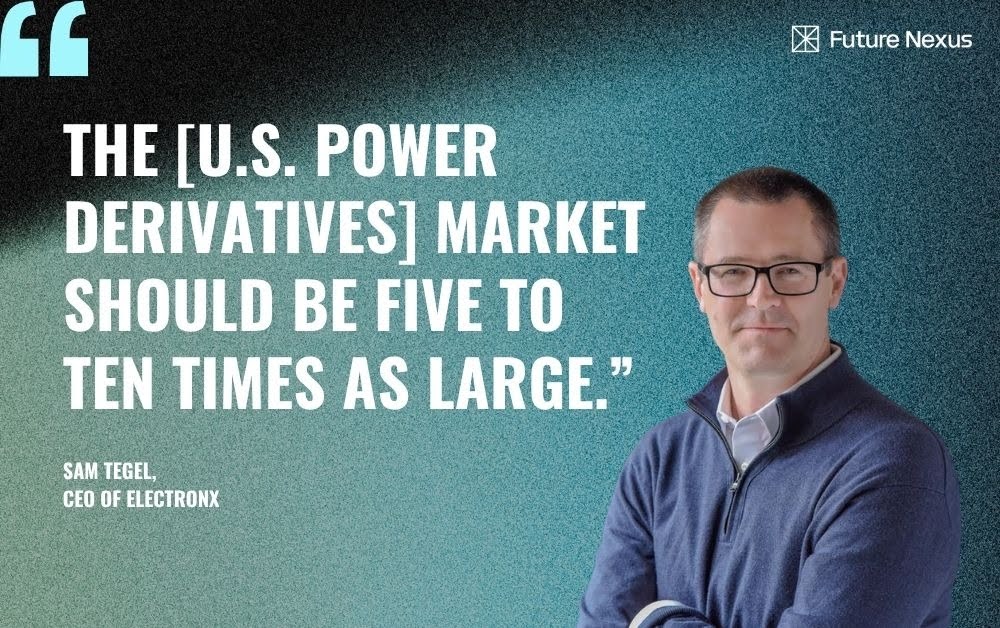
“In the U.S…our view is that [derivatives] markets need to be a lot larger to enable this grid transition on the renewable side, as well as the AI explosion on the demand side,” Tegel said. “The market should be five to ten times as large.”
He aspires for ElectronX to be a base layer financial enabler for the innovation that’s driving power demand and supply. Price volatility has been introduced to the latter by the increased penetration of renewables such as solar and wind, both variable by nature.
“We’re looking to be a change agent,” he said, acknowledging that surging data center energy demands as a result of the AI revolution are an undisputed boon for the startup.
Just this week, OpenAI disclosed a job posting for a power trading lead, a move that highlighted its intent to create a commodity hedging strategy across electricity, natural gas and other energy exposures encountered by its data center operations.
It’s not clear if other tech giants will follow suit, but Tegel expects the industry’s dominant forces will eventually access ElectronX directly or through a third party as they pursue risk management alternatives.
“As these folks build their stack of power and they realize they’re long and short power intraday, they’re going to be monetizing and optimizing that power exposure — we think it’s a huge tailwind for us,” said Tegel. “We’re in the very early innings of that, but I expect it to grow significantly in the years ahead.”
Wall Street traders of yore who relied on paper order slips couldn’t have predicted that investors in 2026 would be able to trade fractional shares themselves with the click of a button, and Tegel believes that equally seismic progress in power markets is essential.
“A modern market would enable lots of new trades that never could exist before, if you go down to much more precision trading, much more algorithmic trading, that emulates other commodities markets,” he said.
“We see ourselves as a key piece of infrastructure to help make that happen, and we’re excited to play our part.”
ElectronX has raised over $55 million from investors including Innovation Endeavors, DCVC, Systemiq Capital, Shell Ventures, Equinor Ventures, XTX Markets, NGP, Five Rings and GTS.
That capital is being deployed in a key area. “Talent is the biggest bet,” said Tegel, who leads a team of about 35 market experts from the startup’s headquarters along Chicago’s iconic North LaSalle Street, as well as a cohort based in New York.
These passionate individuals — who have either high frequency quantitative trading or power-centric backgrounds — are in turn betting on ElectronX’s success, and first to cheer the company’s milestones.
“There are very active Slack channels with lots of celebrations, lots of emojis that are going off at all hours, all the time,” Tegel said with a smile. “We have a very active, enthusiastic group of people going after this.”
Though ElectronX’s cold start was challenging, Tegel and his team have embraced daily learnings that come with establishing a new market and ensuring that it’s comprised of an appropriate mix of hedgers and speculators.
“It’s been really rewarding to be able to build something of real value for a lot of people,” he said, albeit conscious that the mission is still far from accomplished.
As the startup plots out future growth, Tegel has his sights set on derivatives that are both shorter and longer than an hour in duration, in part to match the more mature market that exists in Europe.
“We’re focused on the hourly, but our product map will expand significantly, probably in both directions over time,” he said. “We have a lot of different product innovations coming down the pipe.”
ElectronX also has ambitions to stretch its reach beyond U.S. power markets.
“We have interest to expand in Europe over time, as well as other geographies,” said Tegel, explaining that certain power trading markets on the other side of the Atlantic Ocean are ahead of their U.S. counterparts.
“They have a pretty rich, short-term hour trading market there, and there’s a lot of innovators out of Denmark — a number of them are customers of ours already.”
For now, the startup has close to 70 institutions currently onboarded including multinationals such as Engie, physical asset owners like Base Power, Habitat Energy and Xcel Energy, commodity trading houses including Gunvor Group, and nimble quant firms. Almost all are eager to provide feedback on topics including ElectronX’s user interface and potential product suite.
“Naturally, building something new is hard and challenging, but there’s appetite and a lot of people rooting for us,” said Tegel, who expects the institutional tally to eclipse 100 by year end.
And while ElectronX has amassed meaningful liquidity — which Tegel defines as over 100 MWh of power in each of the markets it operates in — he’s dedicated to continuing to raise the bar.
“We’re in good shape now, and we’ll continue to build our regulatory assets.”