Escaping the demo: The founders building the foundation for medtech physical AI
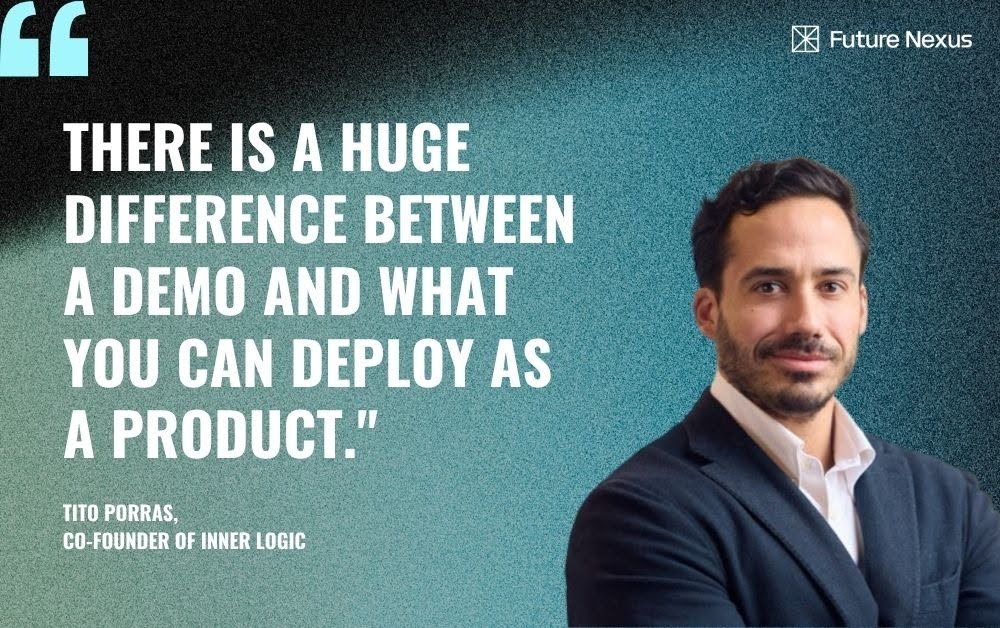
How Inner Logic co-founders Tito Porras, Mathias Unberath, and Axel Krieger are tackling physical AI’s hierarchy of needs in the medical field.
As the AI story evolved over the last four years, Silicon Valley ‘gurus’ have said one thing in many different ways: this is the biggest technological shift of our time that will change how we work and live.
For many, that’s just marketing hype, but industry watchers see the change happening – from systems building software to those running your computer to do tasks that took you days (even weeks!) in minutes. Sam Altman, CEO of OpenAI, envisions “a world where 30% to 40% of the tasks that happen in the economy today get done by AI in the not very distant future.”
But as these technologies become mainstream, many wonder about the implications of AI in the physical world? Self-driving cars are here, yes, but they still mess up in unexpected ways. So do robots, whether in homes or factories. Such instances show that the technology indeed has arrived but is just not ready for prime time yet.
To bridge this exact gap in a sector that is behind even self-driving systems, Inner Logic just emerged from stealth, raising $11.5M in a seed round co-led by Bison Ventures and General Catalyst, with participation from J2VP, Defined, PTX, Valia Ventures, Page One, Alumni Ventures, and Flare.
Building the infrastructure for surgical autonomy
Founded by Johns Hopkins-trained Tito Porras, computer vision researcher Mathias Unberath, and surgical robotics veteran Axel Krieger, Inner Logic – formerly known as Semaphor Surgical – provides medical device manufacturers with a computational environment where they can design, test, and validate their products across thousands of simulated patients.
Their approach is to provide the picks and shovels for a medtech industry that is racing toward reliable AI devices and robotic systems.
“Our team has shown from a scientific perspective that autonomous control of procedural devices is here; it is technically feasible, but the challenge is that you’re missing the fundamental infrastructure altogether [to test them for actual use],” Porras told Future Nexus. “Right now we’re still stuck in the realm of demos.”
The development and demo cycles, which currently rely on cadaver labs and animal studies, are crucial to show that an AI device can work reliably. But there’s never just one operating case; you have to test it across multiple procedural patient scenarios, going one expensive experiment at a time.
And, if something goes wrong during testing, you go back to the drawing board, rework the hardware or software design, and come back again – which takes up a lot of time and financial resources.
This makes it extremely difficult for next-gen devices to be ready for the market.
With Inner Logic, Porras and team are abstracting away this long chain of physical testing. Their simulated environments provide teams with the synthetic or real-world data needed to test how these products – AI-embedded or not – would behave across different patient scenarios.
“For example, if a company is interested in understanding the way hardware to fix bone fractures would behave across a patient population, they would effectively bring to us the design assets for screws, rods, and other structural architecture… Then, from our pre-existing library of thousands of real-world CAT scans, full scans of patient bodies, we’d generate a library of simulated fractures according to the clinical scenario described for testing,” Porras explained.
Crawling before walking
As a neurosurgery resident at Johns Hopkins, Porras wanted to make surgical training more objective. He worked with Unberath (now CTO) on computer vision techniques to quantify surgeon performance. This research soon expanded into efficiency questions around the operating room, from procedure times and tool usage to the economics of surgery.
Finally, a grant proposal with Krieger to build an autonomous pipeline for removing kidneys from pigs brought the trio together and made them realize “the actual opportunity to pursue as a company was bringing surgical autonomy into reality.”
But, as Porras and team (as Semaphor) worked on this intelligence layer for surgical robots, spanning perception, planning, and decision-making capabilities, they realized the market was not actually ready for it.
“If you go to a device manufacturer today to provide them with a model that will control a surgical robot or any degree of autonomous tasks in terms of complexity, they can’t – despite their enthusiasm and desire to do that – they simply lack the infrastructure. We found that they are all stuck at the data step. They either have access to real surgical data but can’t make use of it at scale, or they’re a small company and are actually not generating data,” he noted.
So, the trio decided to solve basic hierarchies of needs first and meet the market where it was – by getting the data pipeline sorted and ensuring the design and testing layer is ready for med-tech companies that would ultimately go AI-first.
The ‘Build vs. Buy’ reality for legacy giants
By meeting the market where it is, the now-rebranded Inner Logic has started tapping into a massive, quiet desperation within traditional medical device manufacturing. Today, legacy giants dominate via metal, motors, and hardware, but most of them are increasingly realizing that building an AI testing infrastructure from scratch is a staggering capital sink.
While Porras was opaque about specific names, he noted that Inner Logic is actively in conversations with approximately half of the top 10 medtech OEMs by market cap, with several converted contracts already in place.
One customer, he said, “went through an internal conversation about build versus buy, and they realized that by the time they were done actually building the hardware aspect and getting that FDA approved, they had little to no residual money to pursue the entire end-to-end development of an AI program.”
For companies like these, licensing Inner Logic’s infrastructure with models is the only pragmatic way to stay competitive.
But there’s also another group that wants to build some models in-house as their IP but use Inner Logic’s infrastructure to understand the way their model will behave – standalone and in comparison to AI systems built by Inner Logic itself.
The company engages both these AI-focused customers by typically starting small with a single clinical use case, evaluated over three to six months against well-defined success criteria, with the manufacturer bringing CAD models, imaging requirements, and whatever data it already has.
The “Lane Assist” approach
Even with advanced simulation and massive troves of data, the idea of AI-driven surgical procedures is terrifying to the general public. But Porras is quick to dispel the myth that autonomous surgery means a robot conducting an entire procedure on day one.
“We don’t think that day one of surgical autonomy is [a] robot doing end-to-end procedures. This technology needs to be deployed and vetted in a staged fashion,” he said. “You will identify the equivalent of lane assist in autonomous driving that you will implement in surgery.”
Initially, he says AI-driven robots and devices would mean systems helping surgeons in their day-to-day jobs by taking away a lot of mundane, repetitive tasks.
For example, Moon Surgical’s Maestro AI robot autonomously tracks the movement of surgical instruments to adjust and steady the camera scope, eliminating the need for a human assistant to stand beside the surgeon for hours just to hold the camera. Another notable use case is a system that monitors the surgery, analyzing it, and drafting post-operative notes for surgeons.
The regulatory winds may also be shifting in the company’s favor.
ARPA-H, the US government’s health research funding agency, recently issued two calls for proposals around procedural autonomy — one to develop algorithms for autonomously steering endovascular robots, and another for the validation framework to prove how such algorithms behave. Both were won by Inner Logic’s technical co-founders: Krieger is developing the control algorithms, while Unberath is building the simulation validation framework.
For Porras, that convergence points at where regulation is headed. “We think a lot of the regulatory posture will be, ‘Okay, help us understand the way this device is going to behave across varying anatomy, different operator characteristics, device form factors,'” he said. “If you can prove that all out in this combination of both real-world and synthetic data, then you will have that big unlock for something measurable, traceable, and repeatable.”
From battlefields to pig farms
So when do we get the surgical equivalent of full, Level 6 self-driving – where a robot is independently making cuts and removing organs? Inner Logic’s Krieger has completed the critical steps of gallbladder removal in a pig model with 100% accuracy, without surgeon intervention.
Porras wouldn’t give a date for routine elective procedures in hospital settings. Instead, he says, the technology’s adoption will first happen where the ethical calculus demands it: military battlefields where human surgeons aren’t always available, or in the rapidly emerging field of xenotransplantation – transplanting genetically modified animal organs into humans.
The second is stranger and more consequential.
“If you could deploy Level 6 autonomy for procurement of the organ from the animal, and then have that organ shipped to the surgeon, you could effectively overnight convert something like organ transplantation into an elective procedure,” he said. No more flying surgical teams to donors – just a scaling pipeline of viable organs, harvested in a lab and shipped wherever needed.
It’s a long road from simulated bone fractures to autonomous organ procurement. The barrier remains verifiable safety, as in biology, no two bodies, tissues, or fractures are exactly alike, and there is no such thing as two cases matching. But that’s precisely why Inner Logic started with picks and shovels and is now aiming to get its tools into as many hands across the industry as quickly as possible.
For Porras, the guiding philosophy and his lesson for anyone building physical AI comes down to the two axioms the company runs on. The first: surgical autonomy is inevitable. “It is a matter of when and who, not how,” he said.
The second is trust, which, in his words, “is something that really flows downhill.”
“Along this chain of development and adoption of autonomy is a series of individual steps along which trust must not be broken,” he said. “The work that happens way upstream must be of high fidelity, of excellent quality, so that everybody who inherits your work product, starting from an intern all the way to the patient, can trust what came before. There is a huge difference between a demo and what you can deploy as a product.”