Hardware as a durable moat & the former surgeon’s bet on “soft robotic cells”
Robotics has long been the stuff of science fiction. From The Terminator to the adorable Wall-E, we have seen machines roam on the big screen for years, wondering when they will actually walk into our lives in a truly meaningful (and safe) way.
AI is finally making that happen.
From Tesla to Figure to Boston Dynamics, companies are pouring billions of dollars to build robots that can do chores across different environments. The only problem? Many are still building around rigid, metal bodies trying to emulate humans, and how we do things, with an AI system stacked on top. The AI learns the physics of the world and tries to instill those learnings into the metal body.
That approach is better suited for robots performing a particular task than products designed to support a person. In the latter scenario, the rigid mechanics of present-day robots can feel fundamentally disconnected from the fluid, dynamic reality of the human body, making the whole experience broken. Imagine the heavy exoskeletons people use for leg support.
To fix this gap, Dr. Jean Nehme, the CEO of morph, is taking a wildly different approach: embedding machines with shapeshifting materials that adapt on their own.
The London-based startup, backed by 8VC, Valia Ventures, Qubit Health Capital, Equinox Group Chairman Harvey Spevak, and musician Pharrell Williams, is building what Nehme describes as “soft robotic cells.”
These modular, synthetic units embed sensing, intelligence, and adaptive control directly into flexible materials, bringing AI and hardware into a single layer and ensuring machines adjust according to the person or environment they’re interacting with.
“We have designed and built a very rigid and static world, but since the beginning, nature has shown us softness and dynamism,” Nehme told Future Nexus.
The surgeon’s view of physical AI
Nehme’s vision for physical AI is deeply rooted in his medical background. Before founding morph, he was a reconstructive surgeon, a health-tech investor, and the CEO of Digital Surgery, a surgical AI company Medtronic acquired in 2020. His experience allowed him to understand not only the softness of biology but also that small biomechanical inefficiencies quietly compound over the years, degrading human mobility and impacting long-term health.
Combining those learnings with the adaptability of octopuses, he designed morph’s platform to let users program robotic cell behaviors, simulate real-world conditions, and rapidly iterate to synthesize soft, deformable components that process environmental and user information to physically change their morphology in real time.
The real-time control loop runs locally on the device, with the system adapting to human movement without frequently sending data to the cloud.
“Physical AI is not just a software problem—it is a hardware problem as well, and the two must work in tandem,” Nehme explained. “Soft robotic cells can be placed into multiple products to better respond to human movement and interaction, representing a shift from static, hard consumer and enterprise product solutions to adaptive, responsive systems.”
Meeting an industry that is already moving
While a good early application of morph’s platform and soft robotic cells could be an intelligent knee brace or an adaptive shoe that adjusts according to the wearer’s needs, Nehme didn’t specify what products his team is building.
However, the company does say that its initial applications will focus on athletic performance, injury prevention, and mobility support, before scaling to broader healthcare, automotive, and industrial safety markets.
So why pull the curtain back without a public product? Nehme points to two converging signals.
“On the technology side, the system was performing consistently and repeatably across different form factors, not just in controlled conditions. That reproducibility was the internal signal we needed,” he said. Meanwhile, market conversations across performance, wellness, healthcare, and industrials all pointed to a massive gap and a real demand for soft robotics technology.
That said, rather than building direct-to-consumer products, like many home robotics companies, morph’s strategy is to operate strictly in the B2B domain as a software, design, and fabrication partner, helping other companies embed soft robotics into their own product lines.
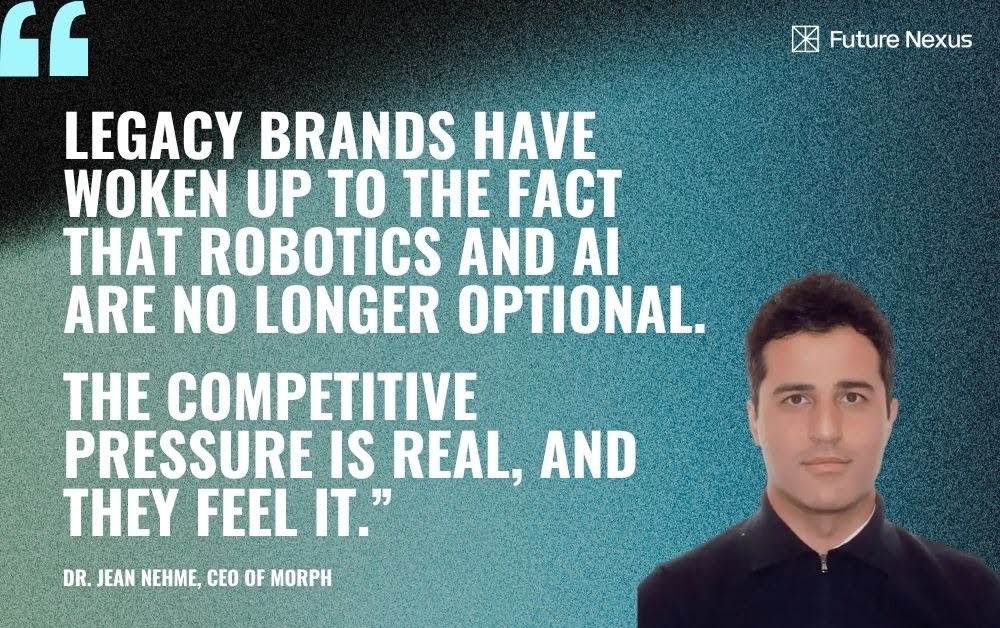
“Legacy brands across almost every sector we work in have woken up to the fact that robotics and AI are no longer optional. The competitive pressure is real, and they feel it,” Nehme explained. “We’re not walking into rooms trying to convince anyone that change is coming. They already know. What they’re looking for is a credible partner to help them get there.”
This urgency has allowed morph to engage major players much earlier and more substantively than a typical startup in the stealth R&D phase. “We’re not pushing against the current,” he added. “We’re meeting an industry that’s already moving.”
Hardware as a durable moat
Even with realistic demand, building deeply integrated intelligent hardware is not a piece of cake, especially in a VC ecosystem that traditionally favors high-margin software products.
But Nehme argues the market realities are shifting.
Referencing the case of “SaaSpocalypse,” he noted that wrapper software built on top of LLMs is fundamentally fragile. An API update from companies like OpenAI or Anthropic can wipe out a software startup’s advantage overnight. Furthermore, the rising costs of talent, compute, and infrastructure mean that frontier AI software can actually be more expensive to build and scale than hardware.
“Physical AI and deeply technical products represent a genuinely durable moat, one that can’t be commoditised by a model update,” he said.
To execute this, Nehme is leveraging his experience as an angel investor, explicitly engineering morph to avoid the biggest red flags he saw other deep tech founders make.
The most common failure mode, he noted, is founders falling in love with a technology before understanding the problem.
“They would build something impressive and then go looking for a use case to justify it. That is a dangerous order of operations in deep tech, where capital requirements are high, and feedback loops are slow,” he said.
The second is “single-layer thinking” or assuming that if the core technology works, everything else will naturally follow, which is not always the case.
“Distribution, manufacturing, regulatory, and adoption are not afterthoughts; they are the product,” Nehme said. “At morph, we started with the problems with an initial focus on the human body and worked backwards. The technology is in service of that, not the other way around.”
morph still has to turn its platform into products people will trust and use. The company says its system now works consistently across different form factors. However, the real test is whether these adaptive materials can move from an intriguing robotics concept into something people are willing to wear or rely on every day.
For Nehme, that consumer leap is part of the appeal.
“I think for mainstream consumers, communicating that artificial intelligence will be able to understand the physical world and engage in a way that is much more than just a chatbot… is going to be fun,” Nehme said. He expects AI combined with soft robotic cells will ultimately create products with “superpowers to service us.”