In 2026, Your Wages Should Not Be On a Two-Week Delay
Ask people in fintech to name the innovation that has done the most tangible good this decade and you get a familiar list. Real-time payments. Mobile wallets. Open banking. Stablecoins, if you have been to the right conferences. My answer is earned wage access.
Here is why. Most of what we celebrate in this industry takes something that already works, work faster or better. Earned wage access fixes something broken to begin with. Tens of millions of Americans do a day of work and then wait two weeks to be paid for it. We built a system that moves money around the world in seconds, and we still run payroll on a schedule designed around the limits of paper checks.
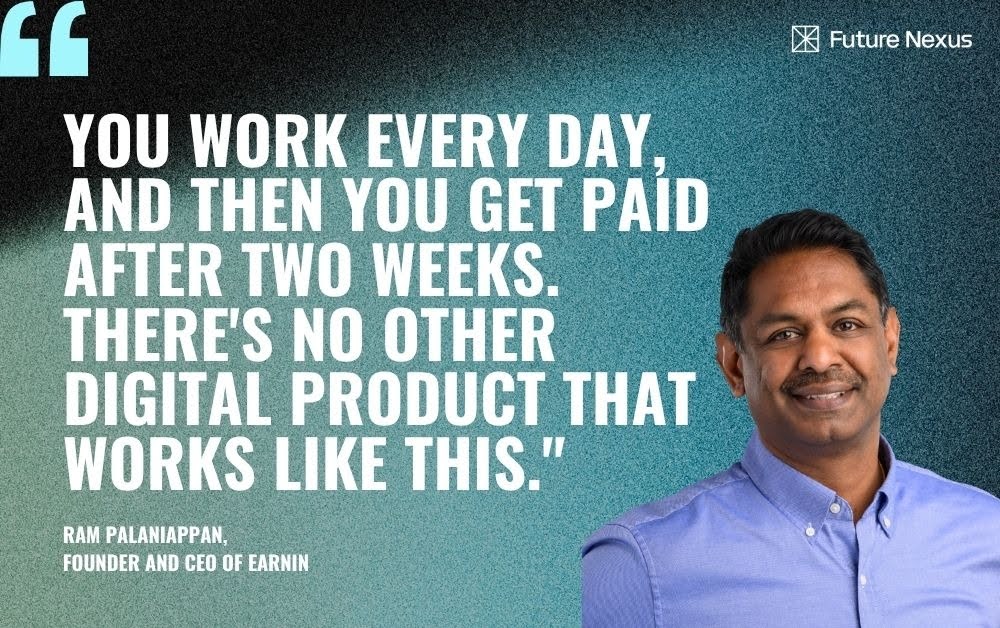
Ram Palaniappan, the founder and CEO of EarnIn, framed the absurdity better than I could. “It’s this really odd pattern for a digital product where you work every day, and then you get paid after two weeks,” he told me. “There’s no other digital product that works like this.”
Phil Goldfeder, CEO of the American Fintech Council, made the same point from the other direction. “Historically, with regard to payroll, we were simply limited by the technology of the day,” he said. “Running payroll was complicated and expensive, so many workers were paid only once a month.” House congressional staff still are. “This is no longer a technology constraint, it’s a choice,” he continued. “Millions of workers are safely accessing their wages with responsible providers and we support a regulatory structure that balances the innovation with consumer protection.”
This is my argument, and it is simpler than the one this industry usually has. In 2026, a worker should be able to reach money they have already earned whenever they want it. Not on a schedule set by a payroll department, not when it suits the employer’s cash management. That is the standard. Everything else is implementation detail.
Three products are wearing one name
Goldfeder represents roughly twenty companies offering the service and sorts them into three categories. “There are three distinct kinds of entities offering responsible consumer access to earned wages, and they each need to be recognized when it comes to regulatory structure.” Those three are subscription, direct to consumer, and business integrated.
With the business integrated model, the provider plugs into the employer’s payroll system, advances against hours actually worked, and is reimbursed by the employer. Direct to consumer skips the employer, estimates what you have earned, then debits your checking account on payday. Subscription companies are broader financial apps where wage access is one feature bundled into a monthly fee.
Safwan Shah, the founder and CEO of Payactiv, is the pioneer in the category as the inventor of the term Earned Wage Access, and the first to offer employer-integrated EWA. He argues there is a more important distinction than the three categories. “Is the amount being accessed based on wages actually earned and verified through employer or payroll data, or is it estimated based on expected income and repayment?” He argues that there is a different risk profile for the latter. He even has a different name for that product: estimated wage advance.
Then there is Clair, which you could argue sits outside all three categories. They are really HR or Payroll-integrated rather than business-integrated, and they decided early on to treat EWA as a lending product.
CEO Nico Simko chose to comply with existing lending law rather than argue his way around it, getting licensed state by state as the servicer of a national bank. “There is a simpler, better, smarter way to do this, which is let’s do the hard work to comply,” he said. That cost more than twenty-five million dollars.
The definitional fight is the wrong fight
The industry pours its energy into whether this is a loan. I have a view, but it is a proxy argument.
Calling it a loan gets the direction of credit backwards. When you work a full pay period and collect nothing until the end of it, you are the one extending credit (interest-free). The float sits with the employer. Shah has made this case since before the category had a name. “I always thought that people would understand that the loan is going from the employee to the employer, not the other way around,” he said, noting the idea still lands as heresy. “Even today, people say that is like challenging something sacred.”
He has since built a useful framework for it. “A typical lending transaction is a two-party transaction. The provider gives the consumer money and must recoup it from the same consumer,” he explained. “In a three-party transaction, like with employer-integrated EWA, earned wages are verified via the employer, and money is recouped through the employer relationship.” Goldfeder’s views remain grounded by engaging directly with users, including his own father, who stated that EWA is “just accessing my own money.”
While 10 states created specific regulatory structures for EWA, a couple of states have already settled this by calling it a loan and then exempting it from most of what applies to loans. As Goldfeder described California and Maryland, “it is categorized as a loan, but you’re exempted from a number of statutes that apply to a loan.” If the label gets a workable framework built faster, the label is not worth dying over.
Even David Silberman, a Georgetown law professor and former CFPB official who does think it is a loan if the money comes from a third party, accepts the underlying entitlement. “Why shouldn’t I get paid when I earned it, rather than when it’s convenient for the employer to pay me?” he said. The access principle survives the fight over labels intact.
What the money actually buys
Every operator named the same two use cases without prompting. Gas and groceries. “Lots of our customers are filling gas ten dollars at a time,” Palaniappan said. “They can’t afford to lock up fifty dollars in their gas tank.” Before EarnIn, he said, those workers were not overdrafting to buy gas. They were missing work because they couldn’t afford to drive there.
Simko described the same calculation. “If you’re at the gas station, it’s five o’clock, either you’re going to pay a few dollars of instant delivery fee, but at least you’re not going to potentially pay a fifty-dollar late fee on your rent.”
Palaniappan laid out the design flaw underneath in two sentences. “The most common pay cycle in the US is you get paid every other week. Every bill is monthly. So for every bill, six times a year, the bill is due before payday.” We engineered a shortfall into the calendar and then act surprised when people need a bridge across it.
Shah, who has spent his career studying the twenty dollar an hour worker, was bluntest about who sets the rules. “I can only humbly request people who’ve never had an urgent financial need in their life: do not for a moment believe that the rules that you made in society, on how life should be governed, apply to everyone the same.” He also taught me a word, aporophobia, the fear of the poor. Almost nobody uses it.
Simko put it more bluntly. “From a financial services perspective, it’s expensive to be poor.”
The best case against
This is not a puff piece, so here is the other side’s argument.
Silberman is aligned with no platform, and he has moved to become more concerned about this product, rather than embracing it. “I used to have much more favorable thoughts towards EWA until I read the New York data on DailyPay, and the notion that their average user is using it twice a week,” he said. That works out to roughly three hundred dollars a year in fees. “For low wage workers, that’s a not insignificant amount of money.”
His mechanism concern is worth taking seriously. “To the extent the subsequent usage is triggered by the fact that you’re now getting less in your paycheck, there’s no net benefit. It’s just you’re treading water, running to catch up, and you’re paying three hundred bucks for it.”
He has no patience for the pricing model either, comparing the expedited fee to a drive-through where immediacy costs extra. He wants one transparent fee everybody pays. “You say it’s free, but actually eighty-five percent of people pay a fee.”
That criticism has teeth. But pricing is fixable, while the two-week delay is a choice we keep re-making.
Where I land
Access should be the default. Fees are the legitimate debate. My argument is that the people using EWA are better off using that product than payday loans, where more than three hundred dollars in fees and interest is commonplace.
Shah, whose company was the only one to accept Connecticut’s fee caps, is comfortable with where that leads. “Some companies in earned wage access will die, because they rely on what we call the high frequency or power user.” He offered the right frame for regulators: “Seat belts did not limit car growth. It expanded car growth.” Meaning, the guardrails that are put in place can benefit the industry.
What he will not concede is the access question, and neither will I. “We should not be in the business of limiting the amount people can get of what they’ve already earned. It’s their right. They’ve earned it.” On how often someone taps it: “Frequency is a function of their need. I am not in the business of predicting and figuring out people’s needs.” Palaniappan called usage caps “a sort of very paternalistic, judgmental thing to say, that somebody knows how much money somebody else needs.”
Not everyone is on board with unfettered access. Clair caps advances at half of earned wages, because “we don’t want people to just rush into this,” Simko said. Guardrails set by people who can see the data are different from a legislature deciding a worker has hit the monthly allowance of their own wages.
What I have a hard time with is the patchwork. We have roughly a dozen state frameworks, a federal bill that cleared House committee with bipartisan support but still a very slim chance of getting to the President’s desk this Congress, and a product that changes when a worker crosses a state line. Silberman, from the other side of the argument, wants the same fix I do. “I’d rather see a uniform system of federal regulation tailored to these products, rather than having each state decide.”
The destination is not in question. “The logical endpoint for anything that’s digital and batch is continuous,” Palaniappan said. Silberman agrees, raising only the plumbing of withholding and deductions. That is just math, and math can be solved. Shah gets more specific, “Payroll can remain periodic but access to earned money should become continuous. It took me a long time to realize that EWA is not making payroll real-time, it is making access continuous.”
So build one federal standard that recognizes all three models, price it honestly, and let people reach their own money whenever they need it. We should think of this as infrastructure that brings payroll into the digital age. The two-week wait is not a law of nature. It is a leftover, and we should stop defending it.