Mercury’s Ryan Wiggins on Building Customer Trust: Lessons from a Decade at Facebook and WhatsApp
Mercury’s VP of Product spent a decade at Facebook and WhatsApp learning what makes people trust software. Now he’s applying these lessons to AI-powered banking.
At Facebook and WhatsApp, a broken feature costs you a user. In banking, it can cost someone their payroll. Ryan Wiggins spent a decade building consumer products at both companies, before joining as Vice President of Product at Mercury, the business-banking platform popular with startups and small companies. And the lesson he carried into this role is that none of this works without trust.
Building experiences that matter to people
Mercury recently launched Command, an AI-powered service that lets customers manage their finances through conversation. Customers tell Command what they want to do in natural language, and it gets done, but only after the customer approves it.
“The core product experience we’re building is that the AI takes care of the setup, then you, the human, are reviewing it and taking action,” Wiggins said.
Wiggins’ Facebook tenure began on the Monday following its 2012 IPO with a customer service role, supporting business chat, before he moved into growth and Workplace ads. The recurring question across those years was what makes people trust a product enough to use it, and how that influences distribution. He brings these same questions with him to Mercury.
What does it take to build reliability and trust? How should companies introduce and distribute products? Wiggins and the team at Mercury spend significant time answering these questions and revisit them often.
The clearest answer came from Wiggins’ time at WhatsApp. The team added an invitation button to the contact-search function, a small touch that became the main way users added new contacts.
“Those types of experiences matter to people,” Wiggins said.
That lesson is now visible in Command. Wiggins said Command closely resembles a consumer product in how people experience it. It feels like software they’re already familiar with and borrows from Facebook’s approach to design and distribution.
“It comes back to wanting customers to use it, being happy, and distributing it,” Wiggins said.
Privacy first, by design
Another lesson: privacy is sacrosanct. Wiggins said it’s the first thing to consider.
The response is multifaceted. Mercury goes beyond a password and two-factor authentication, instead requiring passkeys and multi-factor authentication. It’s a little friction up front, but the peace of mind is worth it. Wiggins said Command only accesses the minimum information it needs, and never taps anything the customer doesn’t have direct access to. The design team focused on minimizing the data sent to large language models; Command can’t see many business identifiers, because it doesn’t need them to complete the task.
“We really thought about the technology of how we implement those and try to make sure that it’s the least available but also the most powerful,” Wiggins said. “We’re that core primitive layer that works across business, personal, all those spaces. People underestimate how important that trust layer is for all the tools you’re interfacing with. ChatGPT isn’t all that useful until you actually bring in things that matter to you.”
Ninety days of financial data isn’t enough
That customer-centric history, combined with recent advances in AI, has Wiggins and his team asking many questions about how to improve the user experience. Measured against legacy institutions, there are plenty of routes to take. For one, Wiggins is mystified that he can only pull 90 days’ worth of data at a time from his legacy banks.
“Why can’t I bring it into ChatGPT to look at what I’ve been spending on, or to Claude to analyze where I can save money?” he asked.
AI has made data analysis, and the means of accessing it, better than people could manage on their own. For designers, that means the freedom to build systems and focus more on how people actually use their products.
Thinking in weeks, not 12-month roadmaps
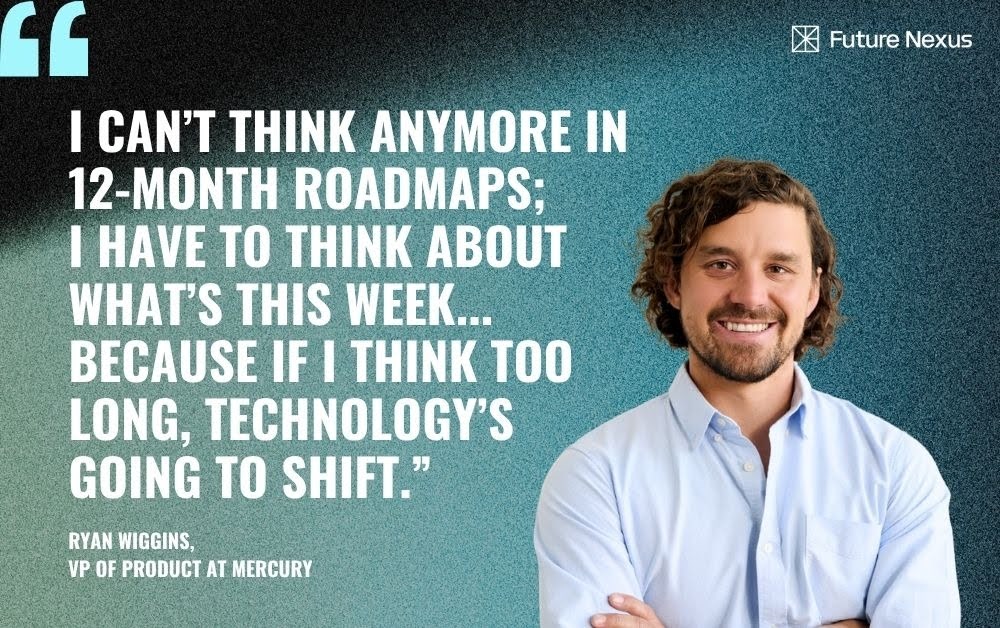
“With the ability to prototype something in an hour, to ship new code in a day or week, what we’re able to do is much more compressed,” Wiggins said. “I can’t think anymore in 12-month roadmaps; I have to think about what’s this week, this month, over the next three months. Because if I think too long, technology’s going to shift.”
Add up the opportunities, compressed timelines, and new technologies, and it had Mercury’s team digging into AI tools to see how every part of the product could be improved. They would rally behind an idea, then, after talking to customers, end up with something radically different.
“We can build really capable primitives, but we have no idea how people are going to use them,” Wiggins said.
Wiggins thought the initial focus would be on the navigation experience, where the tech would ask questions and run calculations but stop short of executing. Given widespread fears about AI acting on its own, the designers were nervous about taking that step. But if a human stayed in the loop before the decision stage, customers could have both speed and control. That’s why Mercury’s design leaves the final decision to the human.
Right product, right time
These developments have Wiggins believing Mercury has the right product at the right time. The numbers agree: Q1 applications are up 2.5x year-over-year.
Business formation is also soaring, with many new founders coming from a tech-savvy generation raised in a customer-centric tech environment. And every one of these entrepreneurs needs a way to manage their finances, ideally with an interface like the apps they grew up with.
“Today, people want to build dwellings and products that really impact people’s lives,” Wiggins said. “When they build, they are looking for tools that are capable and software that is capable.”
An OS for your money
With so many options in this new era, how do designers identify top priorities? Wiggins takes the old-school approach. Talk to customers. Analyze data. Users need convenient access to their information so they can make decisions — and that, Wiggins said, is an enormous surface area.
What Mercury is building, as he’s framed it, has less resemblance to a banking app and more to infrastructure, a common layer to plug into and a growing set of financial tasks running on top.
“It’s hard not to draw parallels with an operating system in some ways,” Wiggins said.
But while a conventional OS earns trust by getting out of the way, Wiggins is wagering this one earns it by first asking permission.