Move fast & sustain things: Edison Partners on scaling companies with healthy urgency
The non-coastal growth-equity firm explains the difference between a $20M company and a $100M one.
Money, says Chris Sugden, managing partner at Edison Partners, doesn’t solve problems. It accelerates them. He likened this phenomenon to AI: both accelerate a company’s current state, for better or worse.
Thanks to AI’s rapid advancement, Edison Partners argues that it’s time to replace the well-worn philosophy of “Move fast and break things” with “Move fast and sustain things,” paired with a sense of “healthy urgency.”
They make the case for this in the 2026 edition of their annual Growth Index, a study of Edison’s top-performing portfolio across enterprise, healthcare, IT and fintech. In its fifth decade and 11th fund, the growth equity firm focuses on non-coastal, capital-efficient companies with 30-plus% growth rates and $10–$40 million in revenue.
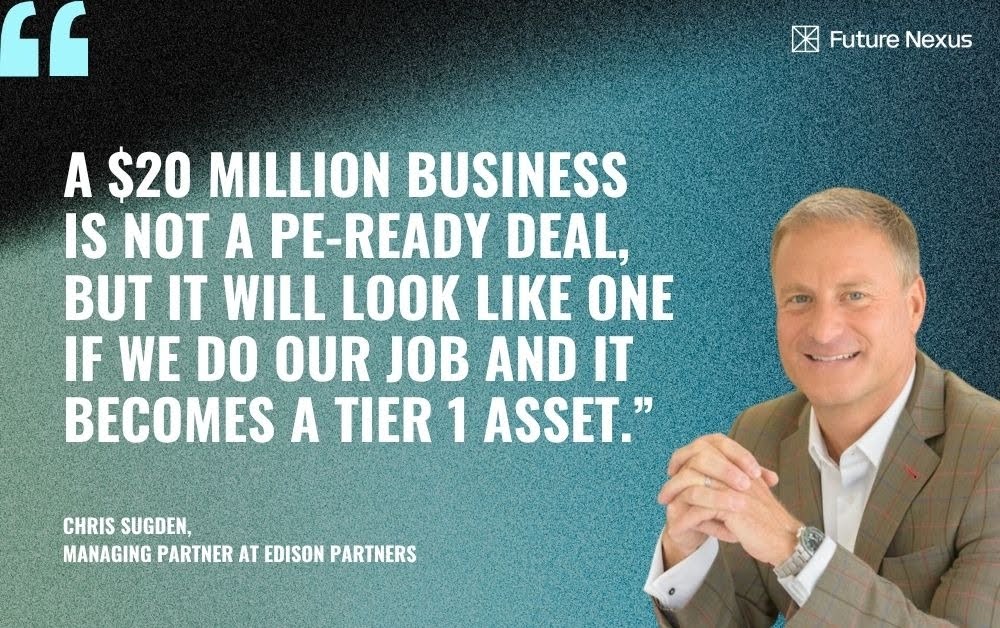
“A $20 million business is not a PE-ready deal, but it will look like one if we do our job and it becomes a Tier 1 asset,” said Sugden.
“If you’ve got a business model that’s not scalable, if you’re still searching for product/market fit, these things aren’t solvable with money,” he further observed. “The problem becomes bigger because you have to go faster. You’ve accelerated those problems before you figure out what the problems or opportunities are.”
Which is why Edison likes to be early with portfolio companies, identifying problems before they fester.
People… and the Midwest
Key to Edison’s job is the Edison Edge, a three-pronged approach. Centers of Excellence offer personalized solutions to address ubiquitous growth-stage pain points; the Edison Director Network matches companies with boards that can actually empower growth; and personalized programming rounds out the model, tailoring Edison’s support.
Sugden said that a network of executives experienced in a company’s specific vertical is key because they understand both the trials of starting a company and that sector’s unique traits. They work alongside Edison partners, who are themselves experienced founders, bringing a deeper level of understanding and credibility.
He contrasts that with firms that apply a standard playbook based on a company’s spot on the growth curve. That begs the question of what’s more important: playbooks or people?
It’s the people, Sugden quickly said. Each founding team has different skill sets. Sure, many are led by multiple-hat-wearing superheroes, but that approach doesn’t scale. Skill gaps are inevitable.
“That may sound like patronizing founders, but what got them to $20 million, plus or minus, isn’t going to get them to $50 or $100 million,” Sugden explained. “So, we have to talk about which people are going to make the journey, and which people aren’t yet even here today.”
That people-first read also shapes where Edison looks. Edison Partners eschews the coasts in favor of places like Indiana, Alabama and Georgia. Sugden said being away from Wall Street and Silicon Valley financiers helps maintain focus. There, founders often aren’t even thinking about rounds; they’re busy building companies. Incoming investments aren’t “their money”; it’s “everyone’s.” When the time is right, Edison plants that funding-round seed.
Who’s behind the thesis
The people-over-playbooks philosophy is, unsurprisingly, one the partners embody. Sugden is a founder himself, and a past or present board member of a long list of companies, including Billtrust, MoneyLion and Payra.
Principal Ben Laufer, a Silicon Valley native, started a sports management company as a Stanford undergrad — a decade before name, image and likeness (NIL) deals made college-athlete ventures mainstream. He also holds an MBA from Wharton. But his education started well before that. Introduced to chess at age two, Laufer was a California state chess champion by seven, and he says those lessons in calculation, pattern recognition and strategic thinking inform his work every day.
“To be able to read quickly about things I wasn’t around for, to gather all that information, understand what happened and synthesize that into something that can be concretely stated as some sort of pattern that can be correlated to what we might experience now or in the future definitely is relevant to my day-to-day,” Laufer said.
Also an accomplished trumpet player, Laufer toured globally, gaining exposure to different cultures and people.
“The discipline associated with how to play classical trumpet seriously and the team orientation it took to be part of multi-national orchestras and communicating through music, as opposed to language, is something that has stayed with me even as I’ve transitioned to the business world,” he said.
Laufer learned early how to win and lose competitions and auditions, and he sees strong parallels to business.
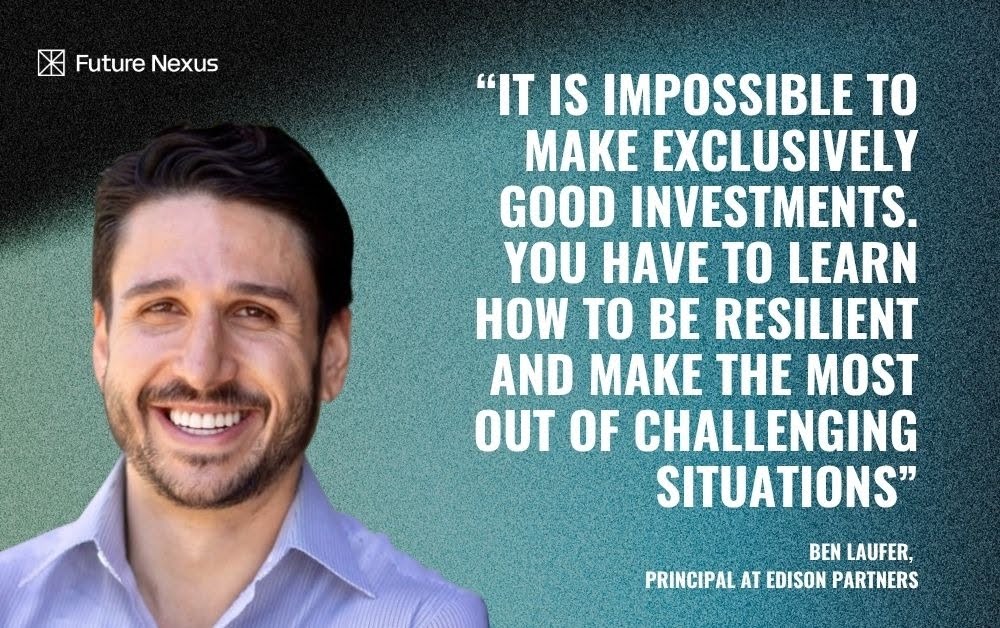
“It is impossible to make exclusively good investments; you have to learn how to be resilient and make the most out of challenging situations,” he admitted.
When your business is looking for society-changing companies, the blend of optimism, a taste for success and resilience to failure are good ingredients to start with. So too is a willingness to believe the improbable.
“You have to be a little bit crazy to think that a $10 million business can become a $100 million or billion-dollar business in a decade.”
What about that “healthy urgency”?
Laufer said healthy urgency is largely motivated by AI forcing the paradigm shift from “Move fast and break things” to “Move fast and sustain things.” Its three pillars are alignment, execution efficiency and sustainability. If key company figures aren’t aligned in the same direction, it wastes capital and can even threaten a company’s survival.
In analyzing more than 6,000 data points, Laufer found that financial performance is closely related to retention of both customers and staff. Successful companies laser-focus their capital and human resources on developing solutions their customers need; they constantly engage with those customers to see if they’re satisfied and what new needs they may have.
“That execution efficiency correlates closely with customer success,” Laufer said.
But it must be sustained for years. Laufer said AI can help with that, but only if the company’s AI strategy is aligned with its overall strategy. Done right, it fosters increased efficiency and performance, putting people in high-value, motivating work. If the strategies diverge, staff can burn out and leave, leading to unsustainable execution.
The report also found AI is showing up in execution before revenue. Laufer said it’s still the early days, with everyone still learning how AI will change society.
“There’s a huge question about what’s going to happen to software businesses,” Laufer said. “Are they going to be displaced completely? Or are they going to be augmented? That’s still to be seen.”
Sugden said everyone wants AI to create new products and revenue opportunities, but there are more fundamental questions to ask first. Can it reduce customer service headcount and free current staff to apply their skills elsewhere in the company?
AI is 10 times more productive at coding than engineers, Sugden said. That is clear.
Laufer said AI’s coding capability helps those companies in Alabama, Indiana, and Georgia succeed. One reason companies flocked to Silicon Valley is that’s where the coders were. Now, thanks to AI, businesses can code from anywhere.
The future is in national infrastructure
Looking ahead, Sugden wants to see brilliant technical ideas for improving national infrastructure. The current focus on rockets has its place, but AI and other new developments can affect change in more mundane areas like traffic management and enhanced 911 (e-911) efficiency. He’d like to see similar attention from new tech to basic financial plumbing like know-your-customer (KYC) and anti-money-laundering (AML) for digital assets.
“It may be old news, but its application to this new asset class is not,” Sugden said. “Compliance tech, along with fintech, that’s a really interesting space to me. The genie’s not going back into the bottle with digital assets.”
Laufer said many of his peers are cautious as they wait for AI to play out; some firms have so far sat out the space entirely. Edison Partners is still in, but with a pragmatic approach.
“The opportunities are there, but the ambiguity hasn’t been higher since I’ve been doing this, and since a lot of people have been doing this,” Laufer said.
For those sitting out AI’s early days, Laufer wonders if their patience will be rewarded. “I think that’s probably the biggest question that I’m interested in seeing answered out of this vintage,” he concluded.
It’s a fitting question for a firm preaching healthy urgency. The bet isn’t that speed wins, or that patience does, but that the companies pairing the two are the ones still standing when the vintage is finally judged.