New Credit Scores Are Everywhere: How to Make Sense of This New World
The credit score used to be the simplest part of lending. You had the FICO score, which everyone understood and used as the primary indicator of credit risk. In many ways, that world has all but disappeared.
In the last five years, we have seen a plethora of new credit scores come to market. This doesn’t include VantageScore, which has been around for more than two decades, but has been in the news a lot because FHFA (Federal Housing Finance Agency) head Bill Pulte has been promoting it as an alternative to FICO for mortgages.
No, I am talking about the number of new credit scores from fintech companies. We have the NovaScore Cash Flow from Nova Credit, the CashScore from Prism Data, and Plaid’s Lendscore (version 2 was released earlier this month) built on cash flow and Plaid network data. And then last month, Block announced that outside lenders could start using its Cash App Score.
For lenders it can all seem a bit confusing. So, in this article, I wanted to answer a simple question: how can we make sense of this new world?
I spent the past few weeks talking with five credit experts to help bring some clarity to the often opaque scores that we are relying on: Can Arkali, Senior Director of Analytics at FICO; Chris Hansen, GM of Cash Atlas Solutions at Nova Credit; Kiran Aware, Chief Consumer Credit Officer at Happen Bank (formerly LendingClub); Jason Rosen, CEO of Prism Data; and Rich Franks, GM of Financial Services at Remitly.
The Score Is No Longer the Decision
Aware didn’t mince words about where FICO sits at Happen Bank, the one lender I interviewed. It “remains a useful, I would say, external reference point and particularly for investors,” Aware told me. “But it is not at the center of our underwriting.”
“We think about this as a one decision system rather than a single score,” Aware said. “It is about whether the whole ecosystem, the decision systems that you have, are producing sound and consistent outcomes across the life cycle.”
Rosen frames it as a data problem.
“A credit report tells you how someone has managed reported credit,” he said. “Cash flow tells you how someone manages money.”
Prism has seen correlations as low as 0.2 between CashScore and bureau scores in some portfolios.
“If we had simply invented another score that was highly correlated with FICO, there wouldn’t be much economic value in adding it,” Rosen said.
Franks went further than I expected: “I don’t think I would buy FICO unless I work for JPMorgan and I needed to prove that I did, or unless I had to securitize and prove that, ‘here’s my FICO mix.’”
That’s a credit executive saying the quiet part out loud.
How We Got Here
Franks gave me the clearest short history.
“For a long time, it was FICO. And then it was kind of incrementation on FICO,” he said. Then the path forked, with banks deciding that “compute is so cheap. I can just do this myself.”
Cash flow data was the accelerant. Last year I called cash flow underwriting the greatest innovation in lending in the last decade. FICO saw it early. UltraFICO launched in late 2018 (I remember it well because we helped launch it at LendIt).
“In hindsight, perhaps with the launch of the very first version of the model, we were arguably a little too ahead of the time,” Arkali admitted. Prism was also very early to this space with Petal (Prism Data was spun out of Petal in 2023) launching with cash flow underwriting in 2017.
Then there’s Plaid, which has a unique place in all of this. In October 2025, it launched its own cash flow score, LendScore, and a month later partnered with FICO to power the next generation of UltraFICO. Earlier this month, it unveiled LendScore 2, which it says delivers 42% more predictive power than traditional credit data alone, with different versions for auto, short-term and home lending. Here is a company that is both FICO’s partner and its competitor. Furthermore, Plaid also resells Prism CashScore, and has been doing so since the launch of their CRA in 2023. These are examples of the fluid and interconnected nature of the credit score ecosystem today.
Hansen described the core business case in plain terms: “Who are the people that I’m declining that I should be approving around the margin, and who are the people that I am approving that I might want to be declining or giving different offer terms to?”
The other driver is that consumer finance, BNPL in particular, simply moved faster than the bureaus.
“Financial products are innovating much faster than the credit-reporting system,” Rosen said.
The Cash App Wildcard
Which brings us to Block. The headline stat from its announcement was striking: roughly 70% of the Cash App users it scored were either unscored or below a 580 FICO. The bureaus simply don’t have much to say about these consumers.
Nova Credit is the preferred distribution partner for the Cash App Score, and Hansen’s team had been talking with Cash App for some time before the announcement.
“When I first hear that someone like them is talking about externalizing their own analytics, your ears perk up a bit,” Hansen said.
What makes this data different is where it comes from. Most cash flow scores, Nova’s included, are built on a consumer’s primary checking account. But Hansen pointed out that “there is a swath of consumers that are not balance carrying, or may not even use one of those primary banks. They are primarily transacting through things like wallets.” For those consumers, the Cash App Score offers insights on behaviors that occur outside of a traditional checking account.
Nova is working with a handful of lenders on the score today, none of them public yet. Lenders get the score plus attributes and reason codes.
“No one wants black box scores,” Hansen said.
Here’s the irony I can’t get past: the most natural buyers of the Cash App Score are lenders competing for the same customers as Cash App Borrow.
Rosen sees that as what makes the move so interesting. Block is “turning its proprietary underwriting intelligence into a product that other lenders can consume,” he said. “The really interesting question is whether other large banks and platforms follow Block’s lead and begin opening their proprietary data and scores to the broader lending ecosystem, or continue to view that intelligence as a source of competitive advantage that should remain behind their walls.”
Nova is betting some will.
“We have these conversations with many people who have proprietary data, their own proprietary analytics,” Hansen told me.
But the skeptics make a strong case. Arkali pointed out that platform scores “are by and large developed on on-us data,” so of course they look predictive inside their own walls.
“The real question here is whether that uplift would actually hold if and when that model is maybe pointed to or applied to a different population,” he said.
Aware agreed, saying that any score built inside one ecosystem “is biased to who the borrowers are or who the consumer is on your platform.” Whether such a score delivers better outcomes beyond that ecosystem “is the critical point,” Aware added, “which I think is still not proven in Cash App score.”
Rosen did the coverage math. Block’s 59 million U.S. monthly transacting actives cap the Cash App Score at about 22% of U.S. adults, and only 9.4 million (roughly 4%) are primary banking actives.
“It’s difficult to build a new, broadly applicable credit standard or underwriting policy around a signal that may only be available for a small fraction of the U.S. population,” he said.
Franks expects the Cash App Score to be useful but niche.
“Sub 600, you’ve got to piece together the story from five different places,” he said. “And Cash App can very much be the sixth place there.”
That’s not a knock on the Cash App Score. A niche serving consumers who have been nearly impossible to underwrite can still be a very good business. The bigger impact may be the precedent. Once one platform proves its data is worth selling, every company sitting on a large, unique dataset will be asking the same question.
The Case for a Common Language
Here’s the uncomfortable truth for the challengers: a world with dozens of scores has a real cost.
“One challenge that I think the industry really needs to be aware of is one of fragmentation,” Arkali said. Without a common language, “it’s going to be that much more difficult for the industry to really and directly understand what a lender’s score of 620 exactly means.”
Even Franks gave FICO its due: “It’s a Toyota Camry versus a Porsche GT3,” he said. “A GT3 is a better car. Absolutely. But if you buy a Toyota Camry, you’re gonna drive it 200,000 miles.”
Arkali would argue that durability is the point.
“If you look at some of the legacy FICO scores that were built many, many years ago, most of those scores are still very much in the marketplace,” he said. “They are being extensively used. And they are actually still validating very, very strongly.”
The securitization market is where that reliability matters most, though Rosen thinks investors are more flexible than people assume.
“Investors value standardized metrics like FICO because they understand them and have decades of performance history around them,” Rosen said. “But they care about loan performance even more.”
Aware’s experience backs that up.
“We have more sophisticated loan buyers that don’t look just at a single score, like a FICO score, to buy the loans,” Aware said. Happen Bank’s 40% lower delinquency versus competitors over five-plus years helped it pass $10 billion in its structured certificate program. But not every lender has two decades of vintage data to show investors.
My Take: One Score Is Over, One Language Isn’t
So is the single-score era over? Yes and no. The single score as the decision is already over for many lenders. The single score as the language is not going anywhere soon.
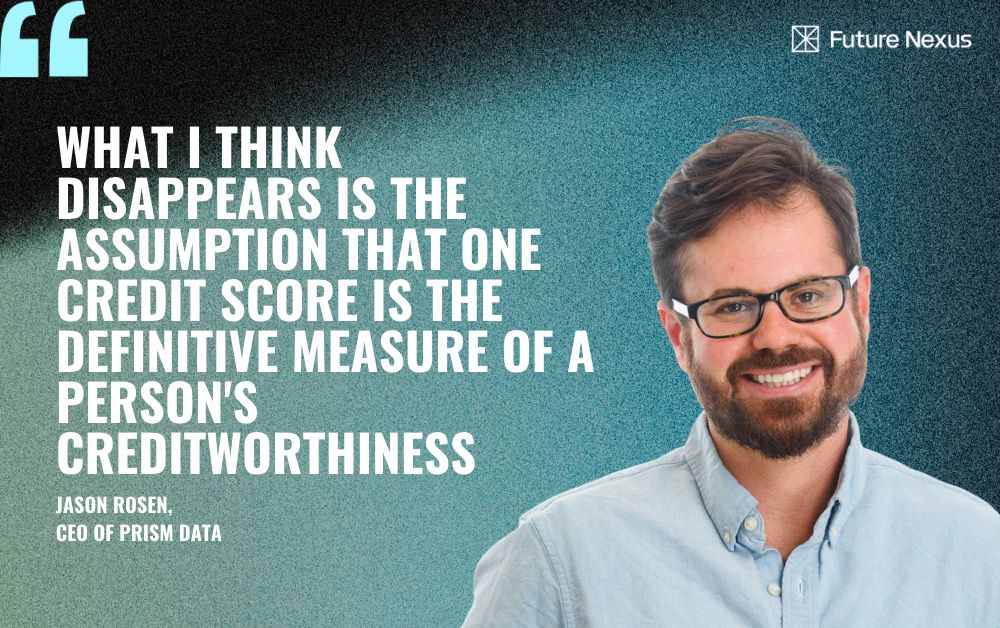
What struck me is that all five people landed in roughly the same place. “What I think disappears is the assumption that one credit score is the definitive measure of a person’s creditworthiness,” Rosen said. Aware sees the general-purpose score’s “role increasingly will be only an input in a larger system.” Hansen described cash flow as “inter-operating alongside FICO as opposed to completely displacing it.” And Arkali, naturally, believes FICO’s “solutions are really designed to actually last.”
What I keep coming back to is Franks’ prediction about where all this ends up.
“Here are the seven new vectors that have come out of this process,” he said. “And then the credit bureaus say, okay, I need to go buy one company that does each of those seven vectors.”
I think he’s right. Expect more scores, not fewer, and then a wave of consolidation as the bureaus decide which signals they can’t live without.
The question every lender should be asking today isn’t just which score to use. It’s how many signals you’re ignoring, and what your competitors already know that you don’t.