Sapphire Ventures Partner Anders Randum on Relationship Building with Founders
Lessons from 14 years in venture on how personal connections can become enduring founder–investor partnerships.
A couple of years ago, Anders Ranum was navigating through the north island of New Zealand on Google Street View in a race against the clock.
The Sapphire Ventures partner wasn’t scouting out his next vacation. Rather, he was playing a virtual geography game against Igor Marinelli, the founder and CEO of Tractian, an industrial AI platform.
“A lot of venture capitalists were chasing Igor, trying to wow him with tickets to basketball games and whatnot,” recalled Ranum.
“I realized that he actually loved a game called GeoGuessr where you land in a random spot, have a time clock and need to say where you are in the world. I challenged him to a game and didn’t do so bad myself, and this became a way for us to bond,” said the native Norwegian.
Perhaps thanks to that bond and a shared desire to navigate the world together, Sapphire led Tractian’s $120 million Series C funding round in late 2024, and Ranum earned a seat on the startup’s board.
Investing, according to Ranum, begins with listening to founders, understanding their motivations and connecting. It’s what he’s been doing since making the pivot to venture capital in 2012 after a 12 year stint at SAP that began in 2000 when the tech giant acquired the company he was working for.
“I was lucky that I came to Silicon Valley during the dot-com boom and bust period, helping build B2B e-commerce marketplaces,” mused Ranum. “I had the great opportunity of sitting in Palo Alto working with one of the largest, most significant software companies in the world looking at the intersection of emerging technologies and trying to understand how to apply that to SAP software systems, but more importantly to their customers.”
During his tenure at the German multinational, he encountered a slew of interesting startups and kept wondering: How can I play a role in this equation beyond being an acquirer?
The answer? A career change.
“As a venture capitalist, you have the traditional responsibility of managing other people’s money and trying to make the best judgments from that point of view, but you also get to wear your product and technology hat to try to see the innovations taking place and how that can possibly impact and change the world,” he explained.
Ranum initially thought his experience as a VC might serve as a stepping stone.
“I wasn’t truly committed to the craft in the beginning few years,” he admitted. “I was thinking ‘What better job would give me access to super amazing founders and startups, and then potentially sneak my way into it, see if I could put on my operating hat and join one of those rocket ships?’”
“Fast forward 14 years later, I have stopped looking and embraced the role of a venture capitalist,” he said with a wide smile. “I love my job, above and beyond because I get to interact with amazing teams and talent that are trying to solve the impossible and make a change, and I can still apply my operating skills and empathy.”
Ranum prioritizes working with founders to whom he can be more than just a source of capital. Often, before even making a funding commitment, Sapphire shows a prospective company the level of support it can deliver by making multiple introductions to potential customers and senior hires.
He describes his job as a “never-ending opportunity to meet great talent and hear what people are willing to put their life and time into.”
So far, Ranum has steered Sapphire’s investments into more than two dozen companies including Auth0, which was acquired by Okta for $6.5 billion, JFrog and Fastly, which went public, and Portworkx, which was bought by Pure Storage.
The firm seeks out ‘companies of consequence’ at an inflection point in their product market fit and go-to-market strategy. It typically seeks to lead or co-lead funding rounds (Series B and onwards) with equity checks of between $30 million to $100 million, though Ranum said Sapphire has become more flexible about how it participates as the size of some rounds expands exponentially.
Sapphire’s focus on business-to-business, or B2B, technology and software, has proven prescient.
“I couldn’t have timed my entry into the venture capital world better,” said Ranum, who joined the firm in the early innings of the SaaS era. “That was a very fruitful period with a lot of IPOs, exits and a lot of excitement.”
He remains optimistic about the firm’s continued success in the AI era despite fears about a so-called ‘SaaSpocalypse,’ which have been somewhat doused by a rebound in software company valuations.
Still, he acknowledged that a frequent, ongoing conversation in multiple boardrooms centers on whether companies are willing to dedicate resources toward leaning into the world of AI, perhaps by innovating, rethinking or reimagining their offerings in lieu of buckling down and preserving existing revenue.
“Some companies will never be able to cross into this AI world,” Ranum admitted, adding that others have been quicker to embrace the technology. One such example is Sapphire portfolio company Intercom, which repositioned itself as an AI-first customer service platform known as Fin, and was recently acquired by Salesforce for roughly $3.6 billion.
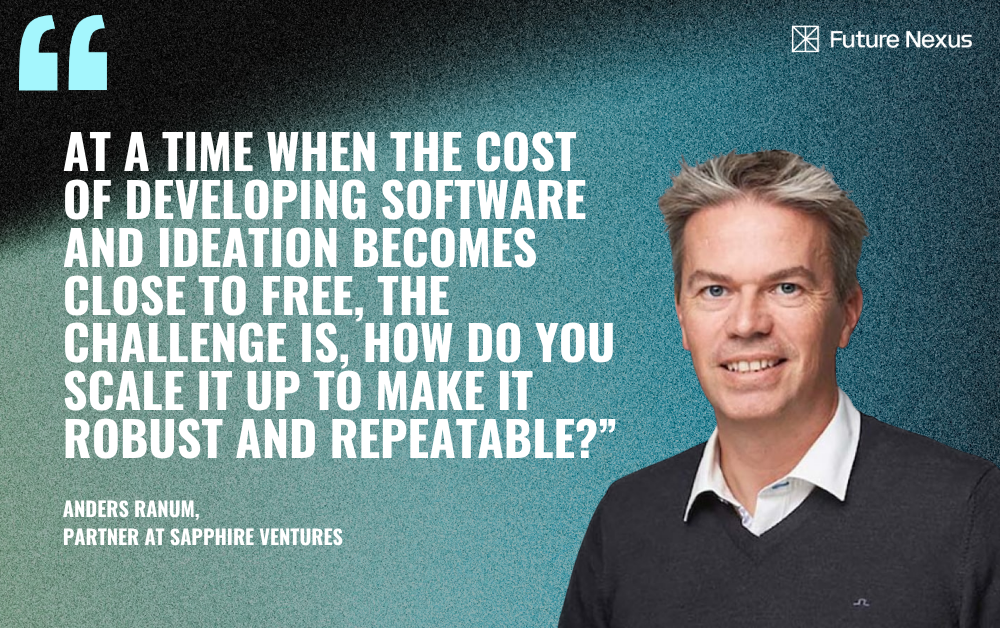
“Change and the pace of change is probably one of the biggest factors that [differs] between when I invested in 2012 and what the world looks like now,” Ranum said. “At a time when the cost of developing software and ideation becomes close to free, the challenge is, how do you scale it up to make it robust and repeatable?”
“We don’t believe that because you can write the code that you necessarily should be building software systems, because you have to run and maintain them,” he added, noting that paying a monthly fee for a CRM platform is a far better alternative and savior of time than building his own.
“This is also true for businesses — it’s not just because they can do it, that they should spend the time and energy on it. They should find their frontier of innovation, where they want to dominate and differentiate, and put resources into that and for everything else, [they] should consider just using a service.”
A key corner of the AI ecosystem that Ranum is excited by is what Sapphire describes as ‘physical intelligence’, or how AI impacts manufacturing and logistics, including the potential of robotics. Another is inference providers, on which trained learning models can run.
Predictably, Ranum doesn’t have enough time to regularly explore the world via GeoGuessr, though he challenged another Sapphire partner to a game earlier this month. Away from screens, his latest attempt to strengthen a bond with a founder involved learning about the ins and outs of an important match, after finding out his love for the sport of cricket.
“It’s not about wowing [a founder] necessarily with how much money you spend on the idea, it’s more about personalizing it and trying to connect on a deeper level, understanding who they are, and how you can show up,” he added.
As for the best advice that he imparts to these entrepreneurs?
“Focus and be very, very mindful of your time, so learn quickly what to say no to,” said Ranum, warning against distractions and productivity loss that can come from pursuing non-core opportunities.
“The other is ‘be long-term greedy’, what I mean by that is, is don’t try to overoptimize everything today — earn your right to participate in the success of the customer over time,” he added, explaining that founders can benefit from compromising on terms such as price and scope with early customers.
“Don’t try to sell it to the whole organization if you can sell it to part of the organization first — earn the right to get in there, service more and more capabilities once you’ve built trust and have their attention.”
Importantly, the relationships he’s nurtured with these pioneers aren’t one-way streets — Ranum said he’s garnered invaluable learnings along the way.
“Some of my founders made me a better person…and help me look at the world in a better way because of the way that they show up to their job and the integrity that they do it with.”