The $10,000 inference trap: A former pro sailor’s fix for AI’s money problem
Koah Labs co-founder and CEO Nic Baird shares what he’s learned building the “AdSense for AI”
Back in the day, the virality of a new app called for a celebration. In the age of AI, it is becoming a nightmare.
The reason? The brute economics of AI.
Unlike traditional apps that largely involved hosting and infrastructure costs — translating to a mere few cents per new user — AI services also carry inference bills, or the cost of running the models that serve answers to the users. The tradeoff, however, is that such inference bills can surge drastically when the user base explodes.
Say your AI service hits 10,000 users, each sending a few dozen messages a day. That is roughly 10 million model calls a month. Even at a tenth of a cent per call, the inference bill clears $10,000.
“You’d be like, ‘We gotta do something about this,’” Nic Baird, co-founder and CEO of Koah Labs, told Future Nexus. “But, basically, the options are: you either raise venture capital so you can pay for your inference bills, or you put a paywall up immediately.”
Baird saw the same problem with his own AI apps, one of which he described as an AI-native version of LinkedIn. But he soon realized that getting enough conversions to make a paywall work is brutal.
“We had a screenshot app we wanted to monetize at a $4-per-month subscription, but we could get just 1% of our user base to buy it. We realized that this is just…really hard, and if you can’t get more than 4 or 5%, then you’re just losing money on inference,” he said, disputing the thesis that generative AI is so inherently useful that the entire world will happily pay $20 a month for subscriptions.
To fix this monetization gap, he launched Koah Labs in 2024, a startup building the “AdSense for AI.”
Backed by a $20.5 million Series A from Theory Ventures (led by former Google AdSense team member Tomasz Tunguz), the company enables AI developers to embed highly relevant, contextual ads directly into AI conversations, saving them from the punishing reality of inference costs.
From sailing to solving AI’s money problem
Today, Koah Labs works with some of the most promising AI startups in the world, including Particle, DeepAI, Liner, and Viro. But Baird has no typical Stanford-to-Y-Combinator backstory.
He instead wanted to be a professional sailor and was well on his way to making that happen, like his father, Ed Baird, an American professional sailor inducted into the National Sailing Hall of Fame. Nic Baird grew up traveling the world for the America’s Cup (the World Cup of sailing) and eventually competed professionally.
When professional sailing gave him downtime between races, Baird started filling that time with commission-only tech sales and operations roles at early-stage startups. Intrigued by the ecosystem, he eventually joined the venture capital firm South Park Commons to embed himself in San Francisco’s founder community. That’s when he met his co-founders Mike Choi and Herrick Fang.
A year after that, Baird and his co-founders set out to build their own consumer AI apps, only to crash headfirst into the inference-cost wall that subscriptions couldn’t break. Other founders they spoke to also had the same problem.
Looking for a way out, they explored traditional ad networks like AdMob, but slapping flashing banner ads and interstitial videos onto a clean, text-based AI chat felt like a jarring UX nightmare. With the growing digital ads market (which he says is on track to hit $3 trillion in five years), they realized the real opportunity was building a monetization layer that would allow consumer AI apps to survive without a massive paying user base.
Will AI usage be concentrated among five major players, or is there going to be a long tail of other apps and tools with enough usage to exist? Turns out, the latter was true, with a lot of new, niche AI tools emerging in the subsequent months.
“We went around to some of these consumer founders we knew… and said, ‘We’re thinking about building this AI-native ad platform,’” Baird recalled. “And they were like, ‘Where’s the contract? I want to sign it today.’ The market just ripped this idea out of our brains.”
Why the old ad formats had to go
Getting advertisers and publishers on board is one part of the puzzle. The other half is actually serving those ads on the platform, while ensuring relevancy and keeping end users’ personally identifiable information private.
But generative AI demands a fundamentally different advertising architecture than traditional social media or even search.
If a user tells an AI chatbot, “I’m so taxed after this long day,” a legacy keyword-matcher might serve them an ad for TurboTax. To avoid this, Koah relies on a proprietary contextual matching system – combining embeddings and re-rankers – to understand the actual intent of a conversational query.
When a user submits a prompt, the publisher’s app calls Koah’s SDK with the conversation context. Koah matches advertisers to the user’s intent, runs a real-time auction, and selects a relevant ad. Advertisers pay Koah for these placements, and Koah shares the resulting ad revenue with publishers (it has not disclosed the exact take rate).
Notably, once the auction selects a winner, the ad is rendered in a way that doesn’t break the user’s in-app experience. To do this seamlessly, Baird’s team had to completely abandon the Interactive Advertising Bureau (IAB) standards that have dictated digital ad formats for years.
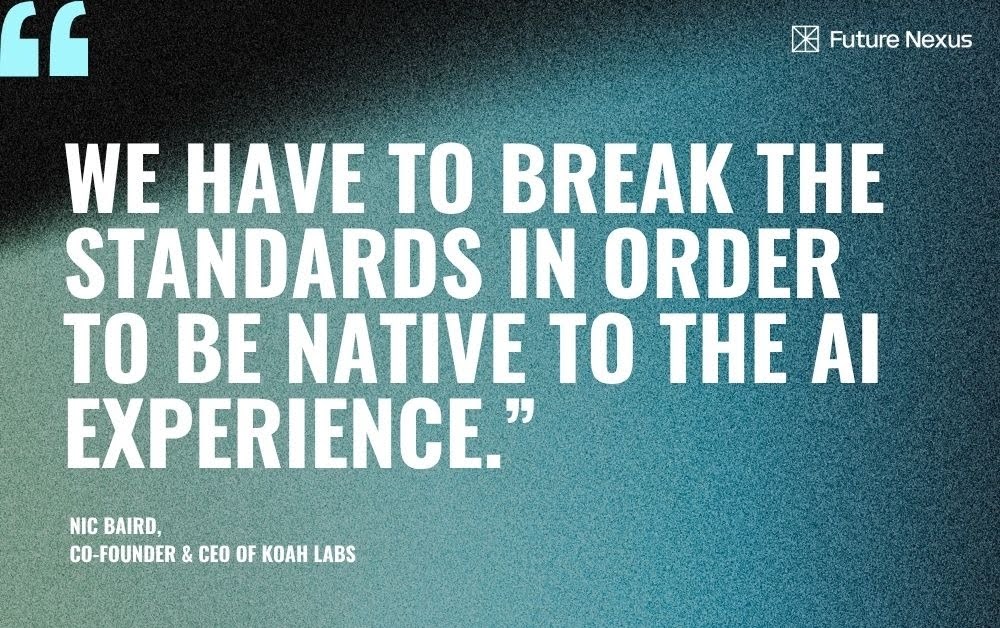
“We basically don’t use any of those standards because we have to break them in order to be native to the AI experience,” Baird explained. “It’s a generative experience. Sometimes the answer is really long, sometimes short, sometimes it’s got images or bullets. You really have to have a very flexible generative format.”
Beyond the formatting, inserting ads into intimate AI conversations comes with perceived risks regarding user privacy and AI manipulation. Koah neutralizes these concerns through a strict architectural separation.
To prevent brands from manipulating the AI’s core reasoning, ads are strictly injected on the front end. “The models do everything on the back end, and you serve the ads on the front end,” Baird noted. “If you ask the chatbot, ‘What did that last ad say?’ it’ll be like, ‘What ad?’ They don’t know it exists.”
To protect user privacy, Koah also pushes tools directly to publishers to scrub personally identifiable information (PII). Before an ad request ever leaves the publisher’s app, names, emails, and sensitive data are stripped out.
“We can’t receive it and then scrub it out, because now we have it,” Baird said, explaining why Koah never holds the data in the first place. Finally, standard ML keyword models are used to maintain brand safety, ensuring premium advertisers never appear alongside dangerous or explicit chats.
A win-win outcome
Because Koah’s ads are contextually relevant and natively formatted, they act as additive recommendations rather than jarring interruptions.
As a result, Baird says the network is seeing click-through rates between 1.5% and 2.2%. This, he says, puts it on par with high-intent Google Search ads, though published benchmarks put average search CTR near 6%. For some of the billion-dollar advertisers on Koah’s roster, the platform is already outperforming Google, Meta, and TikTok as a paid acquisition channel, he said, noting that the sample is still small.
On the apps’ side, Baird says the financial relief is immediate. “Our publishers are making tens of thousands to hundreds of thousands of dollars a month,” he added. “That’s a pretty serious amount of money for a small team of 4 or 5 people making a consumer app.”
Most importantly, Koah says it is doing this without alienating the end user base.
In internal testing, the company claims to have maintained a 99% retention rate compared to ad-free control groups.
“We actually see that there is a user engagement bump,” Baird explained, noting that users are more likely to ask a follow-up question during a monetized session than a non-monetized one. “The outcome is you make more money, and it’s not really worse for your users. It should be a win-win for everybody.”
Playing without a playbook
Building a marketplace for an industry being invented in real time has left Baird relying on instinct. He has learned to take advisors seriously but not literally, since the primitives underneath his business are new.
“We have had experts in this space tell us two polar opposite pieces of advice,” he said.
“Sometimes you gotta kind of just put the blinders on, ignore the noise, and just do what makes sense to you in the moment.”
His other rule is about hiring: bring someone in only when the team is already drowning in the work, never to cover a function nobody there understands yet.
Where he is less hesitant is on where all this ends up.
Baird expects AI advertising to move well past text recommendations inside chat windows. He sees agents transacting directly with other agents, and users chatting with a brand’s AI representative inside whatever app they already open every day. The ad stops being something inserted into a conversation and becomes a participant in one.
That is the long-term horizon. The near-term outlook is narrower and more urgent. Consumer AI is full of small teams shipping useful things on margins that do not survive contact with a compute bill.
“The challenge for us is making sure we’re getting in front of folks as they’re building, because we don’t want them to run into the same problems we ran into when we started the company,” he said. “We want to get in front of people before they decide to stop building their app simply because they can’t afford it.”
He is betting the rest of the industry arrives at the same conclusion, whether or not it wants to.
“OpenAI will make a bunch of money from ads, and all the shareholders of all the other companies will be like, ‘Guys, they’re making billions of dollars over there, what are we doing?'” Baird said. “I think even Anthropic will probably cave at some point. After all, Netflix famously said they were never going to show ads.”