The Missing Piece to AGI
Today’s frontier AI models can write production-level code, clear math and physics olympiads, and generate complex essays and research papers in seconds. But if you ask them questions about simple drawings and diagrams, especially those not in their training data, they fail most of the time.
Andrew Dai, an AI research pioneer whose 2015 work on language model pre-training laid the groundwork for the GPT line, saw this gap last year.
He keeps a large board game collection at home and one day, photographed the cards mid-game to ask, “How many sheep does this player have?” and “What’s the number printed under that marker?” No model got the answers right.
For Dai, that failure showed models have learned to reason in language, but not visually. It also meant that AGI – or when AI could surpass humans across most cognitive tasks – was further off than what the industry has been pitching, and certainly not a year or two away.
At the time, Dai had been at Google for 14 years, across Google Brain and DeepMind, working on mixture-of-experts models, pre-training and data.
Initially, Dai did not intend to stay this long. He wanted to start a company but kept finding reasons not to. Offers came — from Inflection AI, among others, along with a chance to co-found another neolab a few years ago — and each time the work right in front of him won.
“Progress kept going faster and faster, and I kept learning more and more new things,” he said.
Things finally started changing when he saw the board game problem and understood the bigger picture – language, coding, and math were scaling fast, but visual and multimodal capabilities were barely moving.
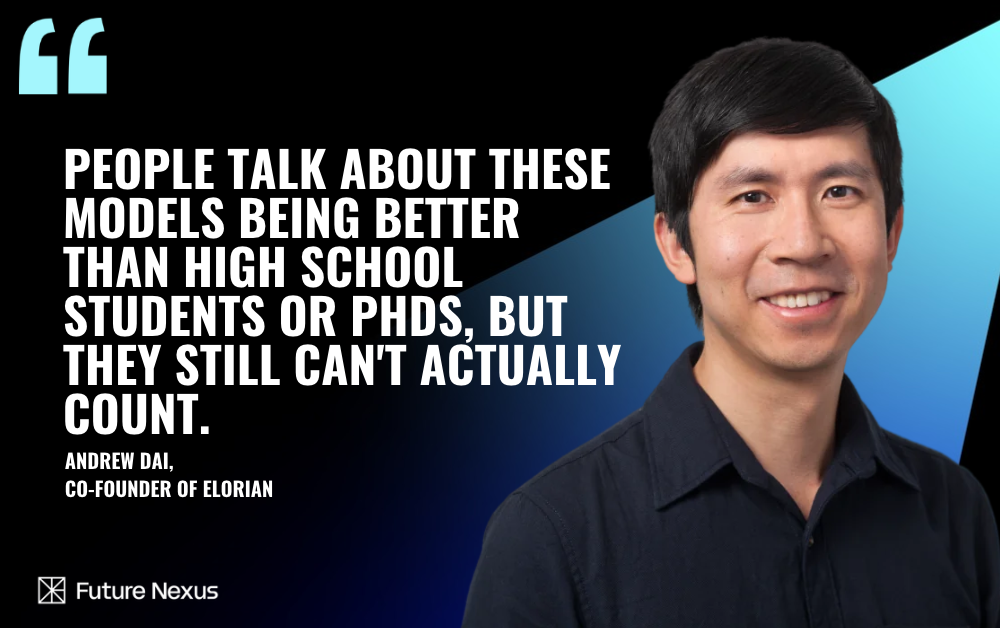
“These models are way behind human adults,” Dai told Future Nexus. “People talk about these models being better than high school students or PhDs, but they still can’t actually count.”
He noted that the category has drawn so little attention that there are hardly any benchmarks out there to show models’ visual reasoning and counting skills. CharXiv, MMMU, and ARC-AGI are among the few.
“People aren’t doing counting benchmarks because the results are so bad. They don’t want to show those results,” he said.
While Google had its own multimodal efforts underway, Dai knew the company’s number one priority is code.
So he finally left to team up with Yinfei Yang, who built multimodal systems at Apple, and former Harvard professor Seth Neel. Together, they co-founded Elorian, a company building models that reason natively in the visual space — what he argues is the missing piece to true AGI.
Building true visual reasoning
When a user uploads an image to ChatGPT or Gemini today, the model does not “think” visually. It does advanced pattern matching based on millions of similar images it saw during training, and then converts that visual data into text tokens to reason over.
Dai likened these current visual AI capabilities – detection, recognition, and segmentation – to animal intelligence.
“If an animal sees another animal on the horizon and can’t tell the difference between a lion and a deer, they will not survive. It’s literally a life-and-death capability,” Dai said.
But what separates humans from animals is our advanced spatial and visual reasoning.
Animals, Dai said, can count to around seven or eight. Humans, on the other hand, can reason about complex diagrams, estimate rough distances, and even calculate angles by mentally visualizing them. For instance, when trying to assemble IKEA furniture, we can wonder, “What will it look like if I rotate this? Is this the right screw?”
This ability to visualize and solve a problem instead of first converting it into text – which Dai argued leads to massive information loss – is what Elorian is teaching its models. Dai called it “visual thinking,” giving models the ability to generate, edit, and reason over images.
“The best way to solve it is to draw it on some paper. We believe certain problems are just much easier, much more natural to do within the visual image space than in this sequence of language symbols,” he noted.
Elorian’s first visual thinking model, Glimpse, shipped last month. When it isn’t sure what it’s looking at, it goes back to the image, cropping regions, pulling video frames, running code to measure what it sees. The team refers to this as a visual scratch space.
It costs $0.60 per million input tokens and $3.00 per million output tokens, which the company claimed is 94% below GPT-6 Astra. Elorian trained it on a few hundred GPUs, starting from an open-weights base.
When speaking to Future Nexus, Dai indicated the company still has a long road ahead, emphasizing that they were founded just under a year ago and that it’s still “premature” to claim they’re better on every visual task than frontier models. In terms of performance, Glimpse matches or beats Astra on five of twelve tests (including scientific chart reasoning and short video captioning) but loses on seven others.
“Spike on a few capabilities, and that’s what we are shooting for,” he said.
Building the “Anthropic of multimodal reasoning”
While Elorian’s first model is out, the journey has been anything but easy. Building a new foundation model startup from scratch required immense capital and world-class talent, putting Elorian in direct competition with the category’s giants.
The hardest reality check came early, in the form of hiring. Researchers, Dai noted, are naturally financially conservative, and asking them to leave the safety of a big lab and bet their careers on a massive technical risk with no existing infrastructure or product was a steep uphill battle.
To break the bottleneck, Elorian positioned itself as the “Anthropic for multimodal reasoning” — a dedicated, highly focused lab attacking a problem the giants were treating as a secondary priority. Furthermore, because multimodal intelligence is a superset of language, researchers interested in continuous learning or memory didn’t have to abandon their passions; those problems had direct analogs in the visual world, which only meant more opportunities to grow for them.
Unique funding strategy to snag talent early
Beyond this, Dai offered early hires an option to own a part of the company, which isn’t possible at labs already valued in the billions.
He also leveraged a distinct financial advantage over better-funded AI labs.
Elorian raised its seed round across two tranches (given more people and a better estimate of what GPUs would cost), going from a $120 million to a $300 million valuation. Backers included Menlo Ventures, Altimeter, Striker, NVIDIA, and Google chief scientist Jeff Dean. The company was offered more and turned it down. Part of the logic was qualified small business stock (QSBS), a provision that exempts shares from federal capital gains if the company’s assets stayed under a threshold when they were issued and the holder waits out the clock.
“Not everyone realizes that, with this amount of funding, if people keep the equity for a few years, they get zero federal tax,” Dai noted. “That’s something that new labs that have raised like $500 million or a billion dollars just can’t offer.”
Accelerating physical technology
Elorian is moving fast. The first model is out, and the company has a commercial pilot with a large video company currently underway, with more lined up with robotics, data-labeling and construction firms.
These partner efforts, per Dai, are crucial to ensure the model generalizes accurately in the real world and performs well on granular visual understanding tasks.
“Benchmarks, they’re not really representative of real-world use,” he said. Elorian has since released the first of its own, DecoyCount, built with data company Mercor to test whether models actually count objects or guess.
Ultimately, when the technology evolves, Dai sees Elorian’s AI being able to solve challenges in the physical world faster.
“Building SpaceX starships faster, building the next iPhone much faster, making batteries more efficient,” he said while giving a few examples. “Imagine an EV battery that’s more efficient, or a car that takes less energy, or solar panels that produce more energy.”
All of this, Dai pointed out, requires working in physical space — better CAD, better engineering, the ability to look at a design for a car and change it. “That is where AI is not very good at all,” he said.
In terms of competition, he also understands who Elorian is up against, citing Gemini as the closest model to what Elorian is building and state of the art in visual understanding. ChatGPT is close behind, with world model startups like Yann LeCun’s AMI Labs sitting adjacent to the company’s work. They are modeling direct action in physical space, while Elorian is working on the reasoning that precedes it.
When asked what happens if a frontier lab turns its full attention to visual reasoning and goes directly against Elorian, Dai seemed unfazed, noting that even in a competitive space like coding, where Anthropic and OpenAI dominate, smaller players like Cursor and Cognition have still built large businesses.
“I think we will have a big advantage because we started early with the specialized architecture, data processes, proprietary data, and the customers. So by the time that other companies pivot in this direction, we will have a very significant lead,” he said.
The path to AGI
Dai believes human-level visual reasoning could arrive within five years, a precursor to AGI when combined with language reasoning.
“We will target visual AGI in the next few years, maybe within the next five years. Language is hard to say. You really need to combine both to get real AGI. If you just have a pure text AGI, it’s not really AGI because humans can obviously do more than language,” he said.
But before all that, Dai continues to build the company, with the willingness to get his hands dirty wherever it’s needed.
“You have to be able to do everything and be willing to do everything,” he said, reflecting on the jump from AI research at a trillion-dollar company to the hustle of a startup. “I was installing our room AV setup with Google Meet and configuring the settings. Today, I fixed the HDMI cable. We have a team of 20 people, but I’m still fixing the HDMI cable. It’s very important to really go deep and understand every part of your company at this early stage.”