The Next AI Data Center Could Be in Your Parking Garage
At the age of 17, Nikhil Bharadwaj moved to the U.S. with a mission: “To solve climate change without bothering people.”
As he begins to bring compute online in a sustainable way, the Xeal Energy CEO, now 30, is taking a step closer to achieving a mission curated by personal experience.
“In India, energy can be scarce and abundance is a luxury,” explained Bangalore-born Bharadwaj, who — as an asthmatic — yearned for a solution to air pollution in Delhi, where he grew up. “I saw rolling blackouts in utilities that would inherently affect disadvantaged communities over others.”
While studying at Penn State, he started a business turning dozens of regular bikes into electric bikes before being thwarted by Chinese tariffs.
And after a roughly 18 month stint at Schneider Electric, concentrating on electric mobility innovation, Bharadwaj quit to become chief technology officer at Xeal, the startup he’d co-founded earlier in 2019 seeking to boost both the availability and reliability of electric vehicle charging infrastructure.
“Using distributed ledger technology, we built the first self-reliant payments protocol, which means our chargers work underground without depending on a single network or the cloud,” Bharadwaj told Future Nexus.
As EV adoption lagged, Xeal — which developed a charging network across multifamily, office and retail properties — weighed revenue generation opportunities from idle charging capacity, or what it identified as “stranded” power.
“Our first patents around GPU-plus-charging go back to 2021,” said Bharadwaj, revealing the company considered using unused power for crypto mining.
Instead, as demand for energy skyrocketed amid the artificial intelligence boom and data centers faced heightened regulatory challenges related to water use and noise, Xeal recognized it could step in.
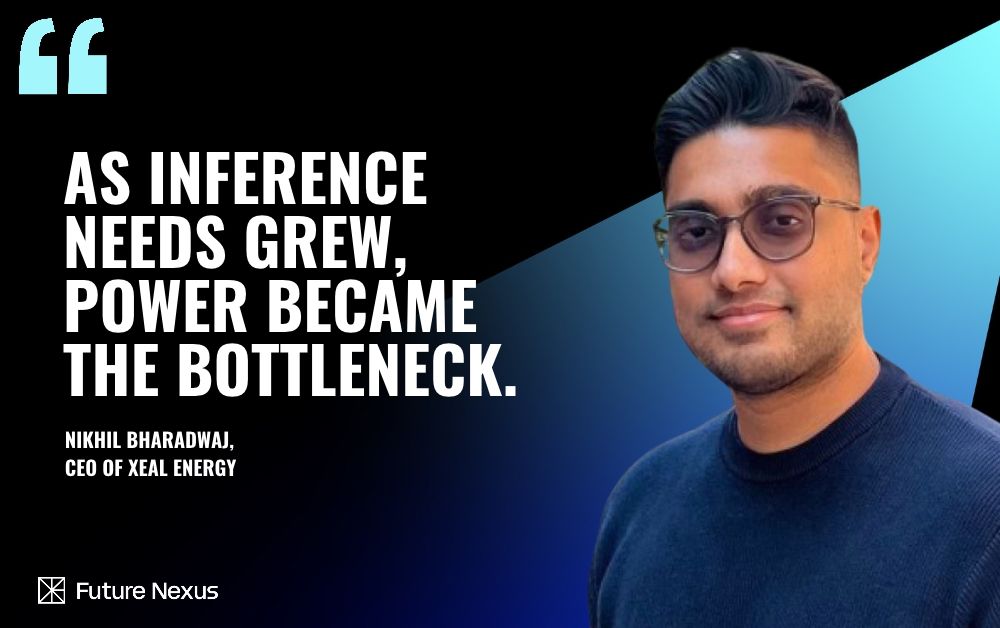
“As inference needs grew, power became the bottleneck,” Bharadwaj said, referring to the process of running trained AI models which requires less power than training those models.
After about a year in stealth, Xeal last month launched Laitent, an arm planning to deploy Nvidia GPUs across an existing charging network comprising more than 200 megawatts of permitted installed electrical infrastructure.
Piggybacking off long-term leases, Laitent — a play on the word latent, which in Latin means ‘to lie hidden’ — will begin to add GPUs to sites in a so-called ‘pod’ that fits in a parking space and contains up to 48 Nvidia GPUs.
“Similar to a cellular base station being installed on a rooftop, it’s a business model we’re borrowing from the telecom industry,” Bharadwaj said, explaining each 50 kilowatt pod requires no water and is essentially an outdoor IT cabinet that allocates power to both EV charging and compute.
Laitent’s first pods will be located in Illinois, where the startup is partnered with JVM Realty.
Its pitch to real estate owners already invested in EV charging infrastructure — beyond a potential internal rate of return that exceeds 30% and a gross yield of about 45% — is simple: Would you like the payback period on your investment to be two times faster, with any additional power costs covered by Laitent as the commercial tenant, and maintenance and insurance taken care of?
For landlords eager for a slice of pre-booked compute revenue, the startup is open to partnership deals in which capital expenditure costs are shared.
“There’s about $8 trillion in multifamily and commercial real estate with zero exposure to data centers, and now they can unlock ancillary rental income in this interest rate constrained environment without having to attract new tenants and no utilization risk,” Bharadwaj said.
Thanks to a series of patents, both granted and pending, he estimates that Xeal has a 12 to 18 month head start on any potential copycats.
“We can bring online about 60 megawatts a year as we capitalize and scale this up, which I think is a huge head start.”
That said, Tesla has trademarked the term “megapod,” signaling a desire to roll out a similar edge compute business relying on its own network of superchargers.
“I see these as two completely different products,” said Bharadwaj, highlighting Tesla’s superchargers rely on direct current (DC) Level 3 charging while Xeal focuses on alternating current (AC) Level 2 charging.
Because of its focus on Level 2 charging, he touted Xeal’s ability to deliver power to both compute offtake partners and EV drivers without the need for concurrent power spikes.
“At our more popular sites in California, we see EV charging in the 20% range and even when every charger is used at night, power is always available because people park longer than they charge,” Bharadwaj said.
Regardless, widespread adoption of both products could potentially help meet growing power needs for global inference, which McKinsey estimates could balloon to 93.3 gigawatts by 2030 from 20.9 gigawatts last year.
“I see this as a great win for the industry,” said Bharadwaj.
Laitent — which expects to bring pods online in eight weeks on average — has inked a deal to provide up to 5 megawatts to its first offtake partner, a large inference provider which Bharadwaj declined to name, and is in discussions with others.
“They signed with us at a premium to market benchmarks because they see us as a way to bring compute online in a matter of weeks versus waiting for years,” he said.
Bharadwaj also noted the pods’ proximity to a swath of potential end users, which could include high frequency trading firms.
In the last month, Xeal has received interest from real estate owners that would collectively enable the company to add about 350 megawatts of capacity.
“There’s real demand to not just put one, but dozens of these at a single site,” said Bharadwaj. He expects the majority of Laitent’s operations to remain associated with EV charging, but is willing to explore adding standalone pods — or clusters of pods — elsewhere.
“Some real estate customers want additional rental income streams for their industrial sites or mixed use locations so we are taking a look at those, but I would call that a phase two.”
Xeal, which has raised over $60 million to date, is funding Laitent’s pod deployment with a mixture of off-balance sheet debt, project finance and equipment leasebacks. The company plans to raise its Series C “soon”, said Bharadwaj, declining to share further details.
If all goes to plan, he projects Laitent will have about 1 megawatt or 1,000 GPUs online in the next six months, and — pending funding — perhaps 40,000 GPUs in the next 18 months and 100,000 GPUs in the next 24 to 30 months.
In the future, Xeal hopes to harness stranded power in EV charging while building a new real estate asset class globally.
Already, the company has received interest from Canada, the U.K., Chile and India. But rather than set operations up across the world, Bharadwaj said Xeal is likely to pursue a franchise model. As for now, he’s focused on deregulated U.S. markets like Texas, Illinois and California.
Beyond its next capital raise, Bharadwaj is hopeful Xeal — and its pods that aim to be less bothersome than data centers — could one day become a public company backed by solid fundamentals.
“I want to go from our first few pods to a megawatt, [then] 10 megawatts, [then] 60 megawatts; to show revenue behind these deployments and build a great business.”