


The following is a guest post from Brent Boehm, CEO of TBF Financial.
Small business loan approvals are climbing. That’s good news.
But the rising volume also means fintech lenders will be stuck with more non-performing loans as a certain percentage of borrowers default and collection attempts fail.
To help manage rising charge-offs, fintech lenders will lean more heavily on commercial debt sales as the year progresses.
More charge-offs
Default and charge-off rates have been relatively low in recent years for several reasons. Chief among them are federal stimulus funds, the tightening of regular business lending, and the Payroll Protection Program (PPP) loans during the pandemic.
Fewer standard business loans were made, and several fintech lenders shifted to PPP to make money, at low risk, by lending the government’s funds. Stimulus money also allowed some business borrowers to pay down or pay off their debts.
Now that the stimulus has ended and lending bounces back, charge-offs will also rise. Other factors that will fuel charge-offs in the coming months include fluctuating markets, rising inflation, increasing interest rates, and Russia’s invasion of Ukraine.
But levels are unlikely to reach dangerous territory for the U.S. unless the system is significantly strained, such as another devastating round of COVID.
Equifax small business indices show the percentage of loans 31-90 days past due in December averaged 1.25%, and those 91-180 days past due averaged 0.40%.
According to Equifax data, the estimated default rate on small business loans and leases averaged 1.94%.
This year will likely return to historical norms, not a cause for alarm. But many fintech lenders will face more charge-off volume and debt than they are used to handling.
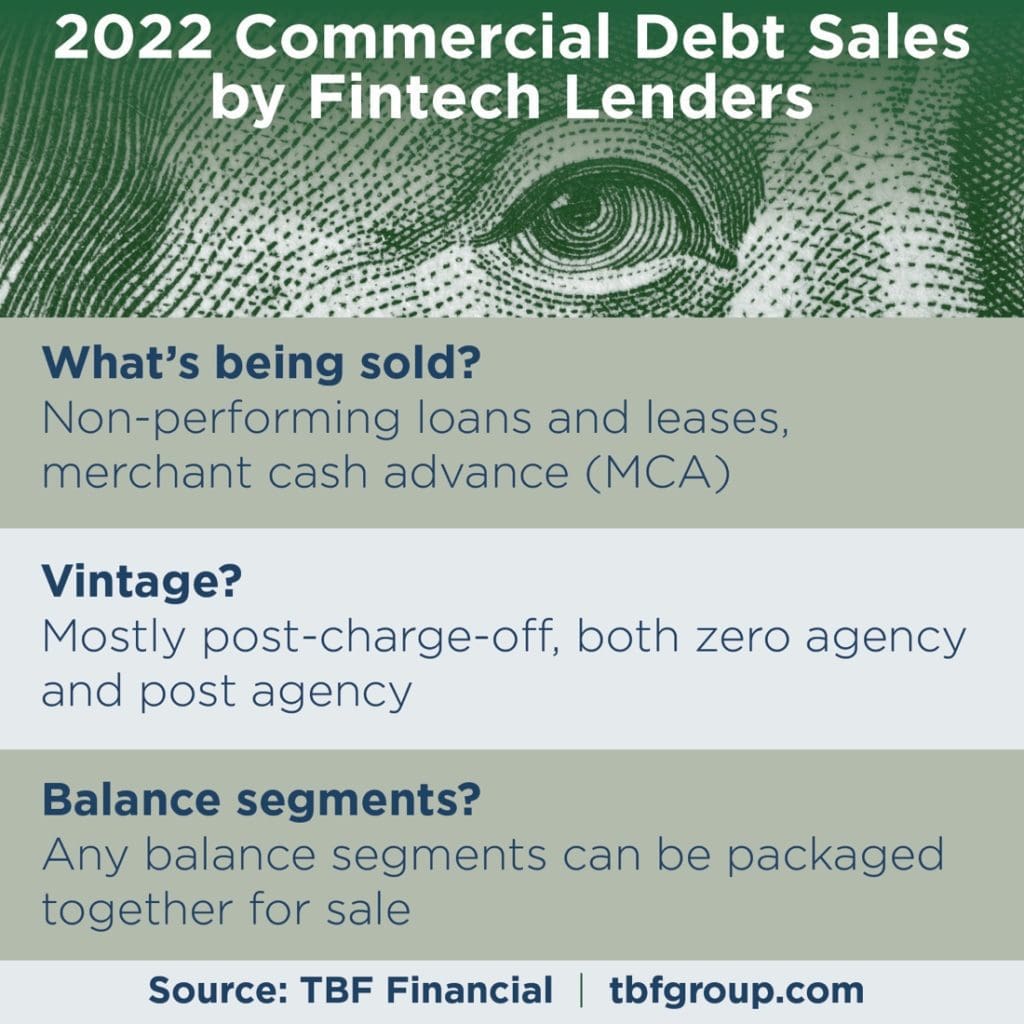
More debt sales
Banks and equipment finance companies have been selling off commercial debt for decades. In more recent years, fintech lenders have regularly sold off commercial debt, too. As charge-offs rise, this year, so will commercial debt sales, and we can also expect more fintech lenders to participate.
How does commercial debt selling work?
The fintech lender (seller) provides the commercial debt buyer with basic information on the sold asset pool. The buyer then offers a price based on fair market value, and the fintech lender signs a purchase agreement if they agree. The buyer typically wires the money to the seller within 24 hours.
So the ability to earn fast cash at closing is a significant motivator for fintech lenders selling commercial debt. But it’s not the only one. It’s also a strategy for keeping internal recovery efforts focused on accounts earlier in the past-due cycle that are more likely to be recovered, an essential consideration as volume rises.
Right time to sell?
When is the right time – and wrong time – to sell?
While every fintech lender has its criteria, the stage when loan defaults reach charge-off is ideal because that’s when the account has been worked sufficiently internally. On the other hand, too old accounts lose value; they should be less than four years since the last payment.
What categories of debt can be sold?
Non-performing loans, leases, lines of credit, and merchant cash advances can all be sold. They may have personal guarantees or no personal guarantees, be secured or unsecured, pre-agency or post-agency, or pre-litigation and/or reduced to judgment.
Fintech lenders sometimes sell specific categories of accounts based on their vintage, geography, quality, balance, etc. Strategies vary. One may sell all non-performing accounts after charge-off. Another may sell specific categories and maintain or litigate others.
What assurances should fintech lenders require from buyers?
Before making that first sale, fintech lenders often vet their buyers, just as they would before initiating any new transaction.
Buyers should be able to provide references from similar types of lenders, selling similar types of accounts; assure sellers they will collect debts in a sensitive manner, over time, without using the lender’s name; and sign non-disclosure agreements (NDAs) before handling proprietary information.
Brokers working on behalf of buyers should be able to demonstrate they are in an established relationship with a specific buyer and have done business with that buyer recently. Brokers and any parties that plan to share proprietary information should also sign NDAs.
After a bit of due diligence, selling commercial debt is relatively fast and easy. It will become increasingly crucial to fintech lenders as charge-off volumes climb.
