

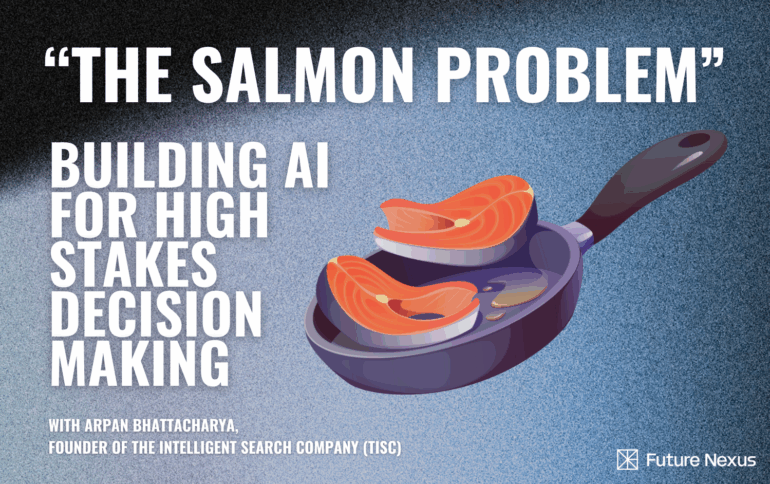
Arpan Bhattacharya is CEO of The Intelligent Search Company, a startup building AI for adversarial environments. He describes what it takes to build “noise cancellation for decision-making.”
When shopping online, context is everything. You either know exactly what to look for, or you find yourself browsing endlessly or typing vague queries into a search bar, hoping to figure out what you actually need.
This has been the standard operating model since the early days of e-commerce. Platforms rely on AI to optimize these experiences — recommending related items or refining keyword-laden searches — but fundamentally, the burden remains on the user to know the right words.
However, for Arpan Bhattacharya and Mahbod (Moe) Sabbaghi, two engineers at Wish who were also tasked with optimizing search, this “information asymmetry” brought a major gap to notice, one that needed urgent attention in sectors beyond e-commerce.
“If you’re looking for a way to fry salmon with crispy skin, you’re looking for a certain type of skillet…a carbon skillet,” Bhattacharya explained. “But unless you know that piece of information ahead of time, or use the internet to get to that information first, you can’t really get what you’re looking for.”
LLM-based answer engines that use retrieval augmented generation (RAG) can largely solve the salmon problem today — decoding the intent and letting you query in natural language — but the duo noted that these systems flounder at bigger challenges. For instance, those tied to the physics of the real world.
“In basketball, for example, if you want to find a dribble handout by a certain player to study how they tend to operate in that situation, unless a human has gone and already labeled that exact scene with that tag, or some AI model has done that ahead of time, you can’t really get to that,” Bhattacharya noted.
To fix this, they brought The Intelligent Search Company (TISC) out of stealth in late 2025.
The startup is building an end-to-end model that takes all your real-world data — covering video footage or drone clips — and creates an internal model of what kind of relationships exist between the different components for instant answers.
Noise cancellation for decision-making
Bhattacharya described TISC as “noise cancellation for decision-making.”
Since most AI models today — like the ones powering ChatGPT — are trained on the open internet, he argues that they are a product of data sourced with cooperative intent. On the other hand, the story of the physical world is different.
Whether it’s a basketball court, a battlefield, or a wildfire zone, the scenarios there are often adversarial. In these high-stakes environments, the data is often actively deceptive.
“Most situations in the physical world where people need to make real decisions… involve some level of somebody trying to screw you over – or trying to hide their intentions,” Bhattacharya said.
This distinction is where TISC diverges from the standard “LLM plus database” approach.
Instead of building another logical processor, the company is engineering what Bhattacharya described as System 1 for machines, referring to the near-instantaneous thinking abilities detailed in Thinking, Fast and Slow, a book by Daniel Kahneman he’s reading.
Bhattacharya explained that current AI acts like System 2: the slow, methodical “scientist” or “logician.” TISC’s system, by contrast, is designed to be the “killer instinct,” a System 1 intelligence that ingests a holistic picture of video, sensors, and statistics to make split-second, intuitive calls or searches.
This also explains the company’s counterintuitive decision to use sports as its “laboratory” before targeting life-critical domains like defense or emergency response.
According to Bhattacharya, the basketball court offers a controlled yet chaotic environment where adversarial human psychology is on full display. “Your opponent is incentivized to hide their intent from you as much as possible, and your job is to reverse engineer what they’re trying to do,” he noted.
This is exactly where TISC comes in handy, providing instant insights on any number of questions coaches and trainers might have for decision-making in real-time.
The “neurotic” approach
But the drive to build this “intuition engine” for adversarial real-world environments is also deeply personal.
Bhattacharya candidly described himself as “neurotic about search,” admitting that while he possesses a high working memory, his long-term memory often isn’t that good (much like all of us), which frequently brings the gaps in current systems to his attention.
“I can be frequently seen scrambling to get to the right information,” he said. “I rely on search bars a lot more than others, so I am a lot more exposed to…gaps in the search experience that other users might not notice.”
This neurosis and focus have also shaped a company culture that is intentionally lean and skeptical of standard Silicon Valley playbooks, especially regarding growth. Bhattacharya admits he is “terrified” of hiring a salesperson too early, fearing that handing over the company’s narrative before its identity is “very deliberate and very stable” could dilute the mission.
For now, TISC is focused on proving that machines can possess this “human-like intuition” and understand the complex data associated with time and space. Bhattacharya also remains grounded about the risks of building deep tech in a hype-fueled market.
“It is a bet we’re making…that we’re smart people who land on the right decisions,” he said.