
Subscribe
Logo
Logo
  • Topics Icon Topics
    • AI Icon AI
    • Banking Icon Banking
    • Blockchain/DeFi Icon Blockchain/DeFi
    • Embedded Finance Icon Embedded Finance
    • Fraud/Identity Icon Fraud/Identity
    • Investing Icon Investing
    • Lending Icon Lending
    • Payments Icon Payments
    • Regulation Icon Regulation
    • Startups Icon Startups
  • Podcasts Icon Podcasts
  • Products Icon Products
    • Webinars Icon Webinars
    • White Papers Icon White Papers
  • TechWire Icon TechWire
  • Search
  • Subscribe
Reading
Custodia Launches Bitcoin Custody Solution
ShareTweet
custodia
Home
Blockchain/DeFi
Custodia Launches Bitcoin Custody Solution

Custodia Launches Bitcoin Custody Solution

Isabelle Castro Margaroli·
Crypto
·Nov. 13, 2023·3 min read

Crypto’s history of centralized custody is not a positive one. For most of the crypto-curious, high-profile failures of crypto custodians spring to mind. MtGox, FTX, and Prime Trust are just some that have left investors with little hope of recovering their assets in full. Now, for many, self-custody is the only way forward. 

But when it comes to institutions, the idea of crypto self-custody becomes more complicated. For asset managers in particular, SEC laws, which Chairman Gary Gensler noted, “cover a significant amount of crypto assets,” prohibit self-custody of client assets. 

“Securities laws prohibit investment fiduciaries that are subject to the SEC Custody Rule from both managing and custodying customer assets,” said Caitlin Long, CEO and founder of Custodia Bank. 

“Although Bitcoin isn’t a security, and although some asset managers (such as pensions, endowments, and foundations) aren’t subject to the SEC Custody Rule, most investment fiduciaries use a third-party custodian for all asset types as a best practice, even if not legally required.”

On November 7, 2023, Custodia Bank launched a Bitcoin custody platform for institutional customers.

Using its position as a Wyoming Special Purpose Depository Institution, the bank combined its compliance to digital asset-focused regulations with a segregated account model. It says this approach provides a strong framework against risks institutions may face when engaging in digital assets.

“Custodia aimed to be ready to scale into the April 2024 post-Bitcoin halving environment, in which we anticipate a spike in demand for the custody service, and we hit that goal,” continued Long.

Creating Trust in a Jaded Market

Custodia enters the realm of Bitcoin custody at a critical time for trust in crypto. 

Tainted by the high-profile failures of centralized crypto platforms in 2022, digital assets have lost some of their hype and, with it, their market cap. Ongoing regulatory uncertainty has also caused some institutions to remain cautious. Custodia Bank itself has felt the weight of regulators’ distrust of the crypto space. The bank’s focus on crypto caused its master account application to be declined earlier this year. 

RELATED: Custodia Bank rejection: What’s next?

However, the institutional adoption of bitcoin remains promising. A number of large institutions are poised with pending Bitcoin ETF applications, and many have launched products providing access to the crypto space. 
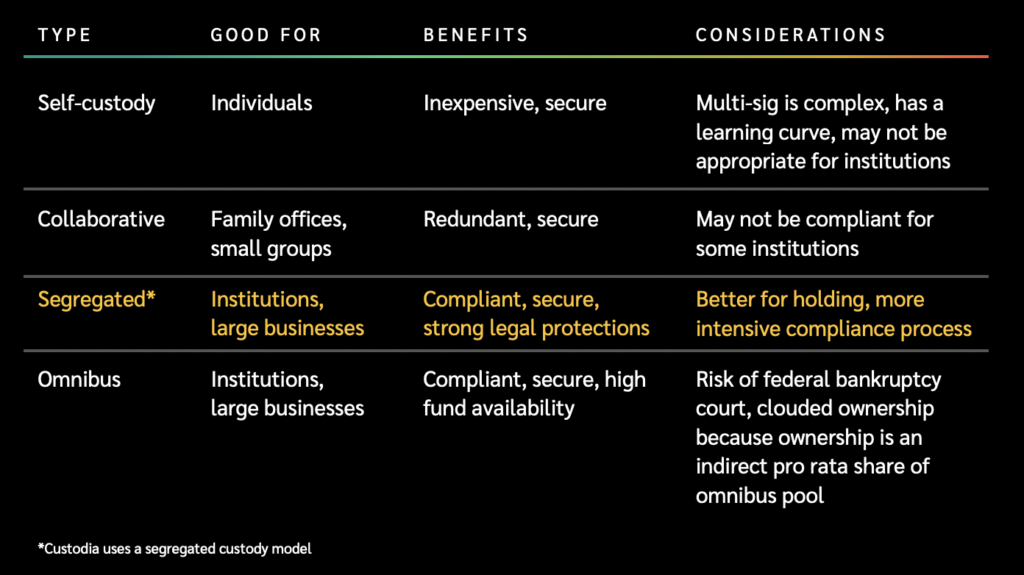
Custody Model Definitions Source: Custodia Bank

Custodia explained that rather than use the omnibus approach, central to their solution was a focus on segregated accounts. With this approach, the custodian stores customers’ digital assets on-chain in separate individual accounts, protecting the associated private keys. “Assets are not moved and cannot be pledged or rehypothecated to another party for any reason,” the whitepaper reads. 

In the omnibus custody model, often adopted for securities, assets are moved to another location after being deposited. The final address is usually for offline storage or “intended for immediate access for other purposes.”

It is here that Custodia identifies potential risks for the safety of the assets. “The technical and legal allowance by the custodian to move digital assets from the original deposited location introduces serious risks that customers must consider, even if that movement is intended to improve the safety and transparency of those funds,” the whitepaper reads. 

The segregated accounts solution is said to retain institutions’ visibility on assets while allowing them to delegate custody to a third party. According to the whitepaper, Wyoming’s SPDI laws also carry additional protections in case of Custodia’s failure. 

RELATED: Custodia Bank goes live

“No other custodian is a bank that can settle US dollars simultaneously with bitcoin, offers the special customer protections that a bank offers in the event of a failure of the institution, and provides the extra customer protections offered by a segregated account structure that truly segregates customers’ bitcoin,” said Long.  

  • Isabelle Castro Margaroli
    Isabelle Castro Margaroli

    Isabelle is a journalist for Fintech Nexus News and leads the Fintech Coffee Break podcast.

    Isabelle's interest in fintech comes from a yearning to understand society's rapid digitalization and its potential, a topic she has often addressed during her academic pursuits and journalistic career.

    View all posts
Tags
BitcoinCustodia Bankcustodyinstitutional investors
Related
The SEC makes the decision to approve a spot Bitcoin ETF

Editorial Cartoon for January 11, 2024

caitlin long at fintech nexus usa 2022

Custodia Bank goes live

SEC moving the goalposts on Bitcoin ETFs

Editorial Cartoon for July 13, 2023

Close up of bitcoin

Why do investors believe bitcoin is readying for a comeback?

Popular Posts

Today:

  • Alloy President Laura SpiekermanAlloy President Laura Spiekerman on Agentic AI and Identity Risk Apr. 2, 2026
  • FNThe Bank Charter Gold Rush: What’s Really Happening and What it Means for Banking Feb. 12, 2026
  • Kamran AnsariInfinity Ventures’ Newest Venture Partner Kamran Ansari Eyes Stablecoins as Fintech’s Next Wave Oct. 16, 2025
  • NumosFunded: Numos raises $4.25M to make AI accountable to finance teams Apr. 3, 2026
  • FNThursHoneycomb CEO on the 30-second fix that took hours Mar. 26, 2026
  • FN2What Fintech Events Are Missing — And How to Get More Out of Them Mar. 19, 2026
  • imageAbacum’s CEO: The Future of Finance Looks Like Product Mar. 5, 2026
  • Jennifer Lassiter, Standard CharteredScribe CEO Jennifer Smith on what happens when AI joins your team Feb. 26, 2026
  • Bretton AI FundedFunded: Bretton AI lands a $75M Series B on the bet that compliance agents, not dashboards, will unblock financial product growth Feb. 13, 2026
  • Copy of Fintech Nexus – Newsletter CreativeWhy PDF Table Extraction Fails in Production—and What Banks Need to Do About It Feb. 5, 2026

This month:

  • FNOura’s CEO Tom Hale on Democratizing Health with AI and Data Mar. 12, 2026
  • Jennifer Lassiter, Standard CharteredScribe CEO Jennifer Smith on what happens when AI joins your team Feb. 26, 2026
  • FNThe Bank Charter Gold Rush: What’s Really Happening and What it Means for Banking Feb. 12, 2026
  • FN2What Fintech Events Are Missing — And How to Get More Out of Them Mar. 19, 2026
  • Alloy President Laura SpiekermanAlloy President Laura Spiekerman on Agentic AI and Identity Risk Apr. 2, 2026
  • FN1Pigment co-CEO Eléonore Crespo wants to give CFOs superpowers Mar. 19, 2026
  • Darren Louie (1)OPINION: AI is about to get your credit card. Who signs off? Mar. 26, 2026
  • FNThursHoneycomb CEO on the 30-second fix that took hours Mar. 26, 2026
  • Santiago SuarezInside Addi’s mission to build a fairer financial system in Colombia Feb. 19, 2026
  • 2026 Investor Predictions for AI and Data10 Investor Predictions for AI and Data in 2026 Dec. 17, 2025

More News
  • About
  • Contact
  • Disclaimer
  • Privacy Policy
  • Terms
Subscribe
Copyright © 2026 Fintech Nexus
  • Topics
    • AI
    • Banking
    • Blockchain/DeFi
    • Embedded Finance
    • Fraud/Identity
    • Investing
    • Lending
    • Payments
    • Regulation
    • Startups
  • Podcasts
  • Products
    • Webinars
    • White Papers
  • TechWire
  • Contact Us
Start typing to see results or hit ESC to close
lis digital banking USA Lending Club UK
See all results