

Should we buy or build?
It’s a question the technology industry has been stuck on for decades. Some argue that building in-house is better because it gives you ultimate control. Others insist it’s better to buy the infrastructure and focus on your core product. Six years ago, Shensi Ding left her job as Chief of Staff at Expanse to permanently side with the “buy” camp.
The problem she was trying to solve: integrations for enterprise systems.
Today, integrations seem like table stakes. You wouldn’t even imagine a functioning enterprise stack without it. But in 2020, it was a whole different story. Teams had to build integrations to sell their product, but the build part was super expensive. You had to hire engineers, bear partnership costs, and then maintain those integrations on an ongoing basis – all of it hitting P&L.
“One of my best friends from college, who is the head of engineering at a recruiting tech company, was saying that integrations were really becoming a drag on the engineering team,” Ding told Future Nexus. “It was a lot of resources… And every single time, customer success had questions, they ended up having to pull engineers off of what they were working on to help support. Overall, it was becoming more of a problem. And the tailwinds of the industry were showing more fragmentation was going to occur, and that this problem was going to keep getting worse.”
Seeing the problem and the fact that no one was solving it, Ding teamed up with her Columbia classmate and friend, Gil Feig, and launched Merge. But here’s the thing: it was not an outright product launch, ready for the market.
Despite setting out to build a technically-heavy product for engineers, Ding and Feig didn’t write a single line of code for nine months – a stark departure from the usual move-fast playbook of Silicon Valley. Instead, the duo took their time to do their market research and get the foundations right.
“I think a lot of people want to be founders just to be founders when they don’t have a good idea [of the market]. I don’t think that’s a good route to take. It becomes very painful, and there’s a lot of opportunity cost, especially when it comes to your career. You should only do it if you are really willing to eat glass, work really hard, and you have an idea that you’re passionate about,” Ding said.
That calculated approach ensured that both Ding and Feig had complete conviction in the problem, their solution, and that there were actually a few potential buyers at the other end of it. It was something they could commit to for the next 10-plus years, with a clear roadmap.
“I just felt it was responsible for us to do that research ahead of time, versus quitting and then doing the research and then finding out that maybe it wasn’t a good idea, and then having to just pivot continuously. Sometimes that works, but I felt it saved us a lot of time,” she added.
The early hustle
In the early days, much like any other startup building a dev tool, Merge also had its fair share of struggles. A lot of companies were raising money and needed integrations to ship their products, but no one knew about what Ding and Feig were building – let alone trusting and trying out the product. As a result, they spent a lot of their time outbounding, posting on social media, and running paid ads to get their attention.
“A lot of it was really just blood, sweat, tears, reaching out to people,” she described.
Finally, when the first customers did respond, the challenge was getting them to tie their business with Merge’s product. Ding said the gap was solved largely by trust, with founders betting on their ambition to make the product better, even when it was not as good as one would expect at the time.
“We didn’t have a better product than what was out there in the market; our product was worse than building it in-house,” she chuckled. “But if you’re very clear-eyed about that as a founder, and they’re betting on your ambition to make the product better, then they will work with you. Otherwise, there’s no reason to… You really need people to take a bet on you, to work with them closely, and to gain their trust.”
Gradually, as the company started working with customers, the product got better.
The AI inflection point
While Merge had built its initial success serving SaaS companies, the generative AI boom triggered a massive shift. When ChatGPT first arrived, Ding and her team saw some interest from small AI startups but mostly watched as vendors attempted to stretch what they could do purely with language models. Ding knew back then that to be truly useful in the enterprise, AI models needed real-time context from different data sources — something that Merge could solve.
“Around the beginning of last year, my prediction was that all AI companies would need a ton of integrations. Because in order to compete in the market, you need to have really customized customer insights… The way to do that is by pulling data from existing resources.”
The market quickly met her prediction. As RAG (Retrieval-Augmented Generation) and agentic workflows gained traction, the world’s largest AI companies (including Mistral and Perplexity) realized that building their own data pipelines into each enterprise software was unsustainable. They started flocking to Merge, making it the go-to unified API layer for enterprise AI. So far, Merge has raised $75 million from Accel, NEA, and Addition, has reportedly crossed $20 million in annual revenue, and grown to around 100 people.
The inflection point meant rapid growth but also came with its own set of challenges for Ding and team. First of all, building the plumbing between AI and fragmented legacy systems wasn’t easy.
“It is hard because there’s a lot of undocumented information that AI cannot really retrieve. The only way is just slamming your head against a wall and doing it, and spending time on it. It is very hard,” she noted, while adding that a lot of times the blocker was also human interaction, as you can’t get started until there’s a handshake of an agreement.
The other challenge was the need to prioritize and solely focus on where the demand was coming from in the AI era. This meant the team had to deprioritize some existing product lines that were just not going to grow in the new market and build for AI customers.
“Today, we sell to the largest AI companies in the world, and that did require us adjusting our first product pretty significantly to match the scale, the needs, and the security requirements of those large AI companies. Those resources had to come from somewhere,” she said, but also noted that the company still works with a lot of the companies that it on-boarded during its early days.
Competing on more than price
Even as Merge now continues to focus on AI, Ding realizes that they aren’t done adjusting. This is where, she said, working with companies at the forefront helps.
“These are the fastest companies in the world… We’re hearing a lot of firsthand insights about how they’re thinking about things, how they’re thinking about the competition, and where they think the market is going. They’re giving us a lot of feedback. The market will follow them. It can lag, but it’s helpful to have a leading indicator so we can start proactively thinking about how to build to adapt to this,” Ding added. “It is very scary, but I realized if you want to win, you’re going to have to be scared. And that’s okay.”
Ding also realizes that as Merge establishes itself as the default plumbing for the AI boom, it will attract competition, including cheaper copycats trying to undercut its pricing.
But she refuses to engage in a price war. Instead, she leans heavily into innovation and customer success.
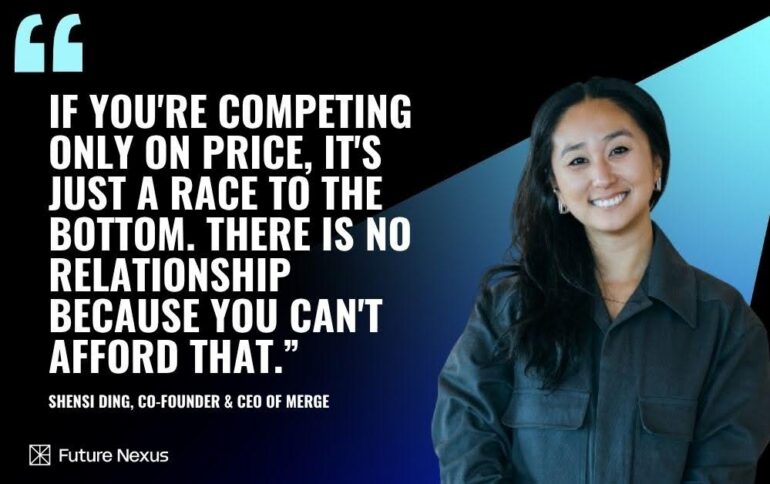
“If you’re competing only on price, it’s just a race to the bottom. There is no relationship because you can’t afford that,” she stated. “You can’t afford to invest in those relationships because the cost of what you’re making from that customer is not enough to justify the amount of time you’re putting into each one of them. There are certain tradeoffs, and we didn’t want to compete in that market.”
Instead of cutting costs, Merge invests in face-to-face relationship building—flying out to see customers, sharing roadmaps, and ensuring their success team remains unmatched. It’s a strategy rooted in her past experience as a Chief of Staff, where business fundamentals like margins and cash flow couldn’t simply be ignored for the sake of temporary growth.
Ding also said that navigating this intense trajectory has strengthened her bond with Feig. While many warn against starting a company with a best friend, Ding likens the experience to “raising a child” together.
Ultimately, despite powering the integrations for the most hyped frontier AI companies in the world, Ding remains remarkably grounded in the unglamorous, day-to-day reality of building infrastructure. For any aspiring founder looking to enter the technical market today, she doesn’t sugarcoat what is to come: “You just gotta work hard. It’s tough. You have to adjust. Buckle up.”