Physical AI’s Picks-and-Shovels Moment
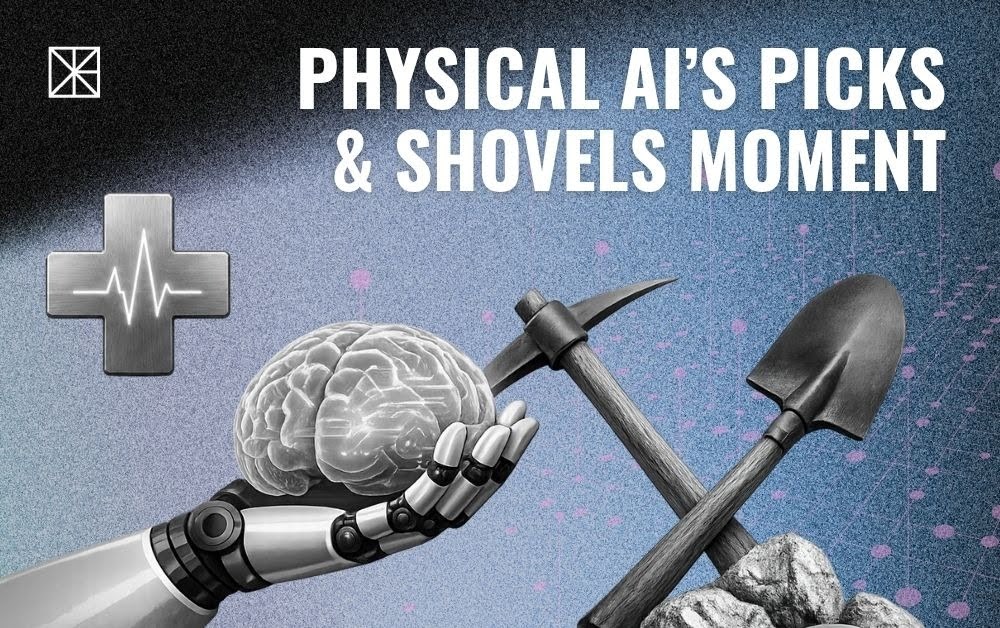
The AI industry spent the past several years teaching machines how to talk. What about teaching them how to act?
Venture is already shifting its funding accordingly. In 2025, AI at large saw $211 billion in funding, roughly half of all global venture funding. Robotics raised a record $15 billion in 2025, only to surpass that full-year total in just the first half of 2026 alone, with $18.8 billion raised by June.
And this financing isn’t going to just the humanoids we all see making headlines. Some of the category’s biggest checks are flowing into the foundational brains designed to work across robotics and other physical AI tasks across industries.
For instance, last November, we saw Physical Intelligence raise $600 million to bring “general-purpose AI” into the physical world. Shortly after, in January, Skild AI raised $1.4 billion to pursue what it calls “omni-bodied intelligence,” or one general-purpose brain capable of controlling any robot for any task.
Healthcare is moving in a similar direction. U.S. digital health startups raised $14.2 billion in 2025, with “AI-enabled” companies capturing half of that capital (and at a 19% premium compared to those which are not). But much of this boom had been centered around “clinical and non-clinical workflows” – in other words, on the software supporting clinicians through administrative work or data infrastructure.
But at last, the frontier dawning before us, even in healthcare, seems to be shifting to physical AI – from interacting with patients and staff (the likes of Diligent Robotics’ Moxi, which powers deliveries for nurses, or Cobot’s Proxie, which moves hospitals’ materials) to upgrading surgical robotics and other medtech devices to be more intelligent.
This is considerably harder. Whereas a chatbot can generate a bad answer and try again, a surgical device doesn’t have a second chance.
A growing group of venture firms is organizing around precisely this challenge. Bison Ventures, whom we previously interviewed, invests across the stack of “AI in the physical world.” Eclipse backs companies transforming physical industries by combining hardware and software. Construct Capital focuses on founders rebuilding foundational industries, while DCVC describes itself as “deep tech venture capital.” Lux Capital, too, has mapped the emerging robotics stack, from data collection through intelligent control.
Inner Logic sits squarely within that picks-and-shovels opportunity, building the simulation, data, testing and validation infrastructure they need to prove intelligent devices will work across thousands of patients and edge cases.
We spoke with CEO Tito Porras to unpack his learnings as a former-surgeon-turned-founder on what it means to build foundational infrastructure in this high-stakes field.
-The Editors