

Christine Yen, CEO and co-founder of Honeycomb, discusses “mob coding” with Claude, building mecha suits for humans, and the visibility problem in software development.
What happens when you build something for a customer, and it breaks without any visibility? Things look fine on your end, but other teams say something isn’t right. The customer insists everything is going haywire, leading them to lose revenue.
The answer is utter chaos.
Devs today might find this hard to imagine, but 13 years ago, this was the exact nightmare Christine Yen — now CEO and co-founder of Honeycomb — faced as a young developer at Parse. Her colleague (now her co-founder) Charity Majors, who handled infrastructure, came to her with a problem.
“Charity came over and said, ‘The Cassandra clusters are really unhealthy. What is going on?'” Yen recalled. “She had all these graphs to back her up. But I had no visibility into it, because there were these aggregate monitoring numbers. From my perspective, the code hadn’t changed. I hadn’t changed any expectations on how people use it. But a customer introduced chaos into the system.”
The culprit turned out to be a newly launched Russian dating app. It had started sending telemetry to Parse’s analytics platform in a shape Yen hadn’t anticipated, wrecking the clusters. The real problem, however, wasn’t the app. Yen and Majors were working toward the same goal but couldn’t even see the data that gave them the full picture.
“As a developer, I was just coming from such a place of fear,” Yen said. “‘Oh, something is broken? I should know what’s broken?’ And I would look through the graphs that were meant for infrastructure engineers, trying to map them to what my code was doing. And it was impossible.”
Yen needed to know: which API endpoint is it hitting? Which app is sending the telemetry? How did those patterns change in the last hour? None of her tools could answer that. Another engineer ended up running a TCP dump — digging manually through raw network traffic — just to get some footing.
When they finally isolated it to one app, the fix was simple. But getting there had already taken hours.
That same challenge — making the invisible visible in real time — is something Yen will revisit on stage at the upcoming HumanX conference April 6-9.
The tool that changed everything
Facebook acquired Parse months after that incident, and the shift was jarring. At a Series A startup, everyone felt personally responsible for the product. “If customers were having a bad experience, you dropped everything to fix that,” Yen said. That didn’t carry over into a hyperscaler, where most engineers had never spoken to a Parse customer.
But there was one thing at Facebook that kept Yen from wanting to leave: an internal tool called Scuba.
Most of Facebook’s tools were far from ideal, built for a monolithic PHP app, not a multi-tenant platform like Parse. Scuba was different. It not only had the infrastructure metrics Majors cared about but also connected those to the identifiers Yen worked from: app ID, platform ID, SDK version, and mobile OS. The things that actually determined how code routed requests.
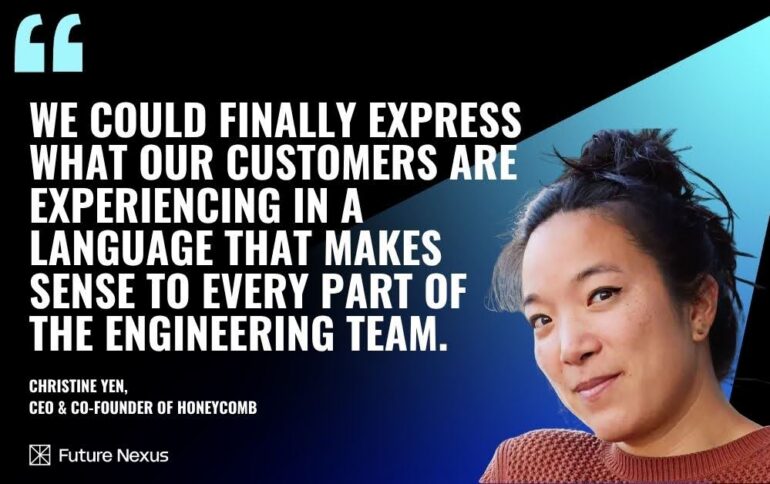
That investigation — the one that had required a Saturday in the office, a manual TCP dump, hours of stumbling around blind — was now a 30-second task. “We could finally express what our customers are experiencing in a language that makes sense to every part of the engineering team,” Yen said.
Neither of them wanted to go back from Scuba. So, when they eventually left Facebook, the logic was to ensure that the rest of the world should also have something like this.
That shared language for engineering teams became the founding idea behind Honeycomb.
Solving for devs
One moment from Facebook stayed with Yen. At an internal data tools boot camp, the Scuba team fielded the usual complaints about their interface — notoriously bad, but their response was pretty much to let it be.
“The team basically said, ‘Yes, we know our UI is ugly. If you want to complain about it, you can come work on our team and fix it. If you’re not going to come work on our team, basically stop complaining about the UI,'” Yen recalled.
Coming from Parse, where usability for developers was a massive priority, Yen focused on fixing this for developer teams outside of Facebook by building Honeycomb with a focus on user experience. “We knew that the friendlier we make it for people to use these tools, which otherwise inspire fear, the better experience people are going to have,” she said.
However, she said, convincing customers of that was its own problem. In 2015 and 2016, most companies ran two or three disconnected tools — monitoring over here, logging over there, APM somewhere else. Engineers jumped between them manually, and nobody expected otherwise. Describing Honeycomb as “a monitoring tool but more flexible” or “a logging tool but faster” would’ve dropped it into that same bucket, with same expectations, same objections, and same results.
In her early conversations with companies like Slack and Nylas, Yen and her team skipped these feature pitches. Instead, they approached seasoned engineers and bluntly asked, “Do you know how everything sucks?”
She would point out how traditional tools failed miserably when a new feature was launched, and a single user started interacting with it in a weird, unpredictable way. When the engineers inevitably agreed that their current tools couldn’t handle those anomalies, Yen had the perfect hook: “We built something for this,” and they’d agree to learn more and try the product.
Yen and Majors had lived this. They could describe the gap between what teams needed and what tools offered with the specificity of people who’d been stuck on both sides of it. That, and the technical bet of building their own columnar data store from scratch — tuned for the speed and flexibility they’d had with Scuba — gave Honeycomb its early traction.
Today, the company has more than 600 paying customers across finance, gaming, and healthcare, with thousands more on the free tier. “I love that,” Yen said, “because this type of tool is so mission-critical. That’s how people start to recognize and break down that muscle memory of how they used to use logs over here, metrics over there.”
The operator’s reality
Growing Honeycomb meant letting go of being an engineer, the way Yen had always been one. That took longer than she expected.
A few years in, her SVP of Engineering sat her down. “Christine, I love that you like to fix bugs at night. If you do it at night, I can’t build systems to make sure our team is prioritizing the right work. So either work with my system or stop fixing random things at night.”
The sales side needed some unlearning, too. When Honeycomb first chased enterprise contracts, Yen thought white-glove meant sending an engineer on-site, learning exactly what a customer wanted, and building it for them. It didn’t work.
“I have since learned customers really want the vendor to be the expert,” she said. “They want to know we have a prescribed, battle-tested path. We can customize it for you, but this is what we recommend.”
And as Honeycomb grew to 200-odd people serving engineering organizations ten times that size, another assumption cracked: that the company could keep using itself as a proxy for its customers. “There has to be a point when we recognize that dogfooding isn’t enough,” Yen said.
Mecha suits, not robots
Today, Honeycomb faces a new stress test: the age of AI.
As AI coding assistants flood production environments with auto-generated code, Honeycomb’s role is more critical than ever. Teams are removing the bottleneck of writing code, but they are still on the hook for making sure that the software actually works as planned.
When the generative AI hype cycle kicked off in 2023, Honeycomb was one of the first observability platforms to launch an LLM-powered query assistant. Yet Yen is protective of keeping humans in the loop, guided by her team’s deep Site Reliability Engineering (SRE) roots.
“Our goal is always to build mecha suits around humans rather than robots,” Yen explained. “We’re not trying to fully replace roles… the human really benefits from AI guidance.”
Internally, Honeycomb engineering teams practice “mob coding” with Claude. Humans collaborate on specs and ask the AI to build a plan. When the AI delivers the code, developers ruthlessly tear it apart in review. Because the AI has no ego, developers don’t have to worry about destroying a colleague’s morale with brutal feedback.
“The humans get to spend their brain energy thinking about edge cases, pressure testing assumptions,” Yen said. “It opens up space for engineering teams to innovate”.
Fast is a feature
With AI agents evolving rapidly, a new tech narrative forecasts the “death of SaaS,” assuming that if AI can write software, traditional moats will evaporate. Yen, however, remains unconvinced.
She recalled a recent dinner with a LinkedIn engineering leader who simply said: The software isn’t the moat. Anyone can, in theory, build a similar social network. But the moat is the data — the actual relationship graph, years of real connections, that exists nowhere else and can’t be summoned from a spec.
Honeycomb’s moat is the operational knowledge of running mission-critical tools at internet scale for companies like Slack and Stripe. Someone could point an AI agent at open-source specs to build a basic observability tool, but scaling it is another task entirely.
“Fast is a feature,” Yen emphasized, pointing out that Honeycomb’s architecture is tuned to stay lightning-fast whether a team has two engineers or a thousand. “That sort of battle-tested hardness is, frankly, what a lot of people run into when they try to take an open source DIY approach”.
Now, as the industry adjusts to this AI-driven reality, Yen is highly optimistic.
If AI handles rote implementation, early-career engineers can speedrun their way to high-level strategic thinking, focusing on design and edge cases that traditionally belonged to seniors. “Engineering teams get to have that seat at the table of the business that they always should have had,” she said.
When asked what one non-technical superpower she’d give every engineer, she didn’t pause.
“The skill of the sale,” she said. “To always land a home run with whatever persuasive argument you’re trying to make. That really, truly would be magic.”