
Subscribe
Logo
Logo
  • Topics Icon Topics
    • AI Icon AI
    • Banking Icon Banking
    • Blockchain/DeFi Icon Blockchain/DeFi
    • Embedded Finance Icon Embedded Finance
    • Fraud/Identity Icon Fraud/Identity
    • Investing Icon Investing
    • Lending Icon Lending
    • Payments Icon Payments
    • Regulation Icon Regulation
    • Startups Icon Startups
  • Podcasts Icon Podcasts
  • Products Icon Products
    • Webinars Icon Webinars
    • White Papers Icon White Papers
  • TechWire Icon TechWire
  • Search
  • Subscribe
Reading
The time is right to solve the $10-trillion AP/AR problem: Anchor CEO
ShareTweet
Home
Fintech
The time is right to solve the $10-trillion AP/AR problem: Anchor CEO

The time is right to solve the $10-trillion AP/AR problem: Anchor CEO

Tony Zerucha·
Payments
·Jan. 27, 2023·2 min read

Compared to most other areas of daily business operations, accounts payable and receivable have been starved for innovation since Quickbooks’ debut decades ago.

Anchor co-founder and CEO Rom Lakritz believes the technology exists to provide a $10-trillion process with a long-overdue upgrade.

An accountant and lawyer by training, Lakritz has also been a consultant, venture capitalist, and on the founding team of five startups. He’s done his share of billing, paid his share of invoices, and spoken with dozens of business owners and AP/AR people. The significant time spent on these needlessly manual processes takes away from growing companies.

“What hurt me most is to think about it all the time, about money coming in and the cash flow,” Lakritz said. “It was something that, for a business owner, you don’t know what’s going to happen. It’s something that is always on your mind.”

The issue stuck with Lakritz as he built, listed, and sold companies. A decade ago, there was no way to solve it — no Stripe, no Plaid. It was only in 2019 that the technology existed, and Lakritz saw the time was right to provide the first B2B payments innovation since Quickbooks. E-commerce, SaaS, artificial intelligence, and machine learning made autonomous billing possible. Blockchain technology, while considered, wasn’t needed.

How Anchor solves the problem

Simplify accounts payable and receivable, and you’re tackling a $10-trillion annual task, Lakritz said. That’s on top of as much as 2% of paid invoices that are duplicates and the average 4.6% of work that never gets invoiced.

The issue is a human one, he explained. Humans send invoices, and humans have to check for accuracy and fraud. If a problem is discovered, the back and forth begins. Time and human capital are wasted.

As he delved into the problem, Lakritz soon learned that any solution must include the agreement the sides sign at the beginning of the deal. The engagement letter becomes a living document and the single source of truth for both parties.

The customer provides payment details at the onset, both parties agree on terms like fees and scheduling, and a cloud agreement is created. Invoices are generated automatically, payments are automatically made, and accounts are reconciled.

Also, see:

https://www.fintechnexus.com/podcast-387-eliot-buchanan-of-plastiq/

“Once you’ve completely automated accounts on the receivable side, the accounts payable side doesn’t really need to look at invoices because we eliminated the B2B risks in payments, and you don’t have errors anymore,” Lakritz said. “You don’t have the risk of fraud anymore. You don’t need this expensive process of accounts payable. It’s changing everything.”

Unlocking value

No one questions their Amazon invoice, he added. There’s no need to question if Zoom bills you for 20 accounts. Anchor wants to bring the same experience to B2B payments.

Anchor's Rom Lakritz headshot
Anchor’s Rom Lakritz

Think of this evolution’s value to all sizes of business, but especially smaller ones, Lakritz said. Instead of the office manager reading invoices and chasing down payments, they can market, generate revenue and grow the company in other ways. When AP or AR action is required, it takes seconds.

“Nobody needs to do anything,” Lakritz said. “You’ve saved so much time, and if you took it if you look at the price, you save two signatures and DocuSign, which is more expensive than that feature on anchor. You save that time, which is about an hour per invoice.”
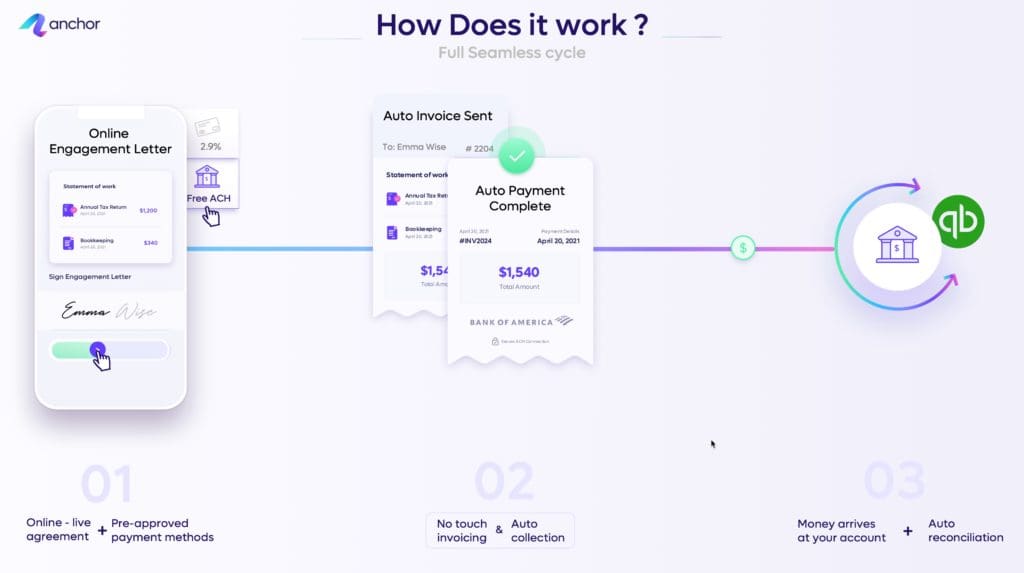
Graphic showing workflow
  • Tony Zerucha
    Tony Zerucha

    Tony is a long-time contributor in the fintech and alt-fi spaces. A two-time LendIt Journalist of the Year nominee and winner in 2018, Tony has written more than 2,000 original articles on the blockchain, peer-to-peer lending, crowdfunding, and emerging technologies over the past seven years. He has hosted panels at LendIt, the CfPA Summit, and DECENT's Unchained, a blockchain exposition in Hong Kong. Email Tony here.

    View all posts
Tags
accounts payableAnchorAP/ARRom Lakritz
Related
DevOps Methodology Development Operations agil programming technology concept.

How organizations can reduce effects of inflation through AP automation

Popular Posts

Today:

  • Copy of Fintech Nexus – Newsletter CreativeWhy PDF Table Extraction Fails in Production—and What Banks Need to Do About It Feb. 5, 2026
  • TechNexus The AI IssueAI’s Existential Opportunity Jul. 9, 2025
  • SolaFunded: Sola lands $17M Series A to transform BPO with AI-native automation Aug. 22, 2025
  • unnamedFunded: Routefusion raises $26.5M Series A to simplify global payouts with a resilient payments network Oct. 10, 2025
  • Multiply CEO MichaelMultiply Mortgage CEO on AI’s move into housing finance Nov. 6, 2025
  • 2026 Investor Predictions for AI and Data10 Investor Predictions for AI and Data in 2026 Dec. 17, 2025
  • FN1Pigment co-CEO Eléonore Crespo wants to give CFOs superpowers Mar. 19, 2026
  • NumosFunded: Numos raises $4.25M to make AI accountable to finance teams Apr. 3, 2026
  • peter2The Flipping Point: Why Fintech Meetup 2026 Marked the End of AI Hype Apr. 6, 2026
  • FNInside Parafin’s Push to Close Small Business Finance’s $2 Trillion Gap Jun. 4, 2026

This month:

  • FNInside Parafin’s Push to Close Small Business Finance’s $2 Trillion Gap Jun. 4, 2026
  • Matt Brown“No Bad Ideas, Just Bad Timing” — Matrix Partner Matt Brown on Fintech’s Next Decade of Runway Jun. 11, 2026
  • FNMerge CEO on building the pipes behind AI, and starting with zero code May. 21, 2026
  • Private Fintech Has Quietly Become Bigger Than Public Fintech. Now What?Private Fintech Has Quietly Become Bigger Than Public Fintech. Now What? May. 28, 2026
  • Stephanie Sher, Founder, Integral VenturesIntegral Ventures’ Stephanie Sher is all about seeing diamonds in the rough May. 14, 2026
  • Chris Taylor Fractional AIFractional AI’s CEO Chris Taylor on Scaling the Unscalable Jul. 23, 2025
  • FNThe Bank Charter Gold Rush: What’s Really Happening and What it Means for Banking Feb. 12, 2026
  • MomentFunded: Moment raises $36M Series B to automate fixed income for financial institutions Jul. 18, 2025
  • Santiago SuarezInside Addi’s mission to build a fairer financial system in Colombia Feb. 19, 2026
  • What is Really Going on With Private CreditWhat is Really Going on With Private Credit Apr. 30, 2026

More News
  • About
  • Contact
  • Disclaimer
  • Privacy Policy
  • Terms
Subscribe
Copyright © 2026 Fintech Nexus
  • Topics
    • AI
    • Banking
    • Blockchain/DeFi
    • Embedded Finance
    • Fraud/Identity
    • Investing
    • Lending
    • Payments
    • Regulation
    • Startups
  • Podcasts
  • Products
    • Webinars
    • White Papers
  • TechWire
  • Contact Us
Start typing to see results or hit ESC to close
lis digital banking USA Lending Club UK
See all results